Florida covers 905 towns, from Escambia County and Santa Rosa County on one end of the state to Miami-Dade County and Monroe County on the other. About 20.3% of the roughly 16,776,031 people living here are 65 or older, so plenty of families are weighing how to keep a parent safely at home.
This page covers the basics that apply statewide: which kind of lift fits which kind of staircase, who in Florida tends to qualify for help, and which state and federal programs can pay for some or all of the cost. When you are ready for local details, pick your county from the list below.
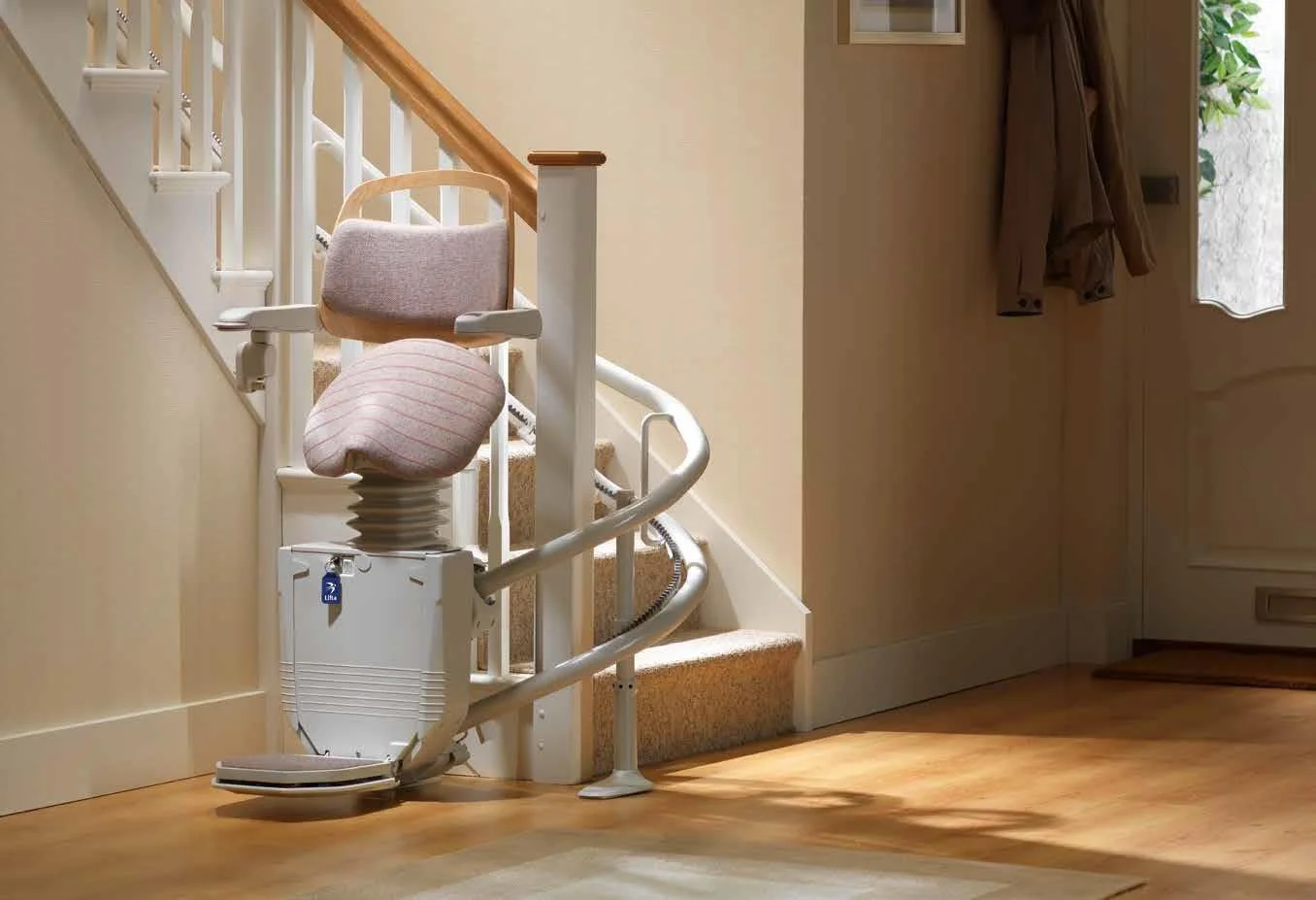
A straight stair lift is the simplest job. If the staircase runs in one line from bottom to top with no turns or landings, the rail is a standard length and installs in a few hours.
Stairs that turn, curve or stop at a landing need a curved lift with a rail bent to fit that exact staircase. It takes measuring and fabrication time, and it costs more than a straight rail.
Steps outside the house, such as those leading up to a front door or a raised entry, call for an outdoor model built to handle the elements. If the person uses a wheelchair and cannot transfer to a seat, a platform lift that carries the chair is usually the better fit.
With 20.3% of residents 65 or older, Florida has a large group of people who may find stairs harder each year. The decision often comes up after a fall, a hospital stay or a new diagnosis.
About 64.3% of Florida households own their home. Owners can install a lift without asking anyone, while renters should talk with the property owner first, since a rail is bolted to the stair treads.
If that includes your parent or spouse, VA benefits are worth checking before you pay out of pocket.
Florida Medicaid's long-term care program can cover a stair lift as a Home Accessibility Adaptation when it is part of an approved plan of care. There is no fixed dollar cap; the amount depends on that plan.
For veterans, the stair lift itself goes through VA Prosthetics, which has no set dollar cap when the lift is medically prescribed. The separate HISA grant pays for ramps and structural changes, not the lift.
If you do not qualify for either, the FAAST New Horizon Loan Program offers low-interest loans for home modifications. Homeowners can also lower their property-tax bill through the homestead and senior exemptions, which frees up cash even though it does not pay for the lift directly. Details for each program are listed below.
We have pages for every county on our Florida list, including Alachua County, Broward County, Duval County, Hillsborough County, Orange County, Palm Beach County, Pinellas County, Sarasota County, Sumter County and Volusia County. Each one covers the local picture in more detail.
Start with the county where the home is located, not where you live, since that is where the installer will be measuring the stairs.
This Medicaid managed long-term care benefit can cover a stair lift as a Home Accessibility Adaptation, with no fixed cap beyond what the approved plan of care allows. Call (800) 963-5337 to ask about enrollment.
VA Prosthetics (PSAS) can cover a medically prescribed stair lift with no set dollar cap, while the HISA grant of $6,800 (service-connected) or $2,000 (non-service-connected) covers ramps and structural modifications, not the lift. Call (877) 222-8387 to start.
A low-interest loan for accessible home modifications, including stair lifts, in the range of approximately $3,000 to $30,000; confirm the current cap with FAAST. Call (850) 487-3278.
Property-tax relief of up to $50,000 standard plus up to $50,000 senior exemption, applied as a reduction to the tax base rather than a cash grant. It does not pay for a stair lift but can offset out-of-pocket costs.
It can. Under Florida Statewide Medicaid Managed Care Long-Term Care (SMMC LTC), a stair lift can be covered as a Home Accessibility Adaptation when it is part of an approved plan of care. Call (800) 963-5337 to ask.
Both, through different programs. VA Prosthetics (PSAS) covers a medically prescribed stair lift, while the HISA grant covers ramps and structural modifications. The VA line is (877) 222-8387.
HISA provides up to $6,800 for service-connected conditions and $2,000 for non-service-connected conditions. That money goes toward structural changes, not the stair lift itself.
Yes. The FAAST New Horizon Loan Program offers low-interest loans of approximately $3,000 to $30,000 for accessible home modifications. Call (850) 487-3278 to confirm the current cap.
No. The Florida Homestead and Senior Additional Homestead Exemption lowers the taxable value of the home by up to $50,000 standard plus up to $50,000 for seniors, which can leave more money for an accessibility project.
Then you will need a curved stair lift, with a rail built to fit that specific staircase. Straight lifts only work on stairs that run in one line from top to bottom.
Tell us about the stairs in your home and we will explain which lift fits, what it costs and how installation works.
