Nassau County runs from the historic streets of Fernandina Beach on Amelia Island to Yulee, Nassau Village-Ratliff, Hilliard and Callahan. Many of the older Amelia Island homes are elevated Victorian and Colonial-Revival-style houses with front stairs up to the main floor, while newer subdivisions tend toward standard one- and two-story construction.
Those two kinds of homes call for different stair lift setups. A raised island house may need an outdoor lift on the entry steps, and a two-story house in a newer neighborhood usually needs an indoor lift on the main staircase. This page walks through what fits where, and which local and state programs to call about paying for it.
In historic Fernandina Beach, the hardest stairs are often outside. When the main floor sits up above the yard, every trip in or out means climbing the front steps, so an outdoor stair lift is often the first thing we talk about.
Outdoor lifts are built for weather, but location still matters here. The county's land is low and level, poorly drained in places, and crossed by creeks feeding the St. Marys and Nassau Rivers. Near the coast and the salt marshes, drainage and flood exposure are worth checking before any exterior lift or ramp goes in.
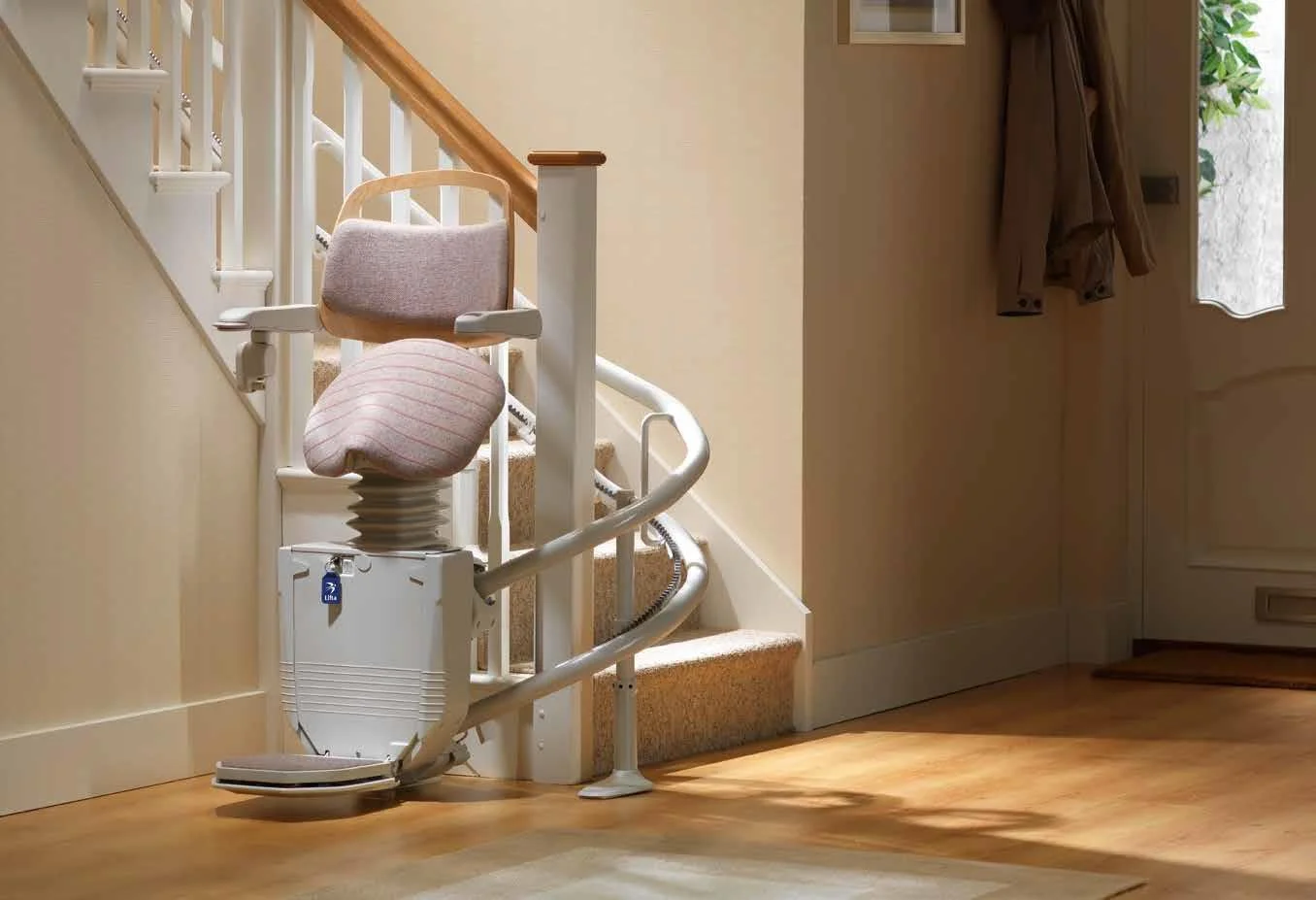
Older homes can also have narrow or turning staircases inside. If the stairs bend at a landing, a curved lift built to that staircase is usually the answer instead of a straight rail.
About 65.9% of Nassau County housing is detached single-family homes, and much of the newer growth comes from suburban building spilling over from Jacksonville. A two-story home with one straight run of stairs is the simplest case: a straight stair lift mounts to the stair treads, not the wall, and leaves room for others to walk up.
Ranch-style homes may have only a few steps at the garage or entry, which can suit a short outdoor or platform lift. Townhouses, walk-up apartments and low-rise buildings bring their own questions, such as stair width and whether a shared stairway needs approval from the owner or association before anything is installed.
About 25.1% of Nassau County residents are 65 or older, and 76.4% own their homes. For homeowners, a stair lift is usually a way to keep using the whole house rather than moving into a single-story place.
If that includes your parent, start with the Nassau County Veterans' Service Office in Yulee at (904) 548-4670, since VA rules on stair lifts are specific and worth hearing directly.
None of the local programs below lists stair lifts as a covered item, so plan on asking each office directly instead of assuming. Medicaid long-term care, the Community Care for the Elderly program and the Nassau County Council on Aging can each help with some home needs, but their published descriptions do not name stair lifts.
For veterans, the VA HISA grant does not cover stair lifts at all. It pays for things like ramps, doorway widening, grab bars and roll-in showers, which can still help at the same house.
Statewide, families can also look into VA Benefits for Veterans (HISA + Prosthetics), the FAAST New Horizon Loan Program, and the Florida Homestead + Senior Additional Homestead Exemption. ElderSource (PSA 4) at (904) 391-6600 is a good first call to sort out which of these apply.
A Medicaid long-term care service available in Nassau County through the enrollee's LTC managed-care plan, for people who meet nursing-facility level of care and Medicaid financial rules. The official description names grab bars and toilet seats, excludes major changes, and does not mention stair lifts; call (877) 711-3662.
In-home services for functionally impaired adults age 60 and up, arranged through ElderSource with local services from the Nassau County Council on Aging. The program lists emergency home repair in general terms but does not name stair lifts; call (904) 391-6600.
A volunteer-based small home repair program for Nassau County seniors, reached through a case management referral at the Council on Aging front desk. Stair lifts are not listed as a covered repair; call (904) 261-0701.
A VA grant for enrolled veterans with a medical need for home-access changes, up to $6,800 lifetime for service-connected disability and $2,000 lifetime for non-service-connected disability. It does not cover stair lifts but does fund ramps, doorway widening, grab bars and roll-in showers.
Older adults
10688 Old St. Augustine Rd., Jacksonville, 32257
Veterans
76347 Veterans Way, Suite 456, Yulee, 32097
Not through the HISA grant, which excludes stair lifts and stairway chair lifts. HISA can pay for ramps, doorway widening, grab bars and roll-in showers. Call the Nassau County Veterans' Service Office at (904) 548-4670 to ask about other VA benefits.
The Community Care for the Elderly program is for adults age 60 and up. Someone younger may still qualify for the SMMC Long-Term Care program if they meet its Medicaid and level-of-care rules; call (877) 711-3662.
No. CHORE is a volunteer program for small home repairs, and stair lift installation is outside that scope. The Nassau County Council on Aging at (904) 261-0701 can still talk through other help.
The SMMC LTC home accessibility service does not name stair lifts, and its official description excludes major changes. Coverage is decided through each enrollee's plan of care, so ask the LTC plan directly.
Often, yes, since many Amelia Island homes have front stairs up to the main floor. Because parts of the county are low and poorly drained, we check drainage and flood exposure at the site before recommending an exterior lift or ramp.
ElderSource (PSA 4) at (904) 391-6600, located at 10688 Old St. Augustine Rd. in Jacksonville. It serves Nassau County and works with the local Council on Aging.
Tell us about the stairs in your home and we will explain which lift fits, what it costs and how installation works.
