Connecticut is divided into 170 towns and nine planning regions, from the Northwest Hills Planning Region to the Southeastern Connecticut Planning Region. Each region has its own page on our site, but the funding programs that pay for a stair lift are mostly set at the state and federal level, so this page brings them together.
If you are weighing a stair lift for yourself or a parent, the two questions are usually the same: will a lift fit these stairs, and who helps pay for it? Below we walk through both, using the state's own figures and the programs that apply to Connecticut households.
About 16.5% of Connecticut residents are 65 or older. For many of them, the stairs at home become the first real obstacle to staying put, long before anything else in the house does.
Roughly 54.0% of households own their home. Owners can approve an installation themselves. If your parent rents, talk with the landlord before ordering anything, since a lift is mounted to the stair treads and the owner will need to agree.
A straight stair lift runs on a single rail along one flight with no turns or landings. It is the simplest install and usually the least expensive option.
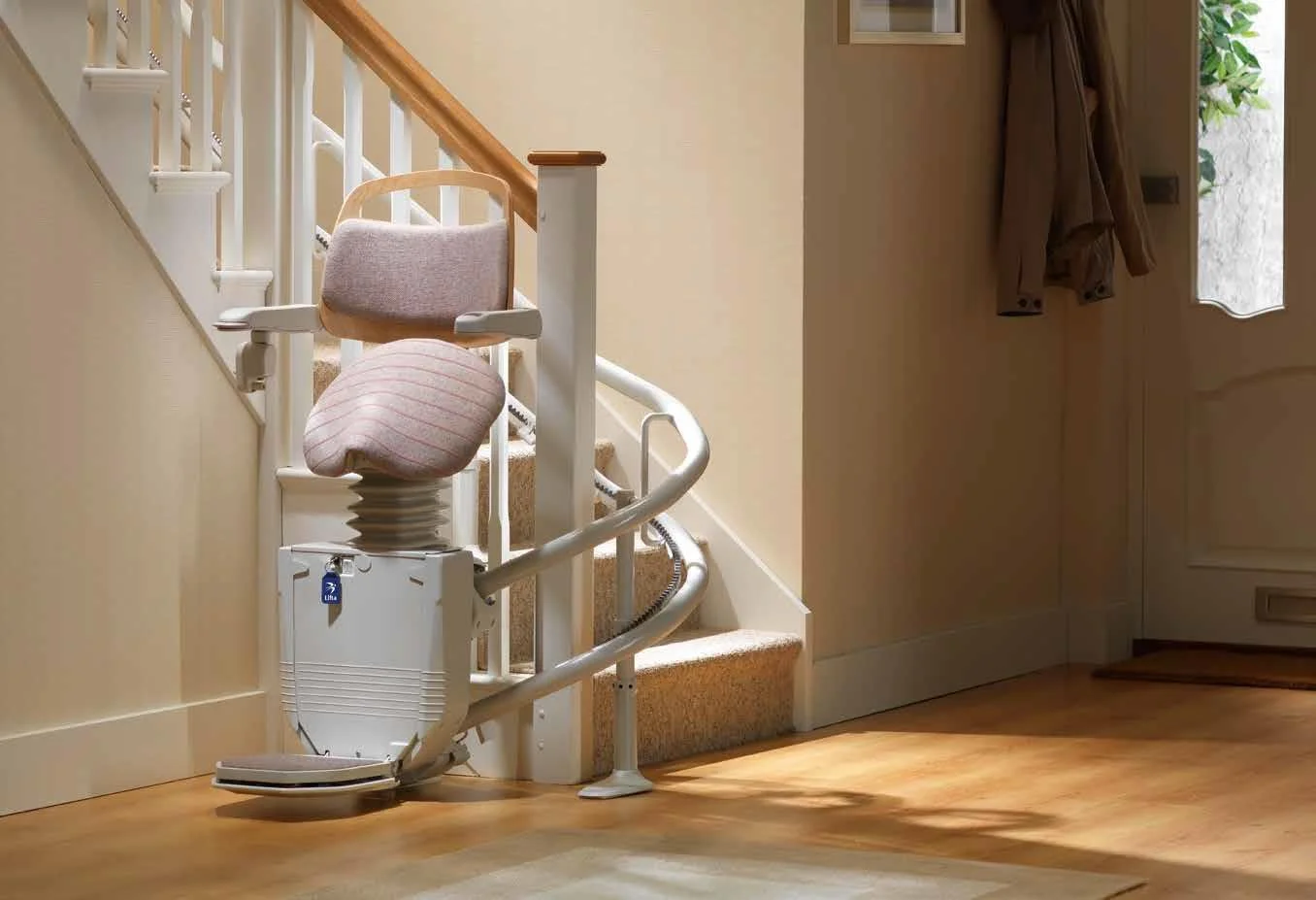
If the stairs turn, wrap around a landing or split into two flights, you need a curved lift with a rail built to that exact staircase. That takes measuring and a longer wait for the rail to be made.
Outdoor lifts are built for steps from a driveway, porch or yard, where weather is a factor. A platform lift is the choice when the person uses a wheelchair and cannot transfer onto a seat. We look at the stairs in person before recommending one of these.
If that includes you or your parent, check with the VA before paying out of pocket.
The VA splits this into two parts. The stair lift itself can come through VA Prosthetics when it is medically prescribed, while the HISA grant covers ramps and structural changes, not the lift. Call (877) 222-8387 to start.
Connecticut has a mix of Medicaid programs, a state loan and a tax credit that can help. Community First Choice (CFC) funds home safety modifications up to $10,000 for people who qualify for Medicaid.
For seniors 65 and over, the Connecticut Home Care Program for Elders (CHCPE) has a state-funded tier above Medicaid limits, though its coverage for modifications is limited. If you do not qualify for either, the CT Tech Act Assistive Technology Loan Program (ATLP) offers low fixed-rate loans of $500 to $30,000 for equipment including stair lifts.
Each program is summarized below with its phone number. It helps to call before scheduling an install, since some programs need approval first.
A Medicaid State Plan entitlement that funds home safety modifications up to $10,000, which can include a stair lift as a home modification. Call (888) 992-8637.
A home-care program for Connecticut seniors 65 and over, combining a Medicaid waiver with a state-funded tier above Medicaid limits; there is no fixed cap, and coverage for modifications is limited and set by the approved care plan. Call (800) 445-5394.
Low fixed-rate loans of $500 to $30,000 for accessibility equipment, including stair lifts, treated as a home modification. Call (800) 537-2549.
The stair lift itself can be covered through VA Prosthetics (PSAS) when medically prescribed, with no set dollar cap, while HISA pays $6,800 (service-connected) or $2,000 (non-service-connected) for ramps and structural changes, not the lift. Call (877) 222-8387.
A state property-tax credit of up to $1,250 for married or $1,000 for single homeowners, graduated by income. It does not pay for a stair lift directly, but it frees up household cash.
It can. Community First Choice (CFC) is a Medicaid entitlement that funds home safety modifications up to $10,000, and a stair lift can fall under that. Call (888) 992-8637 to ask about eligibility.
Both can be covered, through different parts of the VA. VA Prosthetics can cover a medically prescribed stair lift, while the HISA grant covers ramps and structural changes. The number is (877) 222-8387.
The CT Tech Act Assistive Technology Loan Program (ATLP) offers low fixed-rate loans from $500 to $30,000 for accessibility equipment, including stair lifts. Call (800) 537-2549.
Not directly. The Homeowners' Elderly/Disabled Circuit Breaker Tax Relief Program is a property-tax credit of up to $1,250 married or $1,000 single, which lowers your tax bill and leaves more cash for other costs.
Yes. Stairs with a turn or landing need a curved stair lift, with a rail made to fit that staircase. We measure in person before ordering.
Yes. We have pages for all nine planning regions, including the Capitol Planning Region, the Naugatuck Valley Planning Region and the Western Connecticut Planning Region.
Tell us about the stairs in your home and we will explain which lift fits, what it costs and how installation works.
