Hartford has one of the oldest housing stocks in the country. 66% of the city's housing was built before 1960, and 34% dates to before 1940. Walk through the neighborhoods and you see multi-story New England colonials, capes and triple-deckers, almost all with a staircase inside the house.
That kind of home is exactly where a stair lift tends to make sense. The same goes for the towns around the city, from New Britain and Rockville to Collinsville, Weatogue and Stafford Springs. This page covers how local homes affect which lift fits, and where people in the region can look for help paying for one.
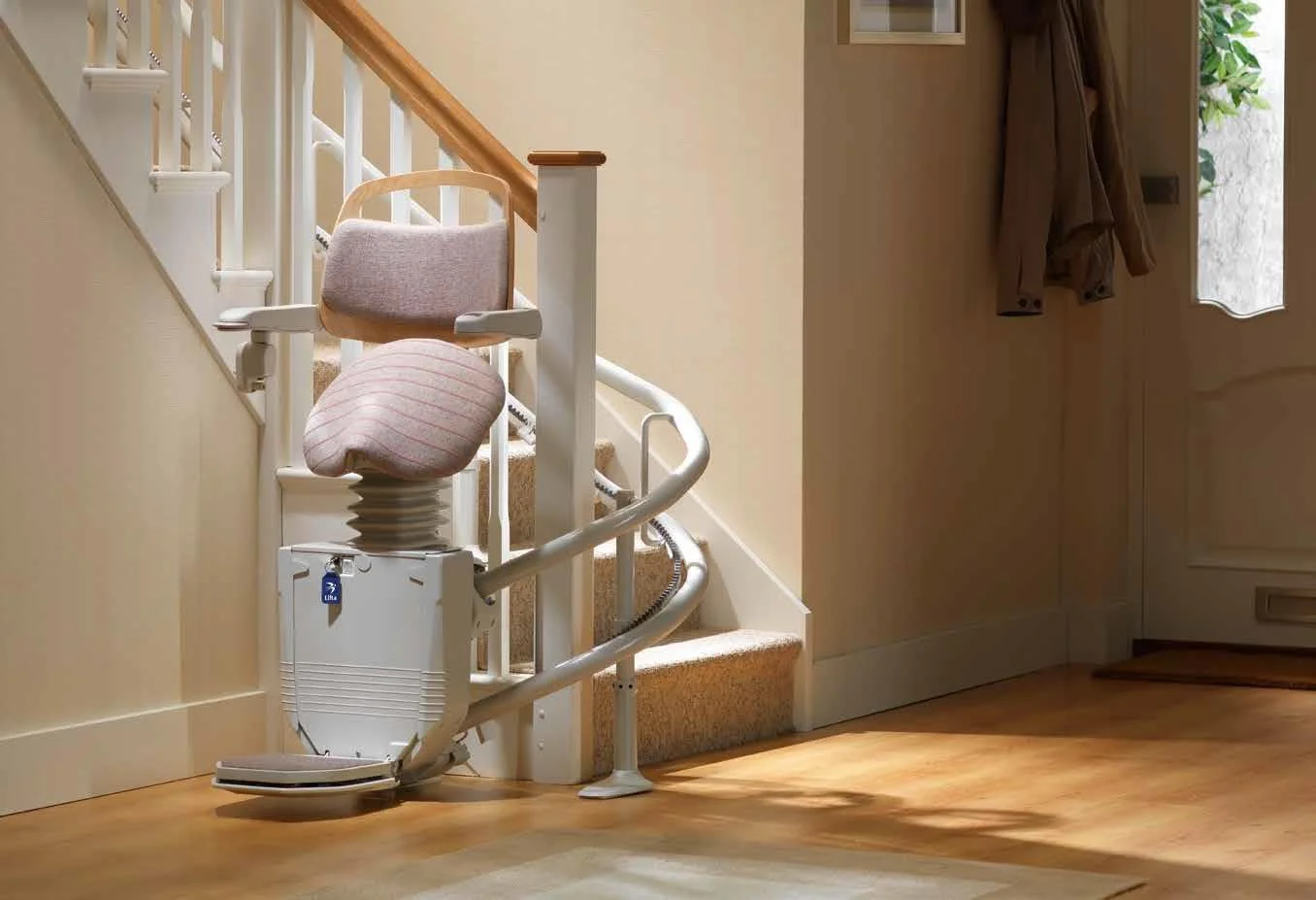
A colonial usually has one straight run of stairs from the front hall to the bedrooms. That is the simplest case. A straight stair lift mounts to the treads, not the wall, so plaster walls in a pre-1940 house are not a problem.
Capes often have steeper, narrower stairs, and some turn at a landing near the top. When the staircase bends, the rail has to be custom bent to follow it, which makes it a curved lift. We measure every turn and landing before recommending one or the other.
Triple-deckers and walk-up apartments have long interior stairs, sometimes shared between units. If you rent rather than own, talk with the building owner before planning an installation, since the rail attaches to the stairs.
The Capitol Planning Region is the largest of Connecticut's nine planning regions by land area, at 1,027.354 square miles. It runs from dense urban neighborhoods in Hartford along the Connecticut River out to lower-density suburban and rural towns like North Granby, Mansfield Center and South Coventry.
In the outer towns, the hard part is often the steps up to the front or side door rather than the stairs inside. An outdoor stair lift built for weather, or a platform lift for someone using a wheelchair, can handle an entry where a ramp would run too long for the yard.
Single-family homes, detached houses and townhouses across the region can each end up needing a different setup. A townhouse may need a lift on more than one flight, while a detached house may need one inside and one at the entry.
Many adult children here are helping a parent stay in the same colonial or cape they have lived in for decades.
About 45.1% of households own their home. That matters for funding, because several of the programs below, such as the CIL grants and the USDA Section 504 loans, are only open to homeowners.
Veterans can reach the Connecticut Department Of Veterans Affairs at 555 Willard Ave in Newington, (860) 594-6604. For general aging services, the North Central CT Area Agency on Aging is at 151 New Park Ave., Suite 236, Hartford, (860) 724-6443.
No single program pays for every lift, so families often combine a loan or grant with their own funds. Three programs below name stair glides or home modifications as an eligible use: the CT Tech Act loan program, CIL's Loans & Grants for Accessibility, and Rebuilding Together Hartford, which is not taking new applications right now.
Two state agencies sit right in Hartford at 55 Farmington Ave: the CT Dept. of Social Services Community Options Unit, which runs CHCPE, and the CT Tech Act Project. Veterans should know that the VA HISA grant specifically excludes stair glides, so start with the other options.
Other statewide programs exist, including Community First Choice (CFC) and the Homeowners' Elderly/Disabled Circuit Breaker Tax Relief Program. Ask the agency on aging which ones fit your household.
A state program for Connecticut residents 65+ who are at risk of nursing-home placement, run by the CT Dept. of Social Services. It lists Minor Home Modifications for safety and accessibility as a benefit, but stair lifts are not named; call (800) 445-5394.
Low-interest loans of $500 to $30,000 with 1-10 year terms for Connecticut residents of at least 1 year with a disability or older adults, and family members can apply on their behalf. Home modifications for accessibility are an eligible use; call (860) 876-9595.
A nonprofit repair program for older adults and people with disabilities in the Hartford area that lists stairglides among covered modifications. It is currently not accepting new applications, so call the organization's main line to check intake status.
Grants generally from $5,000 to $70,000, secured by a lien on the home, for low-to-moderate income Connecticut homeowners with a disability who have been denied other funding. Interior lifts and stairglides are covered options; call (860) 563-6011.
The regional agency on aging in Hartford for older adults and caregivers, which can refer people to minor home-repair resources. It does not list a specific stair lift grant, so call (860) 724-6443 to ask about the current funding cycle.
Loans up to $40,000 at 1% and grants up to $10,000 for homeowners 62+ in USDA-eligible rural areas with income at or below 50% of area median. Stair lifts are not mentioned in the covered repairs, and only rural parts of the region qualify, so check your address on the USDA eligibility map.
A VA grant of up to $6,800 or $2,000 lifetime for medically necessary home changes such as entrance ramps and roll-in showers. It does not cover stair lifts; stair glides are specifically excluded.
Grants of up to $126,526 (SAH) or $25,350 (SHA) for FY2026 for veterans with certain severe service-connected disabilities who own or will own the home. Stair lifts are not itemized in the program description, so ask the VA about your situation.
Older adults
151 New Park Ave., Suite 236, Hartford, 06106
Veterans
555 Willard Ave, Newington, 06108
No. HISA specifically excludes stair glides and porch lifts. Veterans with qualifying severe service-connected disabilities can ask about the SAH or SHA grants, and the Connecticut Department Of Veterans Affairs in Newington is at (860) 594-6604.
Yes. CHCPE requires age 65+, but the CT Tech Act loan program is open to Connecticut residents of at least 1 year who have a disability, and CIL's grants serve homeowners with a disability. Neither sets a minimum age.
The CT Tech Act Assistive Technology Loan Program allows parents, guardians, family members or legal representatives to apply for the person with a disability. Call (860) 876-9595.
Not right now. Its Critical Home Repair program lists stairglides as a covered modification, but the program page says it is not accepting new applications. Call the organization's main line to check when intake reopens.
Only rural and small-population parts of the region are USDA-eligible, not the dense Hartford metro areas. Look up your address on the USDA eligibility map, and note that stair lifts are not listed among the covered repairs.
Usually, yes. Triple-deckers have internal staircases, and a straight lift works on a single run while a curved lift follows stairs that turn at landings. If the stairs are shared or you rent, get the owner's approval first.
Tell us about the stairs in your home and we will explain which lift fits, what it costs and how installation works.
