From Torrington and Winsted to Lakeville, Falls Village and Cornwall Bridge, the Northwest Hills Planning Region spreads 12 towns across about 786.6 square miles of hilly, forested land in Connecticut's northwest corner. This is Mohawk Mountain and Kent Falls State Park country, and many houses here sit on sloped lots with more than one level.
The village centers hold on to their old New England look, with historic streetscapes like Litchfield's West Street and North Canaan's Main Street. Behind many of those front doors are older farmhouses and colonials with narrow, steep original staircases. Those are the stairs we are most often asked to measure, so this page walks through what fits and what can help pay for it.
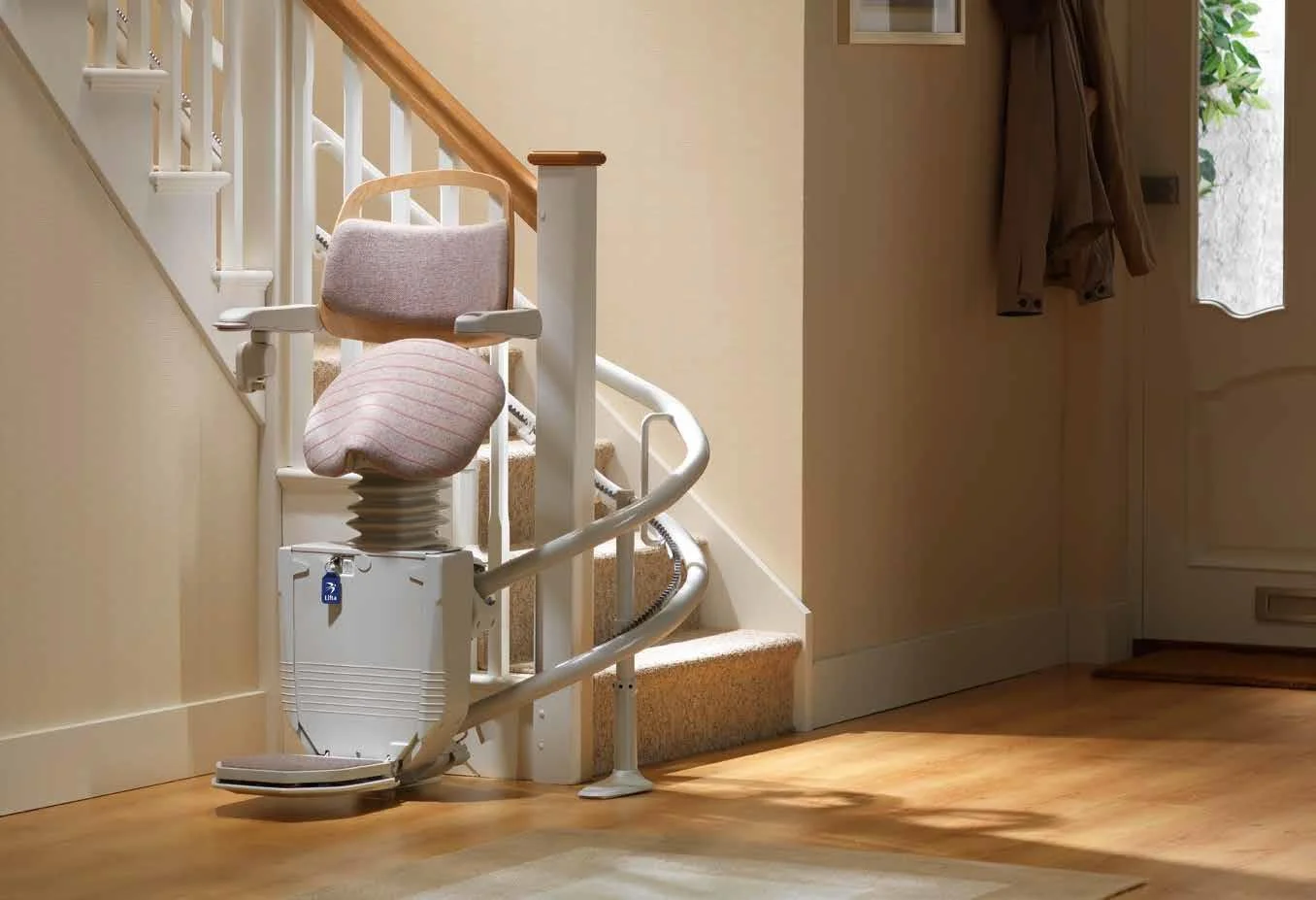
Original staircases in older farmhouses and colonials tend to be narrow and steep. A straight stair lift is usually the first thing we check for, because a single straight run between floors is the simplest install and the rail mounts to the stair treads, not the wall.
If the staircase turns at a landing or winds near the top, a custom curved rail is built to follow it. In a narrow stairway, we also look at how much clearance is left for others in the house to walk past the folded seat.
The region's housing also includes split-level homes, townhouses, detached single-family houses and walk-up apartments. Split-levels often have several short runs instead of one long one, so the question becomes which levels the person actually needs to reach every day.
Townhouses usually have a straight interior staircase, which keeps things simple. In a walk-up apartment, the building's shared stairs are not ours to change without the owner's say, so we start by talking about who controls the stairway.
Homes built into sloped lots in places like New Preston, Riverton and Pleasant Valley often have exterior steps from the driveway or into a lower-level entry. An outdoor stair lift built for weather exposure can handle those steps, and a vertical platform lift is another option where a wheelchair is in the picture.
This is also a low-density area where drives to medical care and contractors run longer. Keeping someone able to use the whole house safely means fewer trips out and less dependence on outside help for everyday moves between floors.
About 20.2 percent of residents are 65 or older, and 66.2 percent of households own their homes. Owning the home matters, because most stair lift installs and several of the funding programs below require that you own and live in the house.
VA programs exist, but read the details below carefully, since one of the best-known VA grants specifically excludes stair lifts.
Outside of Torrington and Winsted, the economy leans on tourism, second homes and small farms rather than large employers. That usually means fewer workplace benefit plans and more reliance on state, federal and nonprofit sources.
The only program in our list that names stair lifts outright is the CIL Loans & Grants for Accessibility program, which lists a stairglide as a modification type. Several others fund home modifications or accessibility changes in general, so call and ask directly whether a stair lift qualifies in your case. A good first call for many families is the Western CT Area Agency on Aging at (203) 757-5449.
A state program for Connecticut residents 65 and older at risk of nursing-home placement that includes Minor Home Modifications for safety and accessibility; stair lifts are not listed by name. Apply through the statewide line at (800) 445-5394.
Low-interest loans of $500 to $30,000 with 1 to 10 year terms, and home modifications for accessibility are a fundable use, though stair lifts are not listed by name. Family members can apply on the person's behalf by calling (860) 876-9595.
The regional agency on aging serving the Litchfield Hills towns, including Bantam, Canaan, Torrington and Winchester; it does not list a stair lift grant of its own. Call (203) 757-5449 to ask about current referral options and funding cycles.
A regional Center for Independent Living that can help people moving from a nursing facility back home under Money Follows the Person, which includes funding for home modifications; stair lifts are not named. Call (203) 729-3299.
Grants generally from $5,000 to $70,000, secured by a lien on the home, for Connecticut homeowners with a disability at or below 100% of area median income who have been denied other funding; a stairglide is listed as a covered modification. Funding is extremely limited right now, so call (860) 563-6011 early.
Loans up to $40,000 at 1% and grants up to $10,000 for homeowners 62 and older in USDA-eligible rural areas with very low income; accessibility changes are covered, but stair lifts are not named. Check your address on the USDA eligibility map and call (860) 902-5382.
Towns under 50,000 people can apply for state funds that mainly help low- and moderate-income homeowners, and each town sets its own rules; stair lifts and accessibility work are not listed. Ask your town hall whether a rehab round is open and whether accessibility work is eligible.
A lifetime grant of up to $6,800 or up to $2,000 depending on disability status, for medically necessary home changes like permanent ramps and roll-in showers. It does not cover stair lifts; stair glides are specifically excluded.
Grants up to $126,526 (SAH) or $25,350 (SHA) for FY2026 for veterans with certain severe service-connected disabilities who own or plan to own the home; stair lifts are not listed by name. Call the VA at (800) 827-1000.
Older adults
84 Progress Lane, Waterbury, 06705
Veterans
Rowland State Government Centern55 West Main Street, Suite 140, Waterbury, 06702
Not through the HISA grant, which lists stair glides among the things it does not cover. The SAH and SHA grants do not name stair lifts either way, so a veteran with a qualifying service-connected disability should ask the VA at (800) 827-1000. The Office of Advocacy and Assistance in Waterbury can also help at (203) 805-6340.
CHCPE is for people 65 and older, but other programs are based on disability rather than age. The CT Tech Act loan program, the CIL Loans & Grants for Accessibility program and Independence Northwest all serve people with disabilities. USDA repair grants start at 62, and USDA loans have no age requirement listed.
Often, yes. Narrow, steep original staircases in older farmhouses and colonials are the most common place we install straight or custom rails in this region. We measure the width, the pitch and any turns before recommending a model.
The CIL Loans & Grants for Accessibility program lists a stairglide as a modification type on its application. You must be a Connecticut homeowner with a disability, meet the income limit and have been denied other funding. Call (860) 563-6011, and know that funds are extremely limited.
It depends on the town and the year. Connecticut towns under 50,000 people can apply for CDBG Small Cities funds, and some run housing rehabilitation rounds, but funding is intermittent. Call your town hall to see if a round is open and if accessibility work qualifies.
The Western CT Area Agency on Aging at 84 Progress Lane in Waterbury serves the region's towns and can point you toward current options. Their number is (203) 757-5449. For CHCPE, the statewide intake line is (800) 445-5394.
Tell us about the stairs in your home and we will explain which lift fits, what it costs and how installation works.
