From the brass-era blocks of Waterbury to the hillside streets of Ansonia, Derby and Naugatuck, a lot of homes in this valley were built for a growing industrial workforce. Waterbury alone went from 45,859 people in 1900 to a peak of 104,477 in 1950, and much of the housing from that boom is still standing and still lived in.
Many of those homes put the bedrooms and the only full bathroom upstairs, reached by one interior staircase. This page walks through how that layout, the valley's hills and the local housing mix shape which stair lift makes sense, and which programs in Waterbury and across Connecticut are worth a phone call when it comes to paying for one.
Waterbury has 42,761 housing units citywide as of the 2010 census, spread across 25 historic ethnic neighborhoods. Similar dense, older housing fills Naugatuck, Ansonia, Derby and Shelton. In many of these houses, the second floor holds everything a person needs at night, and there is no second way up.
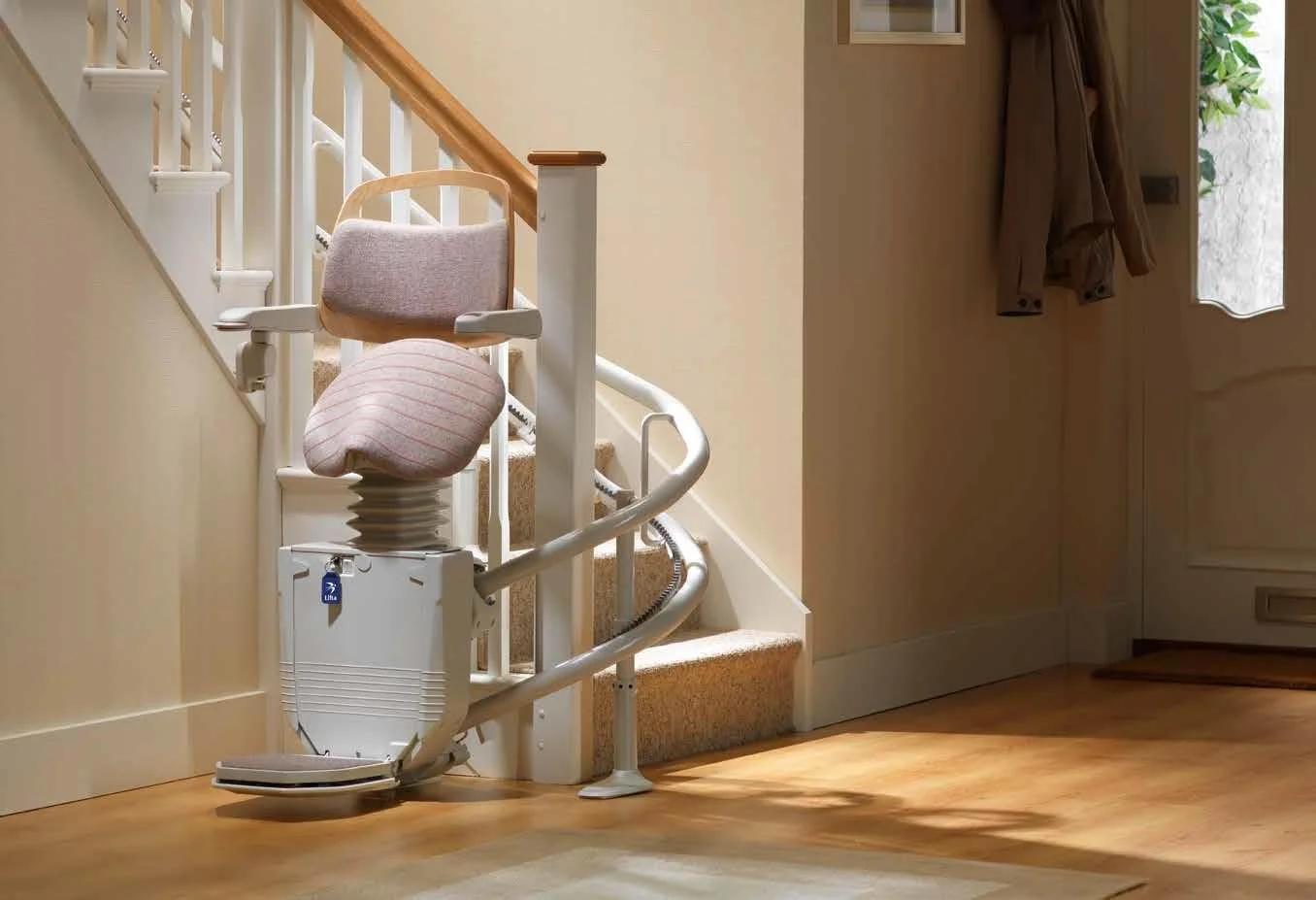
When the staircase is a single straight run, a straight stair lift is usually the simplest fit. It mounts to the stair treads rather than the wall, so it works in plaster-walled older homes. If the stairs turn at a landing or wind near the top, a curved lift built to that staircase is the answer.
Housing here includes single-family homes, townhouses, row houses, walk-up apartments and split-level homes. Row houses and townhouses often have narrow stairs, so we measure the width carefully and look at lifts with a folding seat and footrest that leave room for others to use the steps.
Split-level homes bring a different problem: several short flights instead of one long one. Sometimes one lift covers the flight that matters most, such as the one to the bedrooms. Other times a curved lift that follows more than one flight is the better plan, and we talk through both during the home visit.
The region covers about 412.8 square miles of west-central Connecticut along I-84 and Route 8. Waterbury's elevation runs from 220 to 820 feet, and its name comes from the many streams that ran down the hills on either side of the Naugatuck River. Hillside lots are common across the region, from city neighborhoods to smaller towns like Bethlehem.
On a sloped lot, the front walk or porch can have more steps than the inside staircase. An outdoor stair lift is built to handle Connecticut weather on those exterior steps. Where a wheelchair user needs to get up a short rise, a platform lift may be a better match than a seated lift.
About 59.4 percent are homeowners, which matters because several funding programs below require that you own the home.
Adult children often start the conversation after a fall or a hospital stay. A home visit lets us look at the stairs, the outlets and the landing space before anyone commits to a model.
No program in this region lists stair lifts as a guaranteed covered item, so it helps to go in with clear questions. The VA HISA grant explicitly excludes stair glides. The CHCPE waiver lists an Assistive Technology category, and the care manager is the person to ask whether it can be applied to a stair lift.
A good first call is the Western CT Area Agency on Aging at 84 Progress Lane in Waterbury, (203) 757-5449. They screen for CHCPE and Money Follows the Person. Veterans can reach the Connecticut Department of Veterans Affairs Office of Advocacy and Assistance (5th District) in Waterbury at (203) 805-6340.
Statewide programs worth asking about include Community First Choice (CFC), the CT Tech Act Assistive Technology Loan Program (ATLP) and the Homeowners' Elderly/Disabled Circuit Breaker Tax Relief Program. Details for each are in the program list below where we have them.
A Medicaid waiver run by the state DSS for Connecticut residents 65 and older who are at risk of nursing-home placement, with a 2026 income limit of $2,982/month and an asset limit of $1,600 single or $3,200 married with both applying. Stair lifts are not listed among covered services, but the program includes Assistive Technology, so ask your care manager; the Waterbury line is (203) 465-1000.
The Waterbury-based agency for older adults, people with disabilities and caregivers across towns including Waterbury, Naugatuck, Ansonia, Derby and Shelton. It does not directly fund home modifications or stair lifts, but it screens for CHCPE, Money Follows the Person and other benefits; call (203) 757-5449.
A Medicaid program, administered locally through WCAAA, that helps people living in a nursing facility or other institution move back home with an individualized transition budget. Whether a stair lift counts as a transition expense is not listed, so confirm with a WCAAA transition coordinator at (203) 757-5449.
Very-low-income homeowners in USDA-eligible areas can get 1% fixed loans up to $40,000 over 20 years, and homeowners 62+ who cannot repay a loan can get grants up to $10,000 lifetime, with a combined maximum of $50,000. Accessibility repairs are allowed but stair lifts are not named, and smaller towns such as Bethlehem, Oxford, Southbury and Woodbury are more likely to qualify than Waterbury, Ansonia, Derby or Shelton.
A lifetime VA grant of up to $6,800 for service-connected disabilities (or non-service-connected with a 50%+ service-connected rating) and up to $2,000 for other eligible disabilities, requiring a VA physician's prescription and VA Form 10-0103. It does not cover stair lifts: VA policy excludes stair glides and porch lifts, funding fixed changes like roll-in showers and widened doorways instead.
Grants for veterans with specific severe service-connected disabilities who own or will own the home: SAH up to $126,526 and SHA up to $25,350 for FY2026, with Temporary Residence Adaptation up to $50,961 or $9,100. Stair lifts are not listed specifically, so ask through the Connecticut Department of Veterans Affairs office in Waterbury at (203) 805-6340.
A non-profit Center for Independent Living at 1183 New Haven Road Suite 200 in Naugatuck, offering advocacy, independent living skills, information and referral, housing help and veterans' services for people with disabilities. Stair lift funding is not listed, but it is a useful local referral point; call (203) 729-3299.
Older adults
84 Progress Lane, Waterbury, 06705
Veterans
Rowland State Government Centern55 West Main Street, Suite 140, Waterbury, 06702
No. VA policy excludes removable equipment such as stair glides and porch lifts from HISA. Veterans can still ask the Connecticut Department of Veterans Affairs office in Waterbury at (203) 805-6340 about other VA options such as SAH or SHA grants, though stair lifts are not specifically listed there either.
Stair lifts are not itemized in the program's covered services. The program does include an Assistive Technology category, so ask your CHCPE care manager whether it can apply. The Waterbury line for the program is (203) 465-1000.
Hillside lots are common throughout the valley, and exterior steps are often the bigger hurdle. An outdoor stair lift can serve those steps, and a platform lift may suit a wheelchair user. We look at both the inside and outside stairs during a home visit.
The USDA Section 504 program offers grants up to $10,000 for very-low-income homeowners 62+ who cannot repay a loan, and smaller towns are more likely to be in eligible areas. Eligibility is checked address by address on the USDA map, and stair lifts are not named in the program, so confirm before you apply.
CHCPE requires age 65 or older, but WCAAA also serves individuals with disabilities and caregivers at (203) 757-5449. Independence Northwest in Naugatuck, a Center for Independent Living, offers information and referral at (203) 729-3299.
The Western CT Area Agency on Aging at 84 Progress Lane in Waterbury, (203) 757-5449, can screen for CHCPE and Money Follows the Person in one conversation. In parallel, a home visit from us shows which type of lift fits your stairs.
Tell us about the stairs in your home and we will explain which lift fits, what it costs and how installation works.
