Urbana was laid out in 1805, and the blocks around the Monument Square Historic District still hold early-19th and early-20th-century multi-story homes with their original staircases. Head out toward St. Paris, Mechanicsburg, North Lewisburg, Christiansburg, Rosewood or Woodstock and the picture changes to standalone single-family homes and ranch-style houses spread across the townships.
Those two kinds of homes call for different stair lift answers. This page walks through what we look at in each, what the flat farm country means for entry steps, and which Champaign County and Ohio programs are worth a phone call before you pay out of pocket.
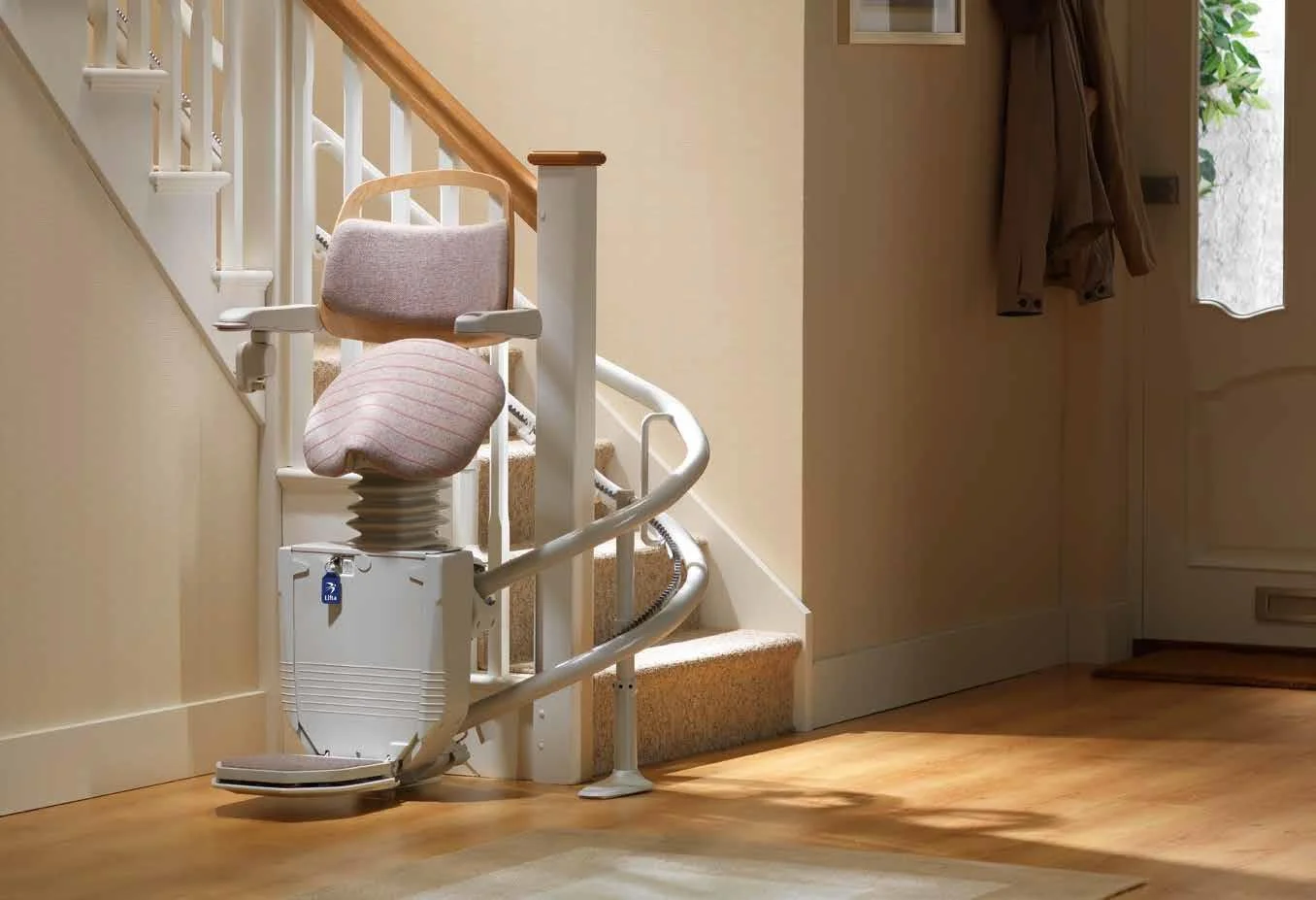
Many two-story homes near Monument Square were built long before anyone planned for a stair lift. Original staircases in these houses can be narrow or steep, and some turn partway up. We measure the width, the rise and any landing before recommending a model.
A straight staircase usually takes a straight rail, which is the simpler and faster install. If the stairs turn or wrap around a landing, a curved rail is built to follow that exact shape. Either way, the rail mounts to the stair treads, not the wall, so original plaster and woodwork stay as they are.
This matters for a lot of families in town. As of the 2020 census, 20.6% of Urbana residents were 65 or older.
According to the 2020 census, 70.6% of county residents live in rural areas, so many of the homes we see are detached houses on their own lots. A ranch-style home may have no indoor stairs on the main floor but still have steps down to a basement laundry or up to the front door.
Champaign County sits in Ohio's glacial till plains, flat to gently rolling ground. That flat grading makes ramps easier to fit than in hillier parts of the state. Where a ramp would run too long, an outdoor stair lift or a platform lift at a porch or entry can be the better fit.
Townhouses often have a straight interior staircase, which suits a standard straight lift. In a walk-up apartment, the stairs are usually a shared space, so a renter needs the landlord's written approval before any rail goes in.
If you own a townhouse, check whether an association has rules about changes to the unit. We can supply the specs an association or landlord typically asks to see.
No program on our list names stair lifts outright, so the honest answer is that coverage depends on the case. PASSPORT lists home modifications as a benefit category, and a case manager at the Area Agency on Aging PSA 2 is the person who can say whether a lift fits into a care plan.
Veterans should know one firm rule: the VA HISA grant does not cover stair glides. The VA SAH and SHA grants fund structural adaptations and could in principle include a lift if it is part of an approved plan. For rural homeowners age 62 and up with very low income, USDA Section 504 grants of up to $10,000 lifetime can go toward making a home more accessible.
The county's 2024 median household income was $75,556 and its poverty rate was 7.98%, so many households end up combining some savings with whatever program help they qualify for. The program list below covers who to call.
Ohio's Medicaid home care waiver for people 65 and older, or 60 to 64 with a qualifying physical disability, who meet nursing-facility level of care and Medicaid financial limits. Home modifications are a listed benefit, but stair lifts are not named and no dollar cap is published; call (937) 223-4357.
The regional intake and case-management point for Champaign County that routes older adults to PASSPORT and Older Americans Act services. It does not list a stair lift or home-modification fund of its own; call (937) 223-4357.
Loans up to $40,000 at 1% interest and grants up to $10,000 lifetime for very-low-income homeowners age 62 and up in USDA-eligible rural areas, for removing hazards or making a home more accessible for a household member with a disability. Stair lifts are not named specifically, and your address must be confirmed on the USDA eligibility map.
A VA grant of up to $6,800 or $2,000 lifetime, depending on disability status, for medically needed home improvements. It does not cover stair lifts: the VA excludes removable equipment such as porch lifts and stair glides.
Up to $126,526 (FY2026) for veterans with certain severe service-connected disabilities to adapt a home they own or will own. Stair lifts are not named, though they could be part of an approved adaptation plan; call (800) 827-1000.
Up to $25,350 (FY2026) for veterans with qualifying disabilities such as loss of use of both hands or certain breathing injuries. Stair lifts are not mentioned specifically; call (800) 827-1000.
The local office at 220 E. Court St. in Urbana that helps with VA benefit applications, emergency financial assistance and transportation. It does not list stair lift funding but can help you file for VA housing grants; call (937) 653-4554.
Redistributes donated used medical equipment to residents who cannot afford it and lack Medicaid or Medicare coverage for it; ACIL does not repair equipment. Stair lifts are not named as inventory items; call (937) 341-5202.
Flexible state-administered housing and community development money for locally identified needs in Champaign County. The page does not list stair lifts, amounts or eligibility, so call (937) 666-3431 to ask about current cycles and covered repairs.
Older adults
40 W. Second Street, Suite 400, Dayton, 45402
Veterans
220 E. Court St., Urbana, 43078
No. The VA specifically excludes porch lifts and stair glides from HISA. Veterans with qualifying service-connected disabilities can ask about the SAH or SHA grants instead by calling (800) 827-1000, or get help filing through the Champaign County Veterans Service Office at (937) 653-4554.
PASSPORT accepts people age 60 to 64 who have a qualifying physical disability, as long as they meet Medicaid financial rules and nursing-facility level of care. Most Older Americans Act services through the Area Agency on Aging PSA 2 start at age 60.
Much of Champaign County is rural, but eligibility is decided address by address on the USDA Rural Development eligibility map. Grants are limited to homeowners age 62 and up with very low income who cannot repay a loan.
Yes, in most cases. The rail fastens to the stair treads rather than the walls, and a curved rail can be built to follow a staircase that turns. We measure first to confirm the stairs are wide enough.
Start with the Area Agency on Aging PSA 2 at (937) 341-3000 or (937) 223-4357. A case manager there can tell you whether PASSPORT home-modification benefits apply and point you to other services.
ACIL's REDI program hands out donated used medical equipment to people in its nine-county area, including Champaign County, but stair lifts are not listed as inventory. Call (937) 341-5202 to ask what is available.
Tell us about the stairs in your home and we will explain which lift fits, what it costs and how installation works.
