From Santa Maria and Orcutt in the north to Montecito, Summerland and Carpinteria on the coast, Santa Barbara County packs 24 towns into land shaped by the Santa Ynez Mountains. Many homes in Santa Barbara, Montecito and the foothill neighborhoods sit on steep hillsides, so daily life often means climbing stairs inside the house and outside it.
This page explains how local homes and terrain affect the kind of stair lift that fits, from straight indoor rails to curved and outdoor models. It also lists the public and nonprofit programs in the county, with a plain account of which ones can help pay and which ones cannot.
The Santa Ynez Mountains run east to west and rise steeply right behind the coastal cities, with Santa Ynez Peak at 4,298 ft and Divide Peak at 4,707 ft. The south face drops quickly to a narrow coastal plain along the Santa Barbara Channel, which leaves little flat ground to build on.
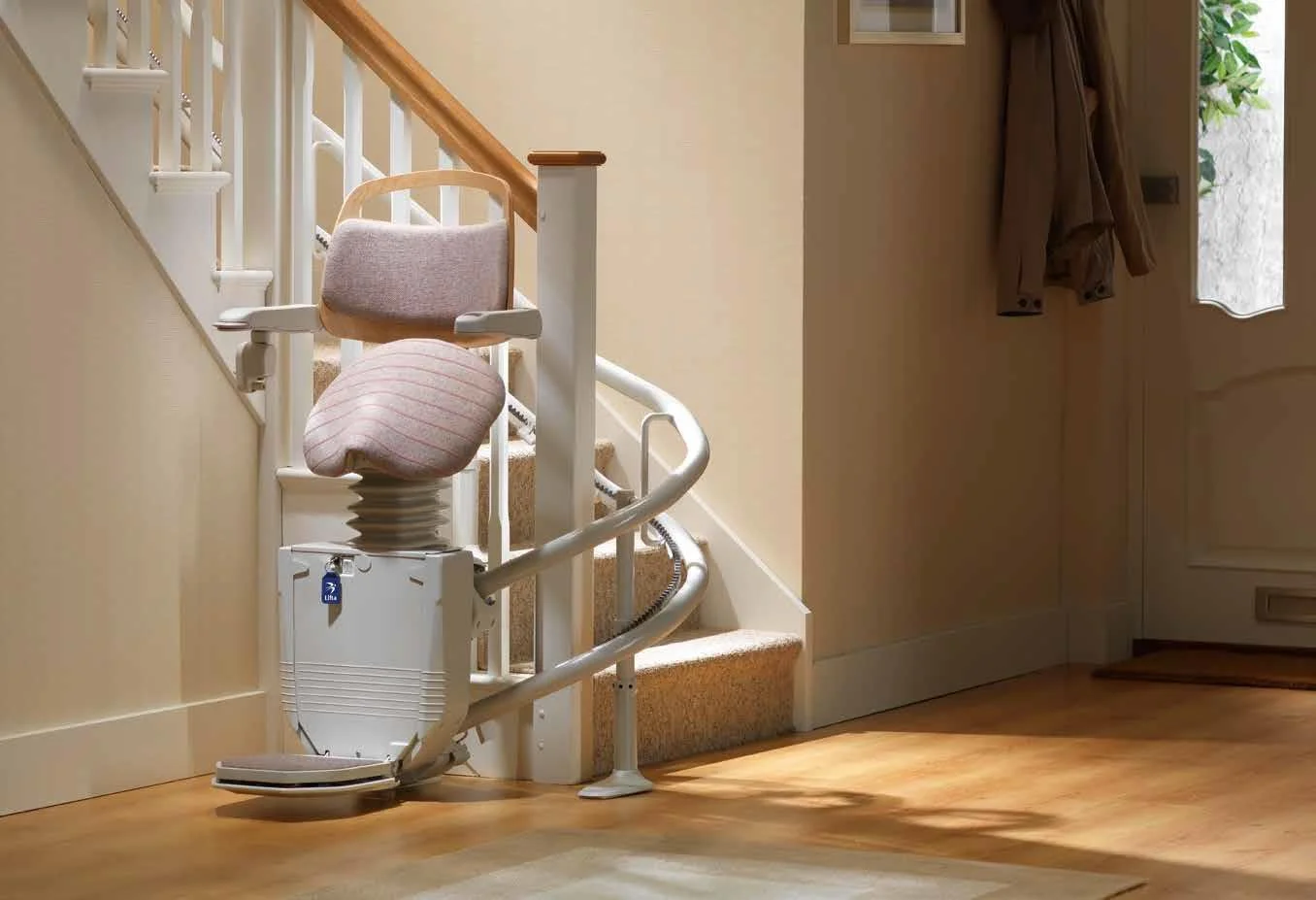
That is why so many homes in Santa Barbara, Montecito, Mission Canyon and Toro Canyon are multi-story, with stairs that turn, split or climb from the driveway to the front door. A straight stair lift works when a staircase runs in one line with no landings. Stairs with a turn or a mid-landing usually need a curved rail built to fit.
Exterior steps cut into a slope are common here too. For those, an outdoor-rated stair lift is the usual answer, and where a wheelchair user needs to get from street level to the entry, a platform lift is worth considering.
Spanish Colonial Revival became the semi-official Santa Barbara style right after the 1925 earthquake. These homes have flat stucco walls, red clay tile roofs, wooden front doors in simple or arched openings, and touches like wooden balconies and decorative tile.
A stair lift rail mounts to the stair treads, not the walls, so stucco and tile finishes generally stay as they are. Narrow or curving interior stairs in older homes are where we measure most carefully, since the rail and the folded seat have to clear the path for anyone still walking the stairs.
Across the county you will also find single-family homes, detached houses, townhouses, low-rise apartments and split-level homes. Split-level homes often have several short flights, and each flight may need its own lift or a single curved rail, depending on the layout. In townhouses and apartments, it helps to check with the owner or association before any installation.
About 16.0% of county residents are 65 or older, and many longtime owners want to stay in the homes they know. Roughly 52.1% of households own their home, which matters because most home modification programs work best when the owner can approve changes.
Renters still have options. CommUnify's Senior Safe At Home program serves renters as well as homeowners age 60 and older, though it handles smaller safety work rather than stair lifts.
For a veteran with a qualifying service-connected disability, the VA grants listed below can be a real path to funding a lift.
The county has some of the most expensive real estate in the country, with Montecito homes commonly selling for $2 to $4 million and Hope Ranch homes for roughly $1.7 to $3 million. Many families here pay privately, but local incomes are more modest, with an average salary around $77,000, so public programs matter.
Of the programs below, the VA Specially Adapted Housing (SAH) and Special Home Adaptation (SHA) grants are the only ones that list stair lifts as coverable. The Medi-Cal HCBA Waiver covers medically necessary home modifications, but whether a stair lift qualifies is decided case by case. Other local programs offer referrals, caregiver hours or minor repairs rather than lift funding.
Statewide, residents can also ask about the Multipurpose Senior Services Program (MSSP) and the FreedomTech Low-Interest Assistive Technology Loan. Calling the local aging office first is a good way to learn which of these fits your situation.
The Central Coast Commission for Senior Citizens (PSA 17) is at 528 South Broadway, Santa Maria, CA 93454. Call (805) 925-9554 for information, referrals and help finding home modification resources.
Veterans can reach the Santa Barbara County Veteran Service Office at 624 W Foster Rd Suite A, Santa Maria, CA 93455, or by phone at (805) 346-7160. The office can help you sort out which VA benefits apply before you file.
A state Medicaid waiver for aged or disabled Medi-Cal members who would otherwise need nursing-facility or similar care, which covers medically necessary environmental accessibility adaptations with no fixed published dollar cap. Stair lift coverage is not stated and is decided in the individual plan; call (916) 552-9105.
A county-run Medi-Cal program that pays for caregiver hours for people who are 65 or older, blind or disabled and living at home. It does not fund stair lifts or structural modifications; call (805) 681-4550.
The Area Agency on Aging for adults 60 and older in Santa Barbara and San Luis Obispo Counties, offering information, referrals to home repair and modification resources, and supportive services. It does not list stair lift funding; call (805) 925-9554.
An independent living center serving people with disabilities of any age, with housing navigation, assistive technology and home modification guidance, and connections to funding. Stair lifts are not listed as a direct grant; call (805) 963-0595.
A free program for county residents 60 and older, owners or renters, that installs grab bars, handrails and smoke or CO alarms and does slip-and-fall prevention. Stair lifts and ramps are not covered; call (805) 617-2897.
Federal grants for veterans and service members with qualifying service-connected disabilities, up to $126,526 (SAH) or $25,350 (SHA) for FY2026 with no repayment. Stair lifts and platform lifts can be covered in an approved plan when medically necessary; call (877) 827-3702.
A lifetime VA grant of up to $6,800 or $2,000 for medically necessary changes such as roll-in showers, ramping and entrance access. It specifically excludes stair glides and porch lifts; call (877) 222-8387.
Older adults
528 South Broadway, Santa Maria, 93454
Veterans
624 W Foster Rd Suite A, Santa Maria, 93455
Yes, in most cases. Stairs with a turn or landing usually take a curved rail made to fit that staircase, which is common in the multi-story hillside homes around Santa Barbara and Montecito.
The rail mounts to the stair treads rather than the walls, so stucco walls and decorative tile are generally left alone. We check narrow or arched stair areas to make sure the lift clears the path.
The VA SAH and SHA grants can cover a stair lift for eligible veterans when it is medically necessary. The Medi-Cal HCBA Waiver covers home modifications, but stair lift approval is decided case by case. Other local programs offer referrals, caregiver hours or minor repairs.
Access Central Coast serves people with disabilities of any age and can help with home modification guidance and funding connections. Call (805) 963-0595.
No. HISA specifically excludes stair glides and porch lifts. Veterans with a qualifying service-connected disability should ask about the SAH or SHA grants instead, and the Santa Barbara County Veteran Service Office at (805) 346-7160 can help.
No. The program covers grab bars, handrails, smoke and CO alarms, heater safety testing and slip-and-fall prevention for residents 60 and older. Stair lifts and ramps are not included.
Tell us about the stairs in your home and we will explain which lift fits, what it costs and how installation works.
