From Brattleboro and Bellows Falls to Grafton, Newfane and the hill towns around Wilmington and Dover, Windham County's 25 towns are full of older colonial and 19th-century farmhouses and village homes. Many were built with a raised first floor and a full stairway up to the bedrooms. That classic Vermont multi-story layout is why getting up and down the stairs becomes the first aging-in-place question for so many families here.
The county covers about 785 square miles of hilly, mountainous terrain in southeastern Vermont, part of it inside the Green Mountain National Forest. Contractors and medical services cluster in a few towns, with Brattleboro as the commercial hub, so families in Halifax, Jamaica or Whitingham often have farther to go for help. This page walks through which kind of stair lift tends to fit local houses and which programs may help with the cost.
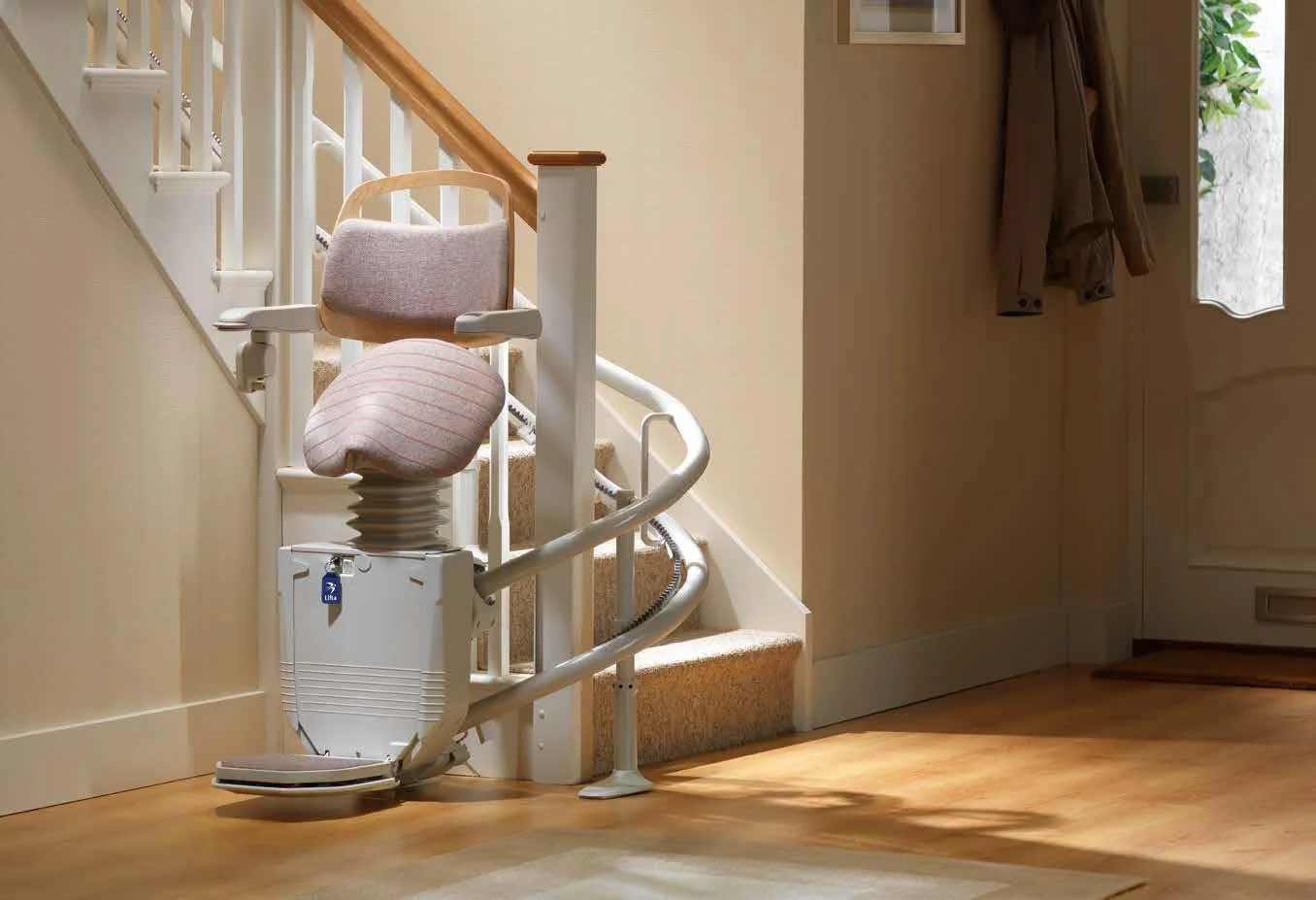
In towns like Newfane, the county seat, and Grafton, a lot of homes keep the bedrooms and often the only full bath upstairs. When climbing that stairway gets hard, the choice is usually between moving a bedroom downstairs or making the stairs usable again. A stair lift is often the simpler route because it leaves the house laid out the way it was built.
Older stairways can be steep or narrow, and some turn at a landing. A straight staircase usually takes a straight rail. A stairway that turns or has a landing partway up typically needs a curved rail made to fit those exact stairs, which is why we measure in person before quoting anything.
The county's housing also includes split-level homes, townhouses, detached houses and walk-up apartments. In a split-level, the daily route can involve more than one short flight, so it helps to sort out which flights matter most before choosing equipment. Townhouses often have one long straight run, which is the most direct install.
A raised first floor means steps at the door, too, not just inside. If the trouble starts on the porch or entry steps, an outdoor stair lift or a platform lift may solve more than an indoor unit would. We look at the entry and the interior stairs together on the same visit.
About 24.4 percent of county residents are 65 or older, and the median age is 47.3, well above the national median. Roughly 71.1 percent of households own their homes, which matters because most repair and modification programs below are written for homeowners.
VA rules on stair lifts are narrower than many people expect, so veterans should read the program notes below before applying.
With a population density of roughly 58 people per square mile and settlements spread among hills and reservoirs like Townshend Lake and Ball Mountain Lake, outlying homes can be a long drive from service providers. Families in Londonderry, Wardsboro or Marlboro may find it useful to line up the assessment and any funding paperwork early rather than waiting for a hospital discharge.
The county has reported labor shortages in skilled trades, so building in some lead time is sensible for any home modification, including a stair lift.
Only one program in our list names home modifications as a covered category: Vermont Medicaid Choices for Care, set up locally through a case manager at Senior Solutions. Several local nonprofits and the USDA fund safety and access repairs without naming stair lifts, so a stair lift there would need to be explained as fixing a safety or access problem.
The VA HISA grant explicitly excludes stair glides. The Vermont Independence Fund (Assistive Technology Loan) is another statewide name worth asking about. A good first call for most older residents is Senior Solutions at (802) 885-2669, which handles Choices for Care enrollment and referrals to local repair and access programs.
Vermont's Medicaid waiver for people 65+ or adults with a physical disability who need nursing-home-level care, with income up to $2,982/month in 2026; its flexible fund lists home modifications and assistive devices, so a stair lift can be covered on that basis. Call (800) 642-5119 or work through your Senior Solutions case manager.
The county's Area Agency on Aging offers case management, options counseling and caregiver support for older Vermonters, typically 60+; it does not list stair lift grants itself but is the usual entry point for Choices for Care and local repair referrals. Call (802) 885-2669.
Free home accessibility assessments plus entry-way and bathroom modifications for low-income Vermonters with a physical disability; stair lifts are not mentioned in its description. Call (802) 224-1807.
Grants up to $7,500 for very-low-income homeowners 62+ and loans up to $20,000 at 1% over 20 years for removing health and safety hazards; stair lifts are not named, so one would need to be justified as a hazard fix. Call (603) 223-6035.
A lifetime grant of $6,800 or $2,000 for medically necessary structural changes, depending on service-connected status. HISA explicitly will not pay for stair glides or porch lifts.
Larger grants, up to $126,526 for SAH and $25,350 for SHA in FY2026, for veterans with qualifying severe service-connected disabilities; stair lifts are not specifically named among covered modifications.
Low-cost repair loans plus grant help and project oversight for homeowners at or below 80% of county median income; stair lifts are not named among covered repairs. Call (802) 254-4604.
Grants of $2,000 to $4,000 per project for greater Brattleboro homeowners, with priority for seniors facing safety or access problems; it covers ramps and safer entryways but does not name stair lifts. Call (802) 246-2224.
Emergency repairs for low-income households in crisis in Windham and Windsor Counties, focused on immediate health and safety risks; stair lift coverage is not specified, and the program sometimes closes when funding is full. Call (800) 464-9951.
Older adults
143 Maple St., Rutland, 05701
Veterans
789 National Guard Road, Colchester, 05446
Choices for Care lists home modifications and assistive devices in its flexible fund, so a stair lift can qualify on that basis, though it is not named on its own. You need to meet the nursing-home level of care, income and asset rules, and a case manager sets your budget. Start with Senior Solutions at (802) 885-2669.
Not through HISA, which explicitly excludes stair glides. The SAH and SHA grants do not name stair lifts either way. The Vermont Veterans Outreach Program in Colchester, (802) 338-4147, can help a veteran sort out which benefits apply.
Choices for Care also serves adults with a physical disability who need nursing-home-level care. The VCIL Home Access Program serves low-income Vermonters with a physical disability, and Senior Solutions typically serves people 60 and up.
Usually, yes. A staircase with a turn or landing generally needs a curved rail built for those specific stairs, while a single straight run can take a straight rail. An in-home measurement tells you which one your house needs.
Services in the county are concentrated in a few towns, and outlying residents face longer travel distances. Planning the assessment and funding applications early helps, especially with reported shortages in skilled trades.
BAAH partners with SEVCA's Emergency Home Repair Program and Windham & Windsor Housing Trust to bridge funding gaps on larger projects. None of the three names stair lifts, so ask each one how they would treat a stair safety problem.
Tell us about the stairs in your home and we will explain which lift fits, what it costs and how installation works.
