From Carbondale down through Scranton to Old Forge, much of Lackawanna County was built for families who worked the anthracite mines and iron works. Many of those two- and three-story frame houses are still standing, with narrow, steep staircases and the bedrooms and bathrooms upstairs.
Add the hills of the Lackawanna River valley, and plenty of homes in the county's 43 towns have stairs both inside and out. This page explains which kind of stair lift tends to fit these houses, and which local, state and federal programs may help cover the cost.
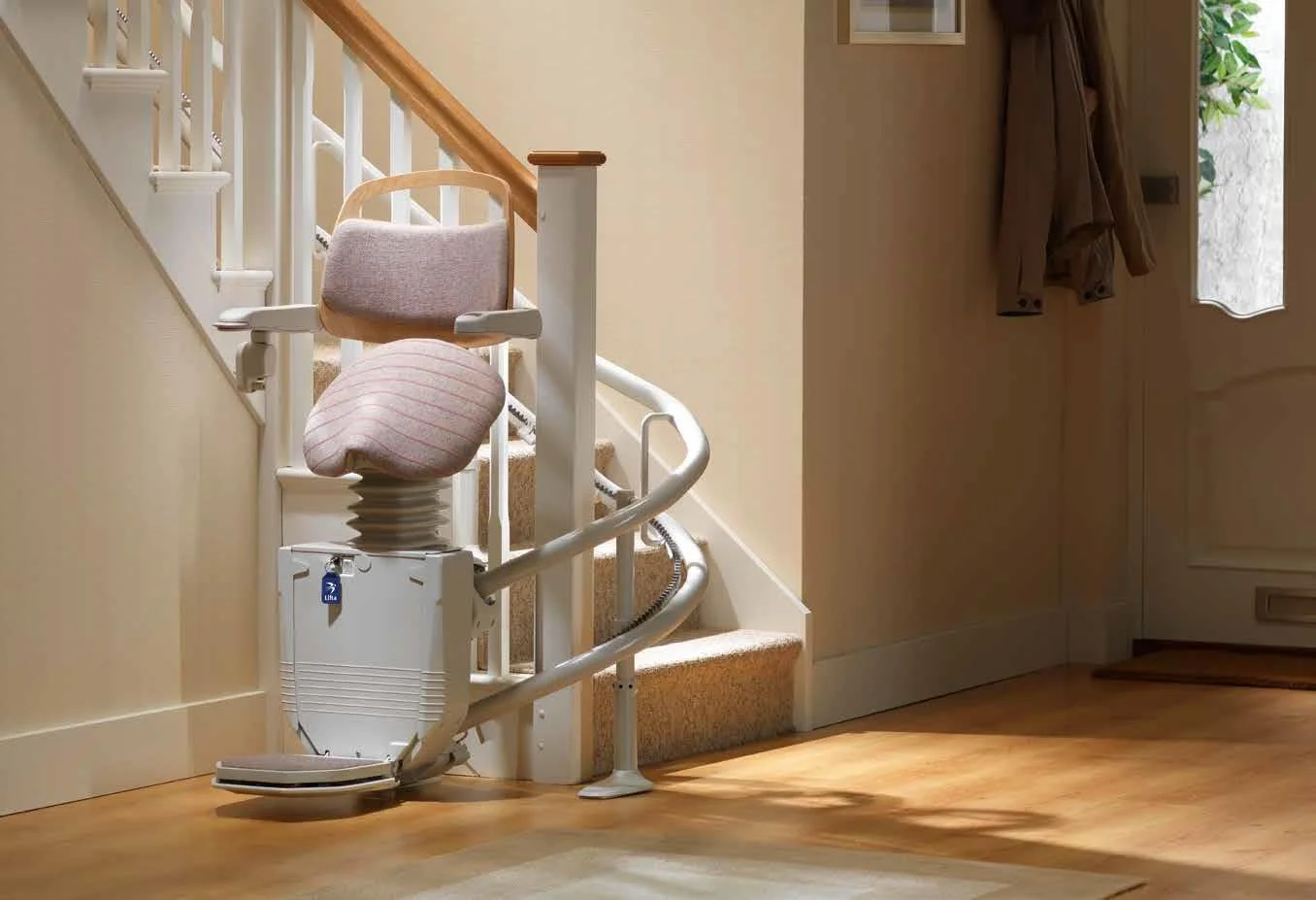
A large share of homes here are pre-WWII frame houses built for mining and mill families. They are narrow and tall, so the staircase is often steep and the only bathroom may be on the second floor.
In a house like that, a few-step platform lift does not solve the problem. The usual answer is a stair lift that runs the full story, so a parent can reach the bedroom and bath without climbing.
Row houses and townhouses in places like Scranton, Dunmore and Olyphant often have a straight run between floors, which is the simplest install. Where a stair turns at a landing or winds near the top, a curved rail built to that staircase is the better match.
The valley sits between Moosic Mountain on the east and West Mountain on the west, each averaging about 2,000 ft above sea level. The valley floor climbs from roughly 600 ft in the southwest to about 1,500 ft in the northeast, and the mountain slopes are generally 20 percent or greater.
That means many homes are built into a grade, with several exterior steps up to the door or a split-level entry. A person may get up the inside stairs fine and still struggle to get in from the driveway.
For those homes, an outdoor stair lift rated for weather can cover the front or side steps. Where a wheelchair is involved, a platform lift at the entry may make more sense than a seat.
About 20.2% of county residents are 65 or older, and 66.1% of households own their home. Many are long-tenured owners who have lived in the same older house for decades and want to stay.
If your parent served and has a service-connected disability, the VA grants listed below are worth checking before you pay out of pocket.
The clearest path is the Community HealthChoices (CHC) waiver, which lists stair glides among the removable equipment Pennsylvania Medicaid covers. The participant asks their CHC service coordinator to add it to the service plan.
For people not on Medicaid, start with the Lackawanna County AAA at 200 Adams Ave., Scranton, 18503, phone (570) 963-6740. They handle OPTIONS assessments for residents 60 and older and run the Caregiver Support Program.
Homeowners with low to moderate income can ask the county about CDBG housing rehabilitation and architectural barrier removal. Veterans can reach Lackawanna County Veterans Affairs at 123 Wyoming Avenue, 1st Floor, Scranton, phone (570) 963-6778, for help with VA grants.
A Medicaid waiver for adults 21 and older who meet a nursing-facility level of care; it covers stair glides, wheelchair lifts and ceiling lifts when authorized in the person-centered service plan. Call (800) 274-3258 or ask your CHC service coordinator.
Lottery-funded in-home services for Pennsylvanians 60 and older with a sliding-scale co-payment and no hard income limit; the source does not mention stair lifts, and home modifications are a supplemental service that varies by local AAA. Call (717) 783-1550.
Reimburses primary caregivers of an older adult, generally 60 or older, for out-of-pocket caregiving costs such as respite, services and supplies; stair lifts are not mentioned in the source. Call (570) 963-6740.
Grant-funded safety and accessibility modifications for homeowners 60 and above in Lackawanna, Luzerne or Wayne counties, though stair lifts are not specifically listed. Applications are currently closed; you can check status at (570) 558-2490.
Federal grants for veterans with qualifying service-connected disabilities, up to $126,526 for SAH and $25,350 for SHA in FY2026; stair lifts are not listed by name, but stair access can be part of an approved home-adaptation plan. Call (800) 827-1000.
HUD-funded help for low-to-moderate-income residents, including owner-occupied rehab and barrier removal that increases access for handicapped or elderly persons; stair lifts are not a listed line item. Call the county at (570) 963-6830.
Older adults
200 Adams Ave., Scranton, 18503
Veterans
123 Wyoming Avenue, 1st Floor, Scranton, 18503
Through the Community HealthChoices (CHC) waiver, yes, if the participant qualifies. Stair glides are listed as covered removable equipment, and the CHC service coordinator must add it to the person-centered service plan. The program number is (800) 274-3258.
The OPTIONS Program serves Pennsylvania residents 60 and older with no hard income limit, using a sliding co-payment. Stair lifts are not mentioned in the program description, so ask the Lackawanna County AAA at (570) 963-6740 whether home modifications are available locally.
Yes. Many homes in this valley are built into a grade with several exterior steps or a split-level entry. An outdoor stair lift or an entry platform lift can handle those steps, and we look at both during a home visit.
Not right now. NeighborWorks Northeastern Pennsylvania says its application process is closed and it is no longer accepting applications. You can call (570) 558-2490 to check whether that changes.
The City of Scranton runs its own separate CDBG housing-rehab program for city residents. The county program, reached at (570) 963-6830, serves 38 other municipalities.
Lackawanna County Veterans Affairs is at 123 Wyoming Avenue, 1st Floor, Scranton, phone (570) 963-6778. SAH and SHA grants are applied for with VA Form 26-4555, and the VA's number is (800) 827-1000.
Tell us about the stairs in your home and we will explain which lift fits, what it costs and how installation works.
