In Duluth, the ground climbs roughly 820 feet from the Lake Superior shoreline to the top of the hill, and many houses were built right into that slope. Up on the Iron Range, towns like Hibbing, Virginia, Eveleth and Mountain Iron have their own older, company-era homes. Both settings leave a lot of St. Louis County households with stairs inside and outside the house.
This page covers 21 towns, from Duluth, Hermantown and Proctor to Ely, Tower, Cook and Orr. Below we go through how local homes affect the choice between straight, curved, outdoor and platform lifts, and which county, state and veteran programs are worth a phone call before you buy.
Duluth's hillside neighborhoods are full of older, multi-level homes with stairs built into the grade. Some housing dates back to 1890 at Chester Terrace, and Morgan Park was a planned community built by U.S. Steel in the early 1900s.
In houses like these, the inside staircase is often only part of the problem. Steps from the street or driveway up to the front door can be just as hard. An outdoor stair lift can handle exterior steps, and a straight lift usually fits a single interior flight with no turns.
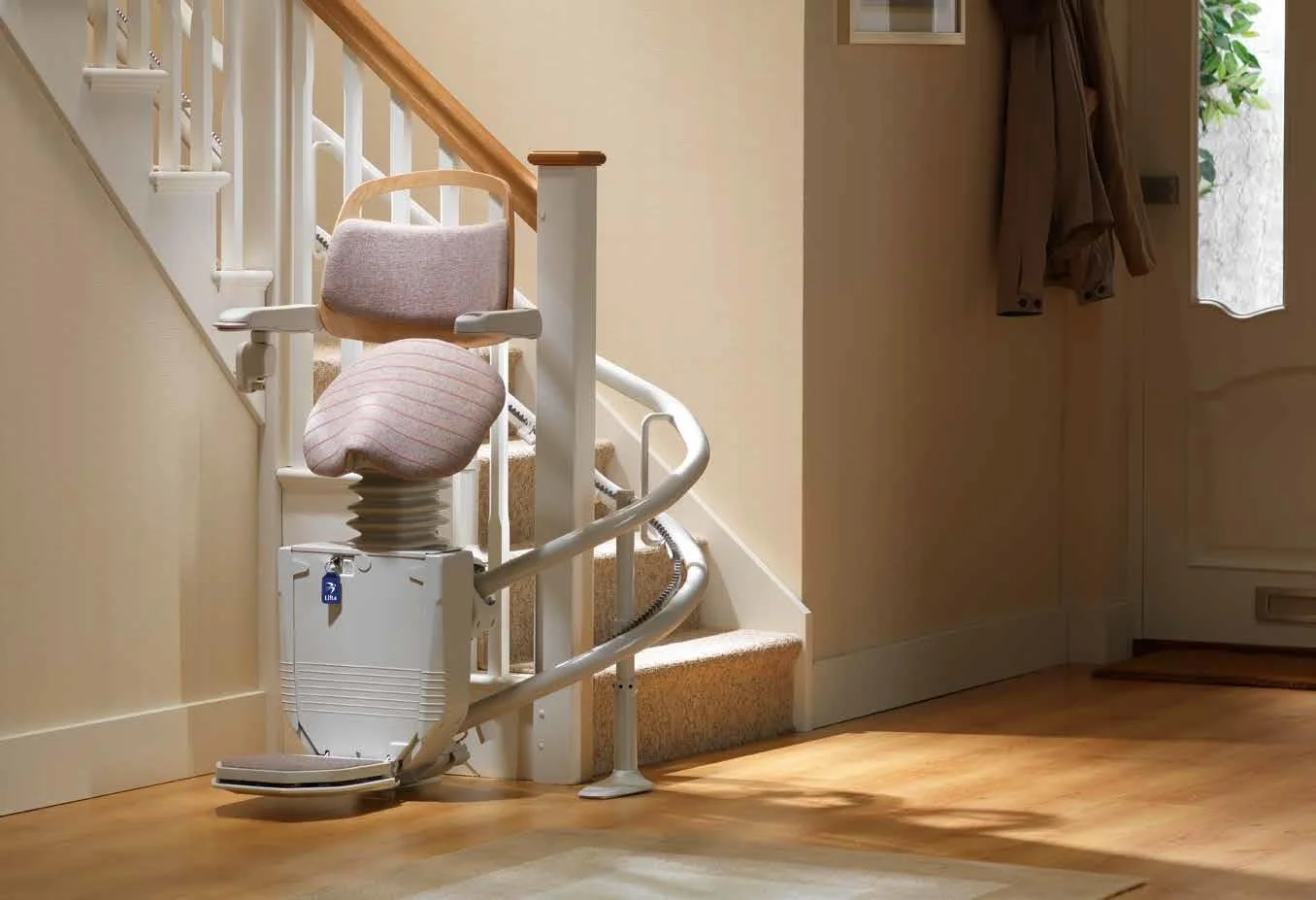
Older homes often have stairs with a landing or a turn partway up. Those need a curved lift, which runs on a rail shaped to that exact staircase. We measure each set of stairs before recommending one type over another.
The mining towns on the Iron Range have a stock of early-to-mid-20th-century company-era housing. Across the county you will also find single-family homes, townhouses, row houses, walk-up apartments and split-level homes.
Split-level homes and townhouses tend to have several short flights rather than one long one. Sometimes the answer is a lift on the one flight that matters most, such as the stairs to the bedroom. Where a wheelchair user needs to get up a few steps, a platform lift can be a better fit than a seat.
St. Louis County has 154,184 residents, and 19.4% are 65 or older. About 66.0% of households own their homes, which matters because most home-modification programs and grants are only open to owners.
This is the largest county in Minnesota, spanning 6,860 square miles with more than 500 lakes, including parts of the Superior National Forest and the Boundary Waters Canoe Area Wilderness. As of the 2020 census, 60.7% of residents lived in urban areas, mostly around Duluth, and 39.3% lived in rural areas.
That split shapes which programs reach you. Some home repair help, such as AEOA's program, serves the county outside Duluth city limits, while Duluth residents need to look elsewhere.
None of the programs below name stair lifts on their source pages, so treat each one as a question to ask, not a sure thing. Several do fund home modifications or accessibility repairs in general, which is the right category to ask about.
A good first call for adults 65 and older is the county's MnCHOICES intake line at (218) 726-2366. That assessment decides whether someone fits the Elderly Waiver or another home and community based program. The Arrowhead Area Agency on Aging at (218) 722-5545 serves people 60 and older and family caregivers.
Homeowners outside Duluth can ask AEOA about its rehabilitation loans. Veterans with qualifying service-connected disabilities should talk with the St. Louis County Veterans Service at (218) 725-5285 about the VA housing grants.
The St. Louis County Veterans Service office is at 4815 Burning Tree Road, Suite 100, Duluth 55811, and can be reached at (218) 725-5285.
The VA Specially Adapted Housing and Special Home Adaptation grants cover modifying a home for veterans with certain severe service-connected disabilities. The VA pages give ramps and doorway widening as examples and do not name stair lifts, so ask directly whether a lift can be part of the plan.
The county's intake line for people with physical disabilities, adults 65+ needing support, and people with disabilities, where a MnCHOICES assessment decides which waiver or program fits. The source page does not mention stair lifts or home modifications; call (218) 726-2366.
A Medicaid program for Minnesota residents 65+ who need a nursing facility level of care and meet income and asset limits; home modifications are a listed covered service, but stair lifts are not named. Apply through the county MnCHOICES intake or call (800) 333-2433.
Serves people 60 and older and family caregivers in the 7-county Arrowhead Region through meals, caregiver support, transportation and in-home services; the source page does not mention stair lifts or home modifications. Call (218) 722-5545.
Loans and grants for safety, livability, energy-efficiency and accessibility repairs for income-qualified owner-occupants, with ramps and bathroom modifications named as examples but not stair lifts; the city of Duluth is excluded. Call (218) 735-6819.
Up to $126,526 for FY 2026 to buy, build or modify a home for veterans with certain severe service-connected disabilities; stair lifts are not specifically named. No phone is listed on the source, so start with St. Louis County Veterans Service at (218) 725-5285.
Up to $25,350 for FY 2026 for home purchase or modification costs for veterans with specific service-connected disabilities; stair lifts are not specifically named. Ask St. Louis County Veterans Service at (218) 725-5285 for help applying.
Older adults
424 W. Superior Street, Suite 507, Duluth, 55802
Veterans
4815 Burning Tree Road, Suite 100, Duluth, 55811
Yes, outdoor stair lifts are made for exterior steps like the ones built into Duluth's hillside lots. We look at both the outside steps and the inside stairs, since many older multi-level homes there have both.
The Arrowhead Area Agency on Aging serves people 60 and older and family caregivers, at (218) 722-5545. The county MnCHOICES intake line, (218) 726-2366, also serves people with physical disabilities and adults and children with disabilities.
No. The AEOA Home Rehabilitation Program covers Cook, Itasca, Koochiching, Lake and St. Louis counties but excludes the city of Duluth. It is a good option for homeowners in places like Hibbing, Virginia or Ely.
For 2026, a single applicant's limits are $2,982 per month in income, $3,000 in assets and $752,000 in home equity. The program has limited slots, so a waitlist is possible.
Home modifications and specialized equipment are listed covered categories, but stair lifts are not named on the source. Ask about a lift during your MnCHOICES assessment through the county at (218) 726-2366.
Call St. Louis County Veterans Service at (218) 725-5285. They can tell you whether you qualify for the VA Specially Adapted Housing grant, up to $126,526, or the Special Home Adaptation grant, up to $25,350, for FY 2026.
Tell us about the stairs in your home and we will explain which lift fits, what it costs and how installation works.
