From two-story townhouses in Kendall and Doral to walk-up apartments in Hialeah and mid-rise condominiums along the coast in Miami Beach and Aventura, Miami-Dade has more multi-level living than most Florida counties. The ground here is flat, running from Biscayne Bay and the Atlantic out to the Everglades wetlands. The climbing happens indoors, on the stairs people use every day.
This hub covers the 69 towns of Miami-Dade County, including Miami, Homestead, Coral Gables, Cutler Bay, Palmetto Bay and Miami Gardens. Below you will find how local home styles shape the kind of stair lift that fits, and which programs to call about paying for one.
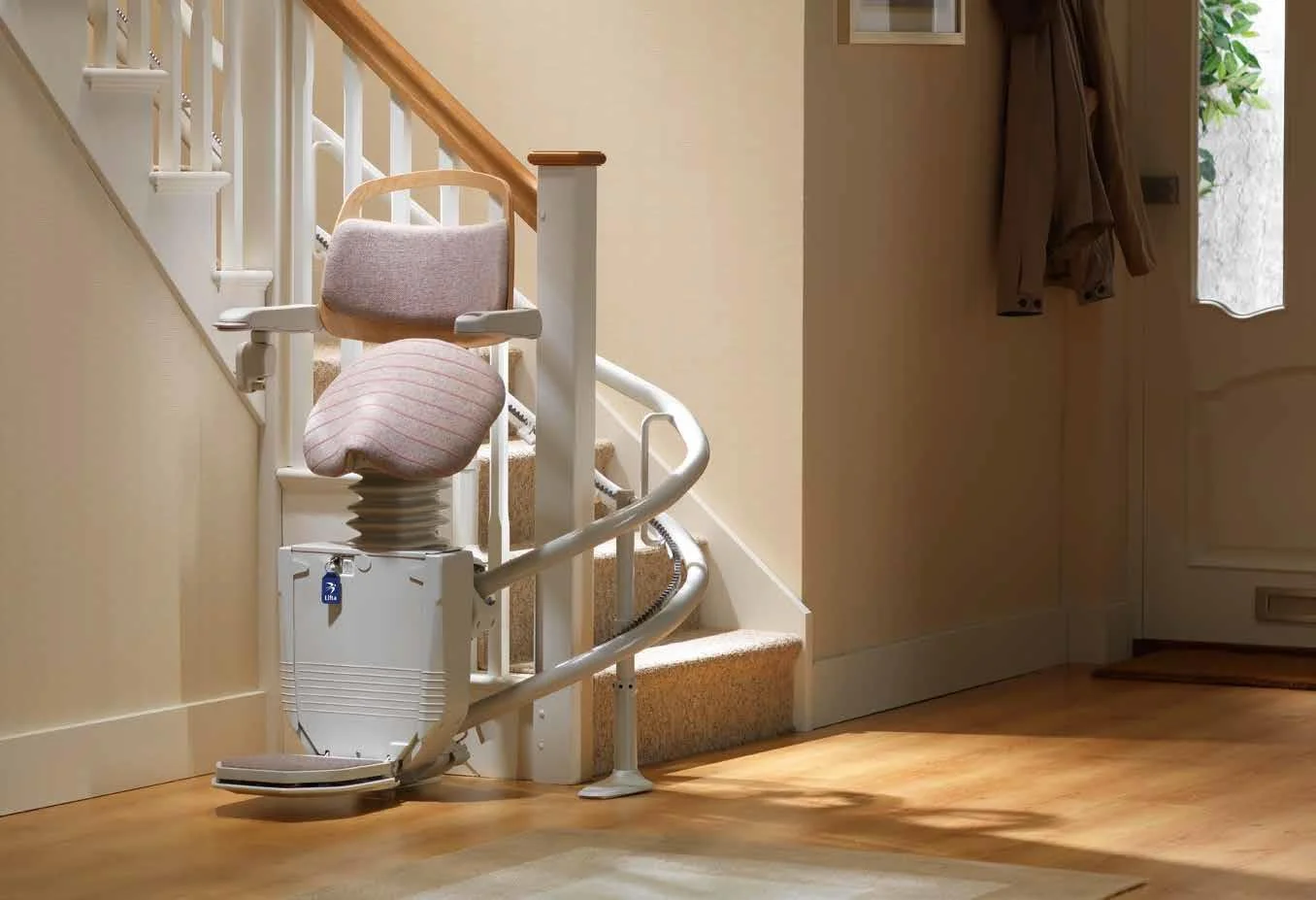
Much of the county's housing is two-story townhouses and multi-family buildings inland, with mid-rise and high-rise condominium towers along the coast and in the urban cores. A townhouse in The Hammocks or Kendale Lakes often has one straight run of stairs between floors. That is the simplest case: a straight stair lift rides a rail mounted to the treads, not the wall.
Stairs with a landing, a turn or a curve need a curved rail built to that staircase. It takes longer to make and install, so it helps to measure early. Single-family homes in places like Westchester, Coral Terrace or Miami Lakes can go either way, depending on how the stairs were built.
Walk-up apartments and low-rise buildings raise a different question. The stairs may belong to the building, not the unit, so a lift on a common stair or at an entry porch is a building decision as much as a personal one.
For those spots, a platform or porch lift can be the better fit than a seat on a rail, especially for someone who uses a wheelchair. Talk with the building's management before you schedule a home visit so everyone knows what will be mounted where.
About 17.0% of Miami-Dade residents are 65 or older, and roughly 52.3% of households own their home. Owners can usually install a lift on their own stairs without asking anyone. Renters should get the landlord's written approval first.
The Bruce W. Carter Department of Veterans Affairs Medical Center is in Miami, and the county's Veteran Services Program at 5400 NW 22nd Avenue, Miami, can be reached at (305) 756-2830.
No single program here promises to pay for a stair lift, so it pays to ask several. Florida Medicaid's long-term care plan decides chair lifts case by case in each person's care plan. The Home Care for the Elderly program and the Alliance for Aging both fund home accessibility modifications in general but do not name stair lifts.
Veterans should know that the VA HISA grant excludes stair lifts. A stair lift is pursued instead through VA Prosthetics as medical equipment, or through the Specially Adapted Housing or Special Home Adaptation grant for qualifying service-connected disabilities. Other statewide resources worth asking about include the FAAST New Horizon Loan Program and the Florida Homestead + Senior Additional Homestead Exemption.
A Medicaid managed-care benefit for adults 18+ who meet nursing-facility level of care; it lists items like grab bars, and whether a stair lift is approved is decided case by case in the care plan. Call (877) 711-3662.
A state program for people 60+ with an approved adult caregiver living in the home, paying a basic subsidy of $160/month plus special subsidies that can fund ramps and home accessibility modifications; stair lifts are not named. Call (800) 963-5337.
The local aging agency for Miami-Dade and Monroe residents, generally 60+, which coordinates in-home services and home modification and repair referrals; stair lifts are not listed by name. Call (305) 670-6500.
A lifetime VA grant of $6,800 or $2,000 for medically necessary home-access changes, but it does not cover stair lifts or porch and platform lifts. Veterans seek stair lifts through VA Prosthetics or the SAH or SHA grant instead.
Older adults
760 N.W. 107th Ave., Ste. 214, 2nd Floor, Miami, 33172
Veterans
5400 NW 22nd Avenue, Miami, 33142
Possibly, but the stairs usually belong to the building, so you need the landlord's or management's approval first. For a shared stair or entry, a platform or porch lift may be the better fit.
Not automatically. Under SMMC LTC, the Home Accessibility Adaptation service is approved case by case in your care plan. Call (877) 711-3662 to ask about your plan.
The SMMC LTC benefit is open to adults 18+ who meet Florida Medicaid financial rules and nursing-facility level of care. The HCE program and Alliance for Aging services are generally for people 60+.
No. HISA excludes stair lifts and porch or platform lifts. Ask about VA Prosthetics, or the SAH or SHA grant if you have a qualifying service-connected disability. The county Veteran Services Program is at (305) 756-2830.
Start with Alliance for Aging (PSA 11) at (305) 670-6500, 760 N.W. 107th Ave., Ste. 214, 2nd Floor, Miami 33172. They handle local intake for in-home and home modification help.
Yes. A stair with a turn or landing needs a curved rail made for that staircase, which takes longer than a straight lift. Have it measured early.
Tell us about the stairs in your home and we will explain which lift fits, what it costs and how installation works.
