Many houses in Parsons, Davis and Thomas went up during the lumber boom of the 1880s-1920s and the coal years that followed. A lot of them are older, multi-story homes set into hillsides, with the original interior stairway still in daily use.
That stairway is often where the trouble starts for an older owner. This page walks through how Tucker County homes and mountain terrain shape the choice of a stair lift, and which programs in Hendricks, Hambleton and the rest of the county may help with the cost.
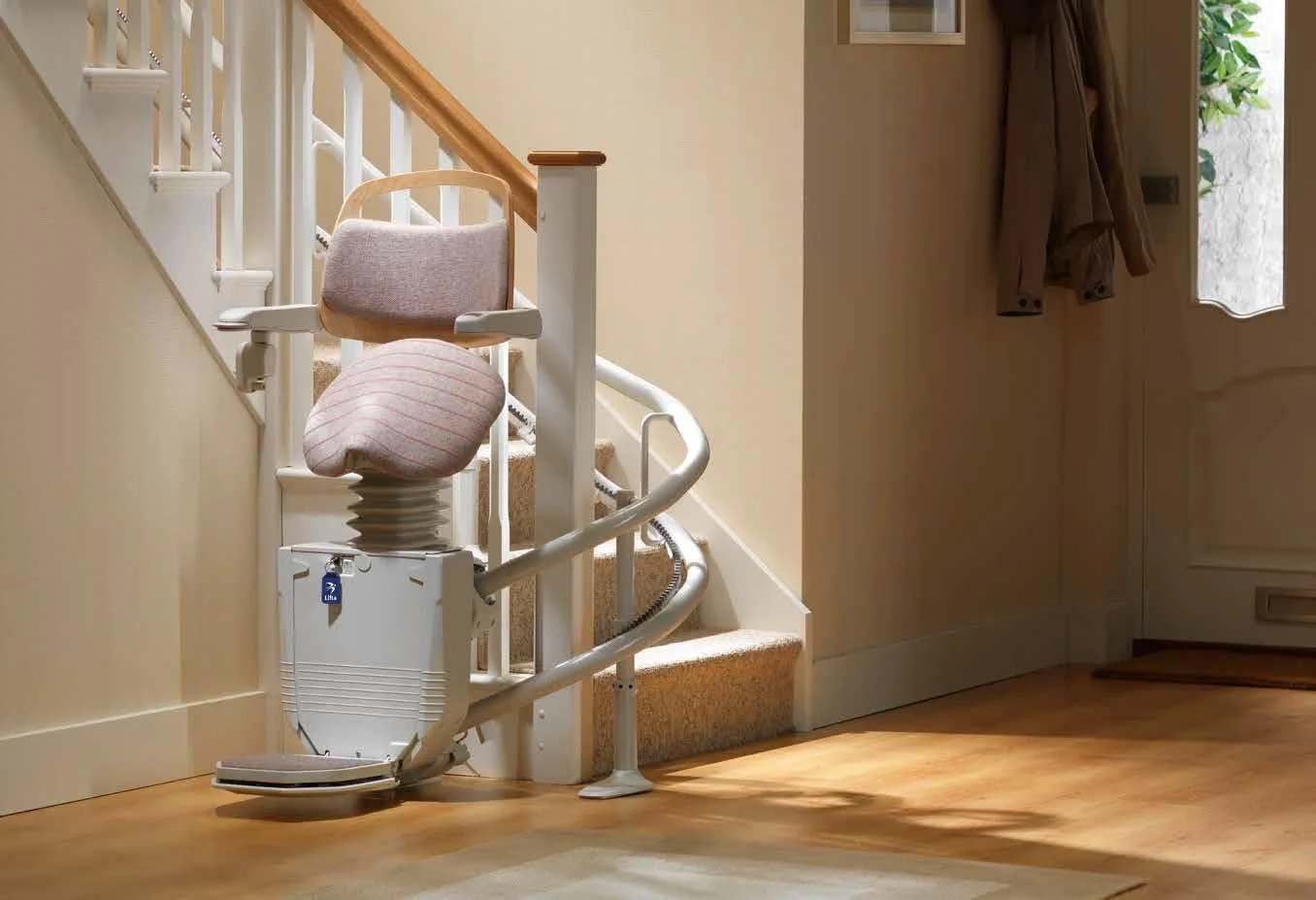
Tucker County's housing is mostly owner-occupied and aging, and the local record notes that original interior stairways are common here. That is different from newer suburbs, where single-story ranch construction is the norm. If the stairs run in one straight flight from bottom to top, a straight stair lift is usually the simplest fit.
Some older homes have a landing partway up or a turn near the top. Those stairways call for a curved lift with a rail built to follow the bends. We measure each run in person before recommending one or the other.
Split-level homes are common across the county, and they tend to have short flights between floors rather than one long staircase. A short straight lift can work well on each flight that gets used every day.
Ranch-style homes may only have steps down to a basement or up to the entry. In low-rise buildings, the stairs can be shared or outside the unit, so ask about who owns the stairway before planning an installation.
The county covers 421 square miles of some of the most rugged, high-elevation land in West Virginia, around Canaan Valley and Blackwater Falls. Homes built into a slope often have exterior steps between the driveway and the door. An outdoor stair lift is designed for that kind of run.
For someone who uses a wheelchair, a seat on a rail may not be enough. A platform lift carries the chair itself and is worth discussing if transferring to a seat is hard. Winter access to small, spread-out towns like Hambleton and Davis is a real factor, so plan visits and installation with the weather in mind.
About 28.8% of county residents are 65 or older, and 74.4% own their homes. For many families, that means a parent who wants to stay in a house they own, with stairs that have become hard to manage.
If that includes someone in your family, the VA programs below are worth a call, though one of them excludes stair lifts outright.
The median home value in Tucker County is $137,300, and the local record notes that household incomes here can make private payment for home modifications hard. None of the programs listed below names stair lifts as a covered item in its source material, and the VA HISA grant specifically excludes stair glides.
That does not mean the door is closed. The Aged and Disabled Waiver covers physical adaptations to a member's home case by case, and USDA Section 504 funds accessibility repairs for qualifying rural homeowners. Start with the agency on aging, ask directly whether a stair lift can be approved, and get any answer in writing before work begins.
A state Medicaid waiver for residents age 18 or older who need nursing-facility level of care; it funds Environmental Accessibility Adaptations to the home case by case, but its source does not mention stair lifts specifically. Call the Bureau of Senior Services at (304) 558-3317.
The regional intake and referral point for aging services, including the ADW waiver, across a 15-county area that includes Tucker County; its listed services do not mention stair lifts or home modifications. Call (304) 257-2448.
Loans up to $40,000 at 1% over 20 years, and grants up to $10,000 for very-low-income rural homeowners age 62 or older who cannot repay a loan; accessibility changes such as ramps are named, but stair lifts are not. Contact your local USDA Rural Development field office.
A VA grant of up to $6,800 or $2,000 for medically necessary home changes, but it explicitly excludes stair glides and porch lifts, so it does not pay for stair lifts. Call (800) 827-1000 for other VA options.
Grants for veterans with qualifying severe service-connected disabilities, up to $126,526 for SAH and $25,350 for SHA in FY2026; the source does not mention stair lifts. Call (800) 827-1000.
A nonprofit serving people with disabilities in Tucker and nearby counties with information, referral and advocacy rather than cash grants; no stair lift program is listed. Call (304) 636-0143.
Older adults
1948 Industrial Blvd., Suite 400, Morgantown, 26505
Veterans
2275 Beverly Pike, Elkins, 26241
Yes, in most cases. A curved stair lift uses a rail built to follow turns and landings. We measure the stairway in person to confirm the fit.
The Aged and Disabled Waiver approves home accessibility adaptations case by case, but its source does not name stair lifts. Call (304) 558-3317 or the Upper Potomac Area Agency on Aging at (304) 257-2448 and ask about your situation.
The HISA grant does not; it excludes stair glides. The SAH and SHA grants do not list stair lifts either, so ask the VA at (800) 827-1000 or the West Virginia Department of Veterans Assistance – Elkins Benefits Office at (304) 637-0235.
USDA Section 504 offers grants up to $10,000 to very-low-income rural owner-occupants age 62 or older, plus low-interest loans. The program names accessibility repairs but not stair lifts, so confirm with your local Rural Development field office.
An outdoor stair lift is built for exterior steps. If the person uses a wheelchair, a platform lift that carries the chair may be the better choice.
Tell us about the stairs in your home and we will explain which lift fits, what it costs and how installation works.
