In Midway Hills in Northwest Dallas, the 'Disney Streets' section was platted in the mid-1950s, with streets like Pinocchio Drive, Cinderella Lane, and Wonderland Trail. Traditional Ranch and Contemporary-style homes line those blocks, including a California ranch-style residence designed by Cliff May. That mix tells you a lot about the whole county: plenty of one-story ranches, plus a smaller number of split-level and two-story houses where stairs become a daily problem.
Dallas County spans 26 towns, from Dallas, Irving, and Garland to Highland Park, Seagoville, and Wilmer. The land is mostly flat North Texas Blackland Prairie, so the stairs that matter here are usually inside the house or at the front entry, not on a hillside. This page walks through which homes are good fits for a stair lift and where Dallas County residents can look for help with the cost.
Most homes in Dallas County come from postwar suburban building between 1945 and 1968. Many of those are single-story ranch layouts with no interior stairs at all, so a stair lift is not needed inside.
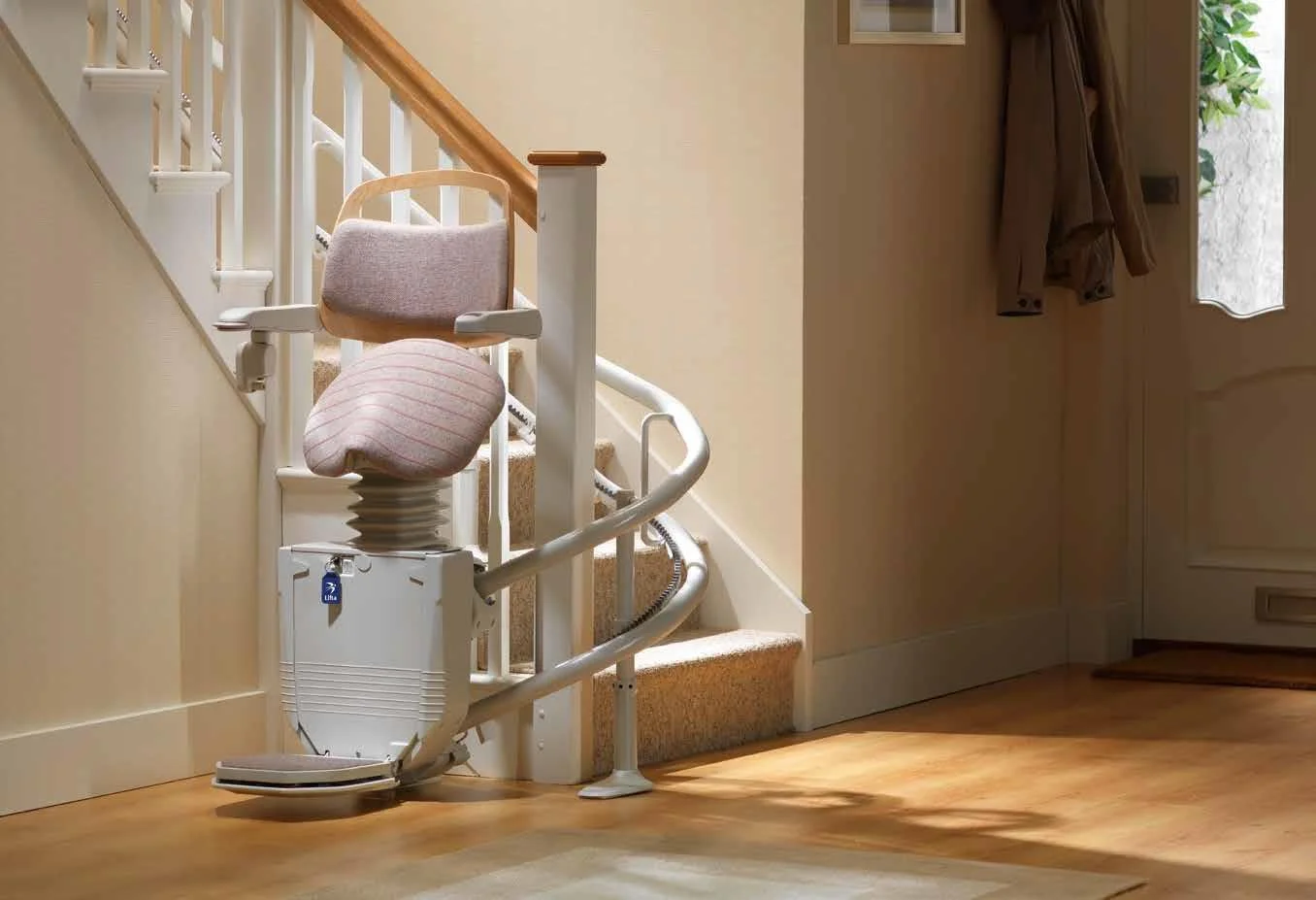
The split-levels and two-story designs from the same era are a different story. A split-level often has short runs of stairs between floors, and a two-story house has one full flight. A short, straight run is usually the simplest kind of stair lift to install, while a staircase with a landing or turn needs a curved rail built to fit.
Beyond single-family homes, the county has townhouses, walk-up apartments, and low-rise buildings. Townhouses often stack living space over two or three floors, which can mean more than one flight to cover.
In walk-up apartments and low-rise buildings, the stairs are often shared with neighbors. That usually means talking with the owner or property manager before anything is installed, and in some cases a platform lift or another option may fit better than a seat on a rail.
Because the terrain is largely flat, outdoor steps here are usually a few steps up to a porch or front door. For a short rise like that, an outdoor stair lift, a platform lift, or a ramp can all be on the table.
Weather matters for anything installed outside. Average August highs run near 93°F and December lows near 41°F, so an outdoor unit should be rated for heat and sun, and covered when not in use.
Dallas County is home to about 2,894,502 people, and about 11.5% are 65 or older. Roughly half of households own their home, which matters because most funding programs require you to own and live in the house.
The median home value was $303,000 in 2024. For many owners, that equity is tied up in the house while monthly income stays fixed, so it helps to check every program below before paying out of pocket.
The clearest source of coverage is the STAR+PLUS HCBS Waiver, which lists stair lifts and chair lifts under minor home modifications for enrolled members. The catch is the statewide interest list, so it is worth getting on it early.
Other local programs cover home repairs or accessibility work without naming stair lifts, so ask directly. The Dallas County AAA is at 1349 Empire Central, Suite 400, Dallas 75247, phone (214) 871-5065. Veterans can start with The Dallas County Veteran Services Office at 2377 N. Stemmons Freeway, Suite 631, Dallas 75207-2710, phone (972) 692-4939.
Other statewide programs to ask about include the Amy Young Barrier Removal Program (AYBR) and the Community Living Assistance and Support Services (CLASS) Waiver.
A Texas Medicaid waiver run by Texas Health and Human Services that covers stair lifts and chair lifts as minor home modifications for adults 65+ or adults with disabilities who qualify, with a statewide interest list. Apply through YourTexasBenefits.com or call (877) 438-5658.
Run by the Community Council of Greater Dallas for Dallas County residents 60+, it includes minor home repairs such as handrails, grab bars, and shower chairs; stair lifts are not listed. Call (888) 223-9509.
A forgivable loan of up to $24,000 for income-qualified owner-occupants inside Dallas city limits, covering major systems and accessibility repairs; stair lifts are not specifically named. Call (817) 494-0980.
A VA grant for medically needed home changes like entry ramps and accessible bathrooms, up to $6,800 or $2,000 lifetime depending on disability status. It does not cover stair lifts, since the VA excludes stair glides and porch lifts.
Grants for veterans with qualifying service-connected disabilities to buy, build, or adapt a home, with SAH up to $126,526 and SHA up to $25,350. Stair lifts are not specifically named, so ask the VA about your situation.
A nonprofit that builds wheelchair ramps for free with donated materials and labor; stair lifts are not mentioned. Request service online or call (214) 558-0339.
A Center for Independent Living with an office in Fort Worth that runs a Home Accessibility Program; the specific modifications are not itemized and stair lifts are not listed. Call (817) 870-9082 to ask whether they serve your address.
Loans up to $40,000 and grants up to $10,000 for very-low-income homeowners in USDA-eligible rural areas, with grants for those 62+; stair lifts are not specifically named. Most of urban Dallas County is not eligible, so check your address on the USDA property eligibility tool.
Older adults
1349 Empire Central, Suite 400, Dallas, 75247
Veterans
2377 N. Stemmons Freeway, Suite 631, Dallas, 75207-2710
It can through the STAR+PLUS HCBS Waiver, which covers stair lifts and chair lifts as minor home modifications for enrolled members. You have to qualify medically and financially and come off a statewide interest list first. Call (877) 438-5658 or apply at YourTexasBenefits.com.
STAR+PLUS also serves adults with disabilities who meet its rules, not just people 65 and older. The DAAA Care Coordination program starts at age 60 for Dallas County residents.
The HISA grant does not, because the VA excludes stair glides and other removable equipment. SAH and SHA grants do not name stair lifts either, so call The Dallas County Veteran Services Office at (972) 692-4939 to talk through options.
No. The City of Dallas HIPP program is only for owner-occupants within Dallas city limits. Check with the Dallas County AAA at (214) 871-5065 about programs that serve the wider county.
Only if your address is in a USDA-eligible rural area, and most of urban Dallas County is not. Look up your exact address on the USDA property eligibility tool before applying.
For a few entry steps, an outdoor lift, a platform lift, or a ramp may work. The Texas Ramp Project builds free wheelchair ramps in the Dallas region and can be reached at (214) 558-0339.
Tell us about the stairs in your home and we will explain which lift fits, what it costs and how installation works.
