From the Robert Mills courthouse in downtown Lancaster to the old mill-village streets tied to Springs Cotton Mills, Lancaster County has a lot of homes that were built long before anyone thought about accessibility. Add in houses in Kershaw, Heath Springs, Elgin, Van Wyck, Irwin, Unity and Buford, and you get a wide mix of staircases to work with.
This page walks through how the county's homes and ground affect which stair lift makes sense, and which state, federal and local programs may help with the cost. Some of those programs clearly cover stair lifts, some clearly do not, and several leave it unclear, so we spell out which is which.
Lancaster's downtown became a National Historic District in 1984, and Springs Cotton Mills, which opened in 1887, was the county's largest industry for many years. The worker housing and older homes from that era often have interior stairs and narrow doorways that were not built to modern accessibility standards.
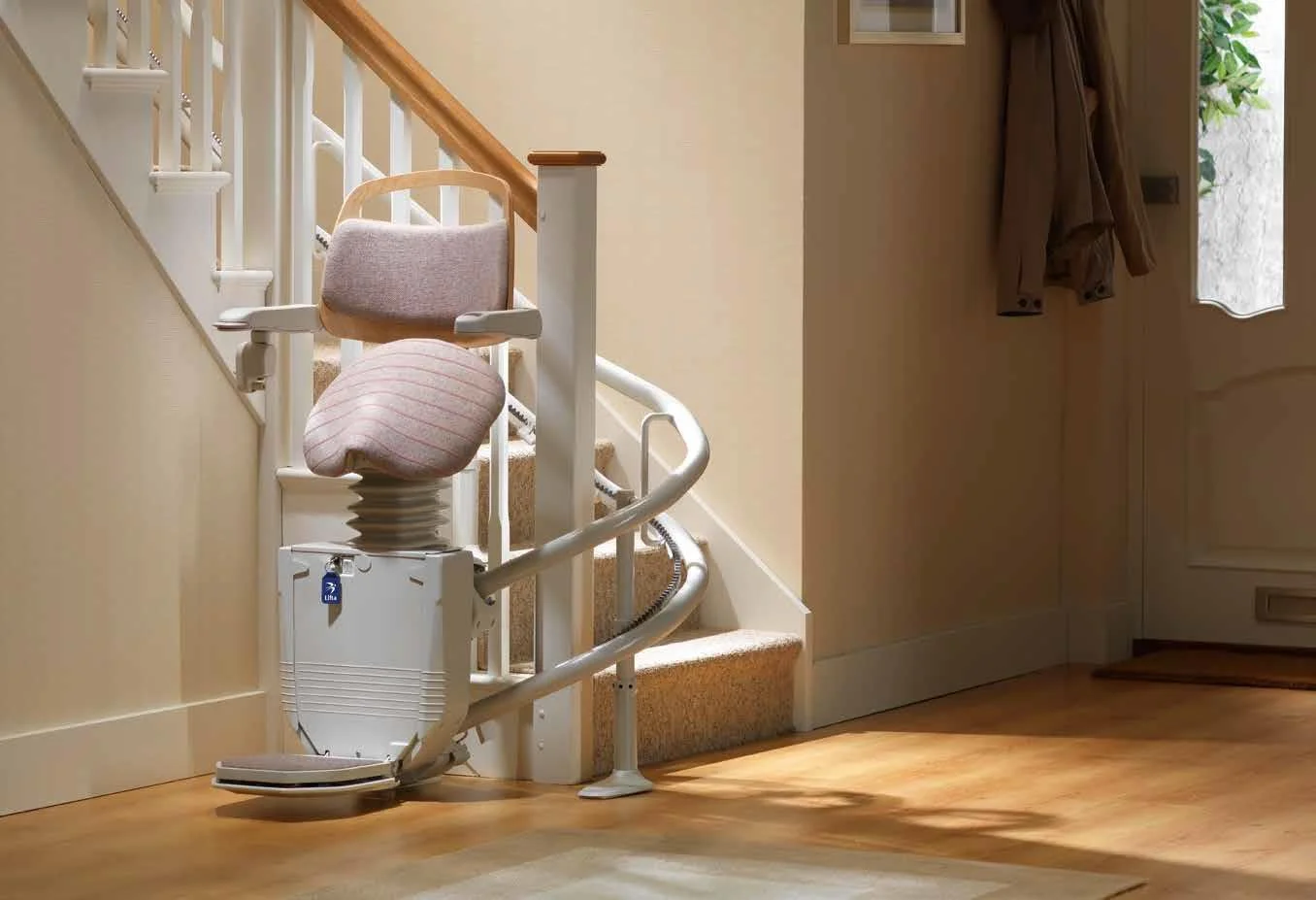
Narrow, steep or turning stairs are the main thing we look at in these houses. A straight staircase usually takes a straight rail, while a landing or a turn usually calls for a curved rail built to fit that exact staircase. Tight hallways at the top or bottom also matter, since the seat needs room to swivel so the rider can step off safely.
Across the county you will find single-family homes, detached houses, townhouses, walk-up apartments and split-level homes. Each one puts the stairs in a different spot in daily life.
Split-level homes tend to have more than one short flight between floors, so the choice is often between separate straight lifts or one curved rail that covers both. Townhouses usually stack bedrooms upstairs, which makes the stair the one route to bed and bath. In a walk-up apartment, the renter will need the owner's written approval before anything is mounted to the stairs.
Lancaster County covers about 549 square miles of South Carolina's Piedmont, between the Catawba River on the west and the Lynches River on the east. The ground rolls rather than sitting flat, so many homes have front or back steps up to a porch.
Households here rely heavily on their cars, with an average of 2 vehicles per household, so getting from the door to the driveway matters as much as getting upstairs. Outdoor stair lifts are built to handle weather on exterior steps. For someone who uses a wheelchair, a platform lift can carry the person and chair together where a seat lift will not work.
About 20.7% of residents are 65 or older, and the median age is 42.5 years, so many families are either planning for a parent or thinking ahead for themselves. Roughly 62.9% of households own their homes, which matters because several aid programs require the applicant to own and live in the house.
The VA has several housing grants, but they differ a lot on stair lifts, so it pays to check the specific program before counting on it. The county is also split between urban and rural, with 62.1% of residents in urban areas and 37.9% in rural areas, which affects who can use rural-only help.
The clearest public option is the South Carolina Community Choices Medicaid Waiver, which lists stair lifts among the home modifications it can cover for people who qualify. Enrollment is limited and waitlists may apply, so it is worth calling early.
For veterans, the VA HISA grant specifically excludes stair glides, and the larger SAH and SHA grants do not name stair lifts among their covered changes. The Lancaster County Veterans Affairs office at 1033 West Meeting Street in Lancaster, (803) 283-2469, is a good first stop to sort out which VA benefit fits.
Other programs below, including USDA Section 504 for rural homeowners and the SC Housing Trust Fund Home Repair Program, cover accessibility repairs but do not name stair lifts on the sources we reviewed. Ask each one directly whether a stair lift qualifies before you apply.
A Medicaid home and community care waiver for South Carolina residents 65 and older, or adults 18 to 64 with a physical disability, who need nursing-facility level of care; stair lifts are listed among covered environmental modifications per individual care plan. Call (888) 549-0820.
A VA grant of up to $6,800 or $2,000 lifetime for medically needed home changes for veterans with a qualifying disability. It does not cover stair lifts, which the VA classifies as excluded removable equipment along with porch lifts.
Up to $126,526 for FY2026 to buy, build or modify a permanent home for veterans with certain severe service-connected disabilities. Stair lifts are not listed among its examples, which include ramps and widened doorways.
SHA provides up to $25,350 for FY2026, and TRA helps eligible veterans adapt a family member's home they are temporarily living in. Stair lifts are not specifically named on the official page reviewed.
Loans up to $40,000 at 1% and grants up to $10,000 for very-low-income homeowners in eligible rural areas, with grants for those 62 and older; accessibility improvements are covered, but stair lifts are not specifically named. Call (803) 881-7080.
Awards grants to 501(c)(3) nonprofits, not to individual homeowners, and past grantee examples funded ramps, grab bars and banisters; stair lifts are not named and Lancaster County was not among listed past service areas. Call (800) 868-9095.
The area agency on aging for Chester, Lancaster, Union and York counties, serving adults 60 and older with caregiver help, Medicare counseling and information and referral; no stair lift funding is listed. Call (803) 329-9670.
Offers home-delivered meals, homemaker services, senior center programs and LARS transportation for county residents; no home modification or stair lift program is listed. Call (803) 285-6956.
Free short-term device loans and donated equipment such as wheelchairs and walkers for South Carolinians with disabilities in every county; stair lifts are not mentioned. Call (803) 935-5263.
Up to $25,000 per home for owner-occupied households at or below 80% of area median income with health, safety or accessibility needs, applied for through an approved nonprofit partner. Stair lifts are not specifically named, and Lancaster County participation is unconfirmed.
Older adults
2051 Ebenezer Road, Suite B, Rock Hill, 29732
Veterans
1033 West Meeting Street, Lancaster, 29720
It can through the Community Choices Medicaid Waiver, which lists stair lifts among covered home modifications for people who need nursing-facility level of care. Enrollment is limited and waitlists may apply. Call (888) 549-0820 to ask about applying.
No. The VA specifically excludes stair glides and porch lifts from HISA. The SAH and SHA grants do not name stair lifts either, so talk with Lancaster County Veterans Affairs at (803) 283-2469 about which benefits may apply.
The Community Choices Waiver accepts adults 18 to 64 who are physically disabled and at risk of nursing-home placement. The South Carolina Assistive Technology Program also serves people with disabilities of any age, though it focuses on smaller devices rather than stair lifts.
USDA Section 504 helps very-low-income homeowners in eligible rural areas with repairs and accessibility improvements, and its grants are for those 62 and older. Stair lifts are not specifically named, so ask directly at (803) 881-7080 and check whether your address is in an eligible area.
Its listed services are home-delivered meals, homemaker services, senior center programs and LARS transportation, with no stair lift or home modification program listed. You can still call (803) 285-6956 or the Catawba Area Agency on Aging at (803) 329-9670 for referrals.
Often, yes, but those homes need careful measuring because of tight stairs and narrow doorways. Straight stairs usually take a straight rail, while turns or landings usually need a curved rail made to fit.
Tell us about the stairs in your home and we will explain which lift fits, what it costs and how installation works.
