From Norwich in the Chenango River valley out to hamlets like Smyrna, Pharsalia and Lincklaen, much of Chenango County's housing was built between the late 1800s and the mid-1900s. Many of those houses are multi-story farmhouses on rolling, hilly ground, built long before anyone planned for aging in place.
That history shapes the stairs we see on home visits in the county's 23 towns: steep, narrow flights, turns at landings, and porch steps that take the brunt of Southern Tier winters. This page walks through which kind of stair lift tends to fit those homes, and which local and federal programs are worth a phone call before you pay out of pocket.
Norwich's oldest documented structure is a 1788 log cabin, and the city's population peaked in 1960. Around it, most settlements are small villages and hamlets surrounded by farmland, so a lot of the stairways here were built by hand, generations ago.
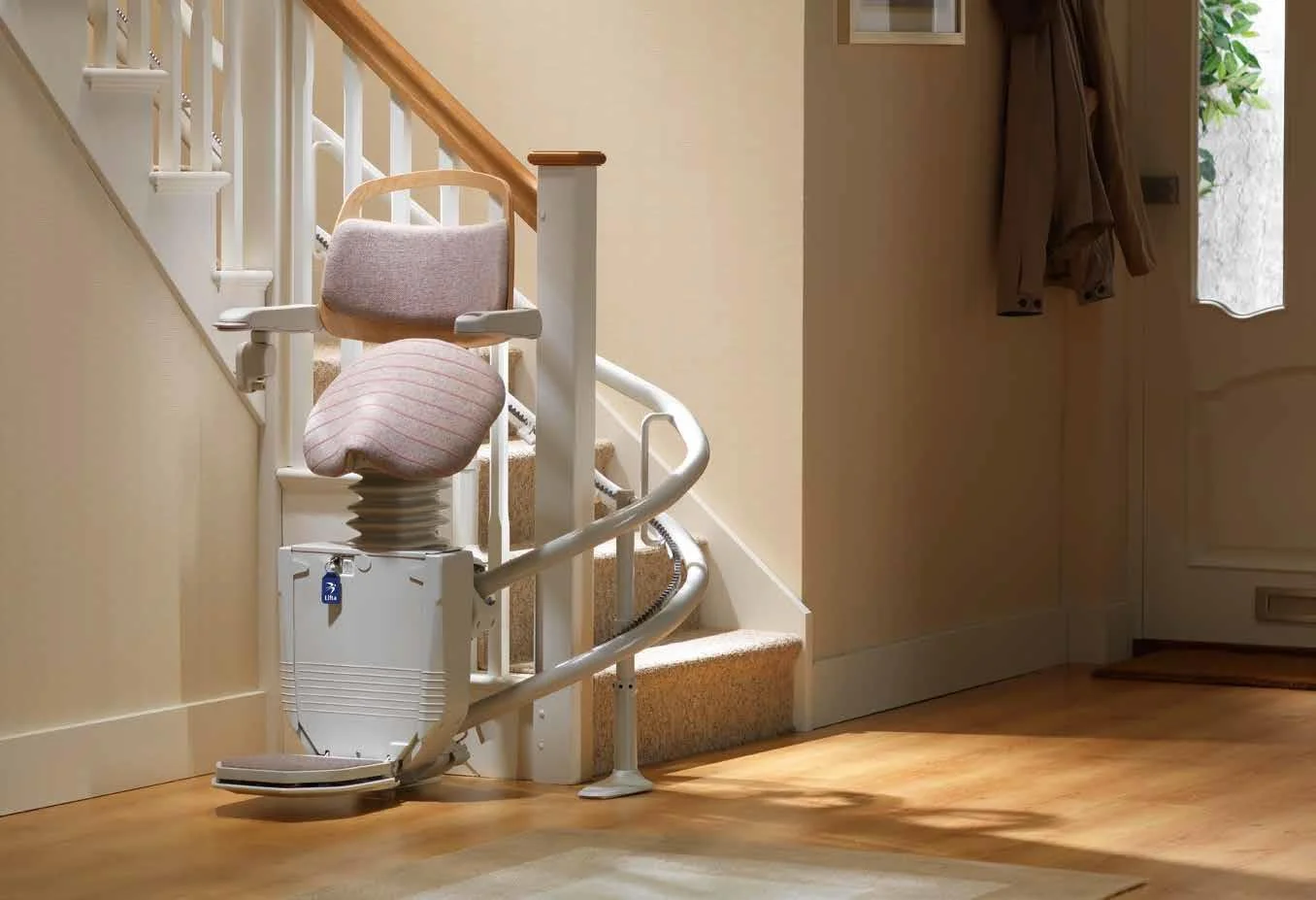
A straight staircase with no turns is usually the simplest and quickest install. Farmhouse stairs often change direction at a landing or wind near the top, and those need a curved lift with a rail built to the shape of that specific staircase.
Before quoting, we measure the width of the treads, the turns, and the space at the top and bottom. In older homes the clearance at the landing matters as much as the length of the flight.
Split-level homes are common here too. They have short flights between several floors, so the question is which flight the person uses every day, such as the one to the bedroom or the bathroom.
In walk-up apartments and low-rise buildings, the stairway is often shared. A renter should talk with the building owner before any work starts, since the rail attaches to the stair treads.
Norwich sits at 1,014 feet in a hilly river valley, and upstate winters add fall risk on outdoor approaches, not just inside the house. For many households the hardest steps are the ones from the driveway or porch to the front door.
An outdoor stair lift built for weather exposure can cover porch or deck steps. Where a wheelchair or walker has to come along, a platform lift may make more sense than a seat.
About 21.2 percent of Chenango County residents are 65 or older, and 75.3 percent of households own their home. Owning the house matters, because several of the funding programs below require the applicant to own and live in the home.
Veterans have their own set of benefits, but not every VA housing benefit pays for a stair lift, so it is worth knowing which one to ask about.
Household budgets here are often tight, so it is worth checking public and non-profit help first. For anyone 60 or older, the Chenango County AAA at 5 Court Street in Norwich is a good first call at (607) 337-1770.
Veterans can reach Veterans Services, also at 5 Court Street, at (607) 337-1775. Medicaid recipients and people with disabilities can ask the Southern Tier Independence Center about the NHTD waiver and other funding sources.
None of the programs below name stair lifts in the material we reviewed, and the VA HISA grant excludes them outright. Ask each office directly whether your request can be approved. Statewide programs such as the New York RESTORE Program may also be worth asking about.
A state program run by the county Office for the Aging for people 60 and older who need help with daily activities and are not eligible for equivalent Medicaid services; it can include home repairs and assistive devices, but stair lifts are not named. Call (607) 337-1770 to ask whether one could be part of an individual care plan.
A non-profit grant and loan program for low-to-moderate income homeowners that covers repairs such as heating, roofs, wiring and rotted steps, with priority for frail elderly or disabled residents; stair lifts and accessibility changes are not listed. Call the Chenango office at (607) 334-7114.
Federal 1% loans up to $40,000 and grants up to $10,000 for very-low-income homeowners age 62+, with a combined limit of $50,000, for owner-occupied homes in eligible rural areas; it funds accessibility work like ramps but does not name stair lifts. Most of Chenango County qualifies as rural, but check your address with USDA's online eligibility tool.
A lifetime VA grant of up to $6,800 or $2,000 for medically necessary fixed alterations such as roll-in showers, widened doorways and permanent ramps; it does not cover stair lifts. Apply through the Prosthetic and Sensory Aids Service at the Syracuse VA Medical Center.
VA grants of up to $126,526 (SAH) or $25,350 (SHA) for veterans with specific severe service-connected disabilities who own or will own the home; ramps and widened doorways are examples, but stair lifts are not listed. Chenango County Veterans Services can be reached at (607) 337-1775.
A New York Medicaid waiver for seniors and adults with physical disabilities who meet a nursing facility level of care but want to live at home; it lists environmental modifications such as ramps and bathrooms, but not stair lifts by name. Call (607) 724-2111 to confirm how applications are routed for Chenango County.
An independent living center program that lends assistive equipment and helps people with disabilities find funding for accessibility needs, with a satellite office covering Chenango County; stair lifts are not listed among loan items. Call (607) 724-2111.
Older adults
5 Court Street, Norwich, 13815
Veterans
5 Court Street, Norwich, 13815
Not through the HISA grant, which explicitly excludes stair glides and porch lifts. The SAH and SHA grants do not name stair lifts either, so call Veterans Services in Norwich at (607) 337-1775 to talk through what applies to you.
Yes, EISEP through the Chenango County Office for the Aging serves people 60 and older who need help with daily activities. It can include assistive devices, and you can ask about a stair lift at (607) 337-1770.
Usually, yes. Stairs that turn or wind need a curved stair lift, with a rail made to fit that staircase, so we measure the whole flight and the landing first.
Outdoor approaches are a real fall risk in Southern Tier winters. An outdoor stair lift or a platform lift can cover porch or deck steps, depending on whether the person walks or uses a wheelchair.
For some programs, yes. USDA Section 504 requires that you own and live in the home, and the VA SAH and SHA grants require ownership, while HISA allows a home you own or rent.
Its Home Rehabilitation Program lists repairs like heating, roofs, wiring and rotted steps, and it does not mention stair lifts. Call (607) 334-7114 if you have other repairs needed alongside the lift.
Tell us about the stairs in your home and we will explain which lift fits, what it costs and how installation works.
