Around Lake Waconia and the smaller lakes in the eastern part of Carver County, plenty of houses sit on sloped lots with walkout or lookout foundations. That usually means a main floor, a lower level that opens to the yard, and a staircase between them that gets harder to climb every year. Farther west, toward Norwood Young America, Mayer and Hamburg, you also find older small-town cores and rural farmsteads with their own steep basement and second-floor stairs.
This page walks through how the homes in Chaska, Chanhassen, Waconia, Victoria, Watertown and the rest of the county's 12 towns affect which stair lift makes sense. It also lists the county, state, nonprofit and VA programs that may help with the cost, and is clear about which ones say they cover stair lifts and which ones do not.
Carver County covers about 376 square miles of low rolling hills, with the Minnesota River along the southern border and the South Fork of the Crow River running through the western and central areas. Builders here have worked with the slope for decades, so walkout and lookout basements are common. For a stair lift, that often means one straight run from the main floor down to a finished lower level.
A straight staircase is the simplest and usually the quickest install. The rail mounts to the stair treads, not the wall, so most straight stairs can take a lift without remodeling.
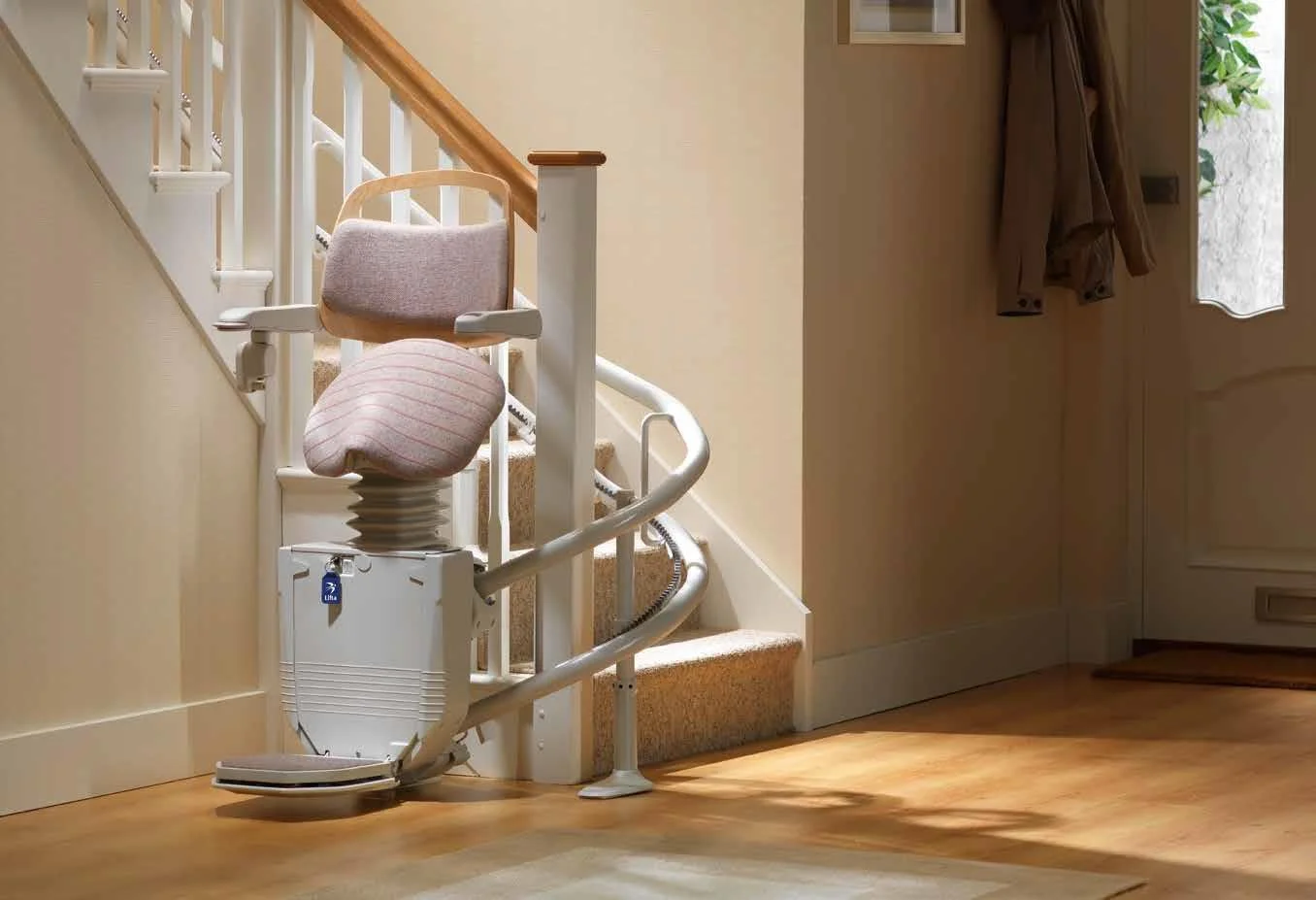
Split-level homes are different. You may have two short flights, one going up and one going down from the entry. Each flight can get its own straight lift, or a curved rail can be built to follow a turn or landing. We measure every step before recommending one or the other.
Newer suburban subdivisions in Chanhassen, Victoria and Chaska include a lot of townhouses. Many have narrow stairs with a turn at the top or bottom, which points toward a curved lift. If your townhouse has an association, check its rules before scheduling an install.
Walk-up apartments and low-rise buildings are a smaller share of the county's housing. About 80.7 percent of households here own their homes, but if you rent, you will need the owner's written permission before any rail goes in.
Older homes in the historic downtowns of towns like Carver, Cologne and New Germany often have steep, tight stairs to a second floor or basement. Those stairs need a careful look at width and headroom. For front steps or a raised entry, an outdoor lift or a vertical platform lift may fit better than an indoor chair lift.
About 13.2 percent of Carver County residents are 65 or older, and most of them live in single-family homes they own. That combination is why so many calls we get start with an adult child worried about a parent and the basement laundry or the upstairs bedroom.
Carver County Veteran Services is at 600 E. 4th Street in Chaska, and you can reach them at (952) 442-2323 to ask about VA housing grants before you commit to a purchase.
No single program here promises to pay for a stair lift. Several do fund home modifications in general, and it is worth asking each one directly whether a stair lift counts in your situation.
For people 65 and older who need a nursing-home level of care, the Minnesota Elderly Waiver lists home modifications as a covered service. Lower-income homeowners can look at the Carver County CDA deferred loan and the Rebuilding Together Minnesota Safe at Home program. Residents 60 and older can call the CAP Agency Chore Program for railings and grab bars, and veterans should start with Carver County Veteran Services.
Other statewide options to ask about include the Alternative Care (AC) Program, the Community Access for Disability Inclusion (CADI) Waiver and the Minnesota Housing Fix Up Loan (Accessibility Loan). The program list below has phone numbers and what each source says about stair lifts.
A Medicaid waiver for Minnesotans 65 and older who need a nursing facility level of care and meet the limits of $2,982 a month in income and $3,000 in assets for a single applicant; it lists home modifications as a covered service but does not say whether stair lifts qualify. Call the Senior LinkAge Line at (800) 333-2433 to start the county Long-Term Care Consultation.
Deferred loan financing for low-income homeowners who live in their home, used to fix health and safety concerns, with a lien that is forgiven over time; the source does not name stair lifts among eligible improvements. Call (952) 448-7715.
No-cost repairs and aging-in-place modifications, including mobility installations, for homeowners at or below 50 percent of area median income ($46,350 for one person, $53,000 for two in Carver County); stair lifts are not specifically named. The application window closed March 31, 2026 and reopens October 1, 2026; call (651) 776-4273.
Help for residents 60 and older on a sliding fee scale, including home modifications such as hand railings and shower grab bars; stair lifts are not covered. Call (612) 999-3939.
The agency that passes federal Older Americans Act funding to local providers serving people 60 and older in the seven-county metro, including Carver County; it does not list stair lift coverage itself. Call (651) 641-8612 to be pointed to local services.
A lifetime grant of up to $6,800 (or $2,000 in other cases) for medically necessary structural changes like entrance access and roll-in showers; the VA states that stair glides and porch lifts are not covered. Call Carver County Veteran Services at (952) 442-2323.
Grants for veterans with severe service-connected disabilities, up to $126,526 for SAH and $25,350 for SHA in FY2026, with ramps and wider doorways given as examples; stair lifts are not specifically named. Call Carver County Veteran Services at (952) 442-2323.
Older adults
2365 N. McKnight Rd., Suite 3, North St. Paul, 55109
Veterans
600 E. 4th Street, Chaska, 55318
Usually, yes. Walkout and lookout basements are common on Carver County's sloped and lakeside lots, and many have a single straight flight, which is the simplest kind of stair lift install.
The VA HISA grant specifically excludes stair glides and porch lifts. The SAH and SHA grants do not name stair lifts among covered uses, so call Carver County Veteran Services at (952) 442-2323 to ask about your case.
The Minnesota Elderly Waiver lists home modifications as a covered service but does not say which ones. You need to be 65 or older, need a nursing facility level of care and meet the income and asset limits. Call the Senior LinkAge Line at (800) 333-2433 to ask.
The CAP Agency Chore Program serves Carver County residents 60 and older on a sliding fee scale. It covers railings and grab bars but not stair lifts. You can reach it at (612) 999-3939, or call the Metropolitan Area Agency on Aging at (651) 641-8612 for other local options.
Its application window closed March 31, 2026 and reopens October 1, 2026. Homeowners at or below 50 percent of area median income can call (651) 776-4273.
Only with the property owner's written permission, since the rail is fastened to the stairs. Most of the county's funding programs listed here are also limited to homeowners who live in the home.
Tell us about the stairs in your home and we will explain which lift fits, what it costs and how installation works.
