Walk through the historic near-downtown neighborhoods of Ann Arbor, or the older streets of Ypsilanti, Saline, Chelsea, Dexter and Milan, and you will see a lot of pre-1960s multi-story houses. Most were built with an interior staircase and no primary bedroom on the ground floor. That layout is one of the most common reasons families in Washtenaw County start looking at a stair lift.
This page covers the homes and towns we see across the county, from Whitmore Lake and Manchester to Barton Hills, and what each kind of house means for a lift. It also lists the local, state and federal programs that may help with the cost, and is clear about which ones actually mention stair lifts.
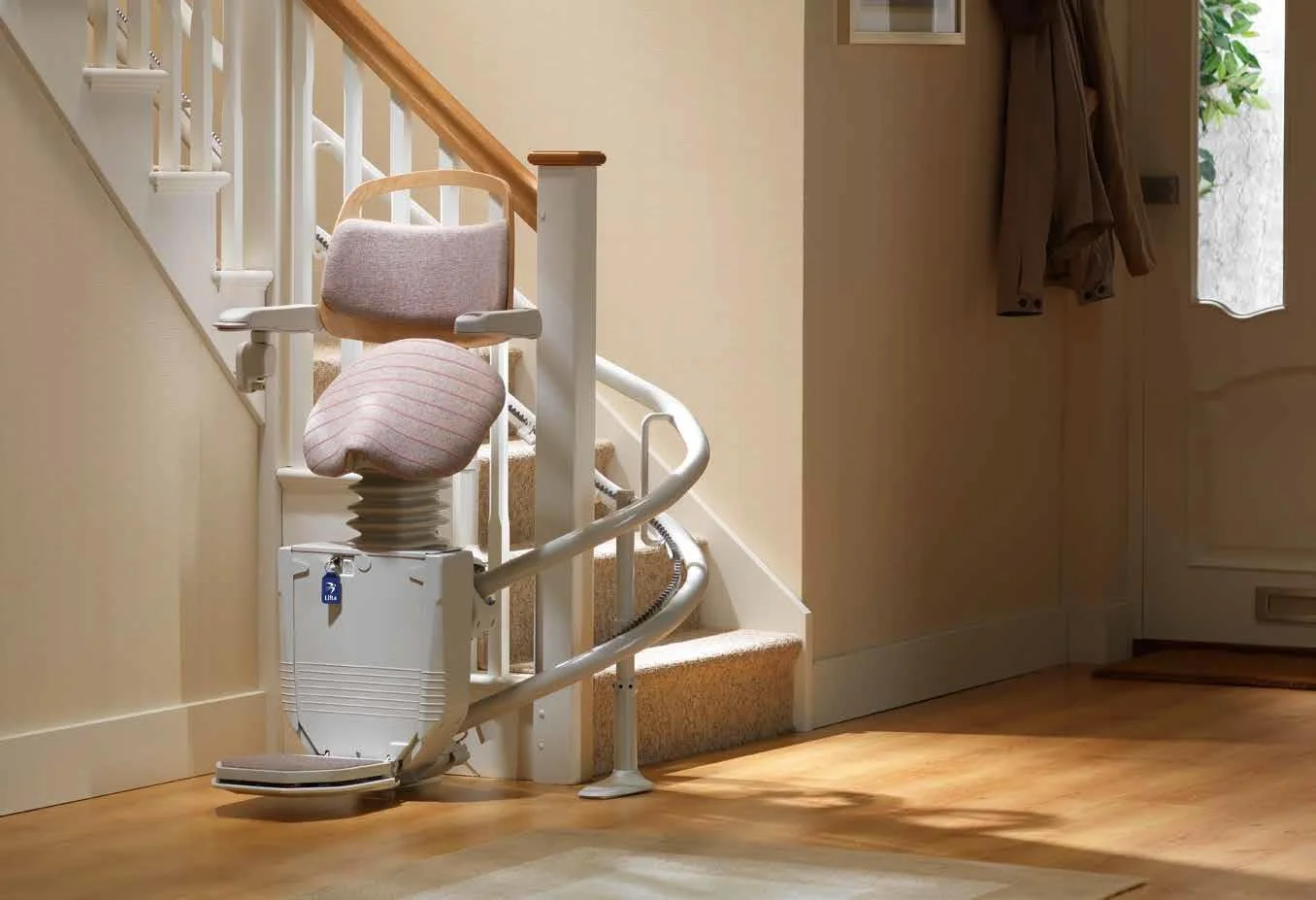
The county has 156,882 housing units, and a large share of the older ones are two-story homes where the bedrooms and full bath sit upstairs. When climbing those stairs gets hard, the choice is often a stair lift or moving out of a house someone has lived in for decades.
A straight staircase with no turns is the simplest case, and the rail can usually be measured and fitted quickly. Older homes sometimes have a turn, a landing partway up, or a narrow run, and those need a curved rail built to the exact shape of the stairs. We measure every staircase in person before quoting either type.
Not everyone in the county lives in a detached house. Townhouses, walk-up apartments and low-rise buildings are common too, especially around Ann Arbor and Ypsilanti, where about 82.8% of county residents live in urban areas.
Townhouses often have a straight interior flight, which suits a standard lift. In a walk-up or low-rise building the stairs are usually shared space, so a renter or condo owner needs permission from the owner or association before any rail goes in. Of the county's housing units, 60.3% are owner-occupied and 39.7% are renter-occupied, so this question comes up often.
Washtenaw County covers about 706 square miles, and 17.2% of residents live in rural areas and outlying townships. Homes out there may have porch or entry steps that matter as much as the inside staircase.
For outside steps, an outdoor-rated stair lift or a platform lift may be the better fit, depending on the number of steps and how the person gets around. Where you live in the county can also change which repair programs you qualify for, which we cover below.
Median household income is $83,754, but 15.3% of residents live below the poverty line.
That gap matters. Many older homeowners here rely on subsidized programs instead of paying out of pocket for accessibility equipment, so it is worth checking the programs below before deciding a lift is out of reach.
The program most likely to pay for a stair lift is the MI Choice Medicaid HCBS Waiver, which covers home modifications for people who qualify. AgeWays handles MI Choice intake for the county at (800) 852-7795.
Several county programs, including the Washtenaw County Home Rehabilitation Program and the Washtenaw County Accessibility Ramp Program, do not mention stair lifts. Jewish Family Services of Washtenaw County can help with maintaining a chair lift already in the home. For veterans, the VA HISA grant excludes stair glides, so call the Washtenaw County Department of Veterans Affairs at (734) 973-4540 to talk through other options.
Statewide programs to ask about include the MI Choice Waiver Program, MI Coordinated Health (formerly MI Health Link), the MSHDA Property Improvement Program (PIP) and VA Benefits for Veterans (HISA + Prosthetics). The Region 1B AAA in Southfield can be reached at (248) 357-2255.
A state Medicaid waiver for people 65+ or adults 18+ with a disability who need nursing-home level of care; it covers home modifications (environmental accessibility adaptations), which can include a stair lift case by case with prior authorization, at no cost once approved. 2026 limits are gross monthly income up to $2,982 and countable assets up to $9,950 (individual) or $14,910 (couple); call AgeWays at (800) 852-7795.
An in-home safety and assistive-technology program for adults 60+ that starts with a home safety assessment by an AgeWays-certified specialist. Its examples are small devices like motion-sensing lights and anti-slip mats, and stair lifts are not listed; call (800) 852-7795.
A HUD-funded home repair program for homeowners in the county's HUD Urban County area with income at or below 80% Area Median Income, roughly $74,800 for one person up to $141,000 for eight. Stair lifts are not listed among its sub-programs; call (734) 544-3008.
Installs exterior aluminum wheelchair ramps at no fee for owner-occupied homes where someone has a mobility need, with $50,000 a year in HUD funds for about 5-8 installations chosen by lottery. Stair lifts are not listed; call (734) 544-6748.
A grant of up to $5,000 per household for low-income senior homeowners in the county, and its approved work list includes maintaining a chair lift or stair climber already in the home, at JFS's discretion. It is not confirmed to fund a new stair lift installation; call (734) 769-0209.
Federal repair loans up to $40,000 at 1% and grants up to $10,000 for very-low-income homeowners 62+ in USDA-designated rural areas, so outlying townships may qualify while Ann Arbor's urban core may not. Stair lifts and accessibility work are not specifically listed.
A VA grant for home changes with a lifetime maximum of $6,800 or $2,000 depending on the disability, requiring a VA physician referral. It does not cover stair lifts, since stair glides and porch lifts are excluded.
Grants for veterans with specific severe service-connected disabilities, up to $126,526 (SAH) or $25,350 (SHA) for 2026, usable to buy, build or modify a home. Stair lifts are not listed; the Washtenaw County Department of Veterans Affairs is at (734) 973-4540.
Older adults
29508 Southfield Rd., Suite 100, Southfield, 48076
Veterans
2155 Hogback Road, Ann Arbor, 48105
Possibly, through the MI Choice Medicaid HCBS Waiver. It covers home modifications for people who need nursing-home level of care, and stair lifts are approved case by case with prior authorization. Call AgeWays at (800) 852-7795 to start intake.
No. The Washtenaw County Accessibility Ramp Program installs exterior aluminum wheelchair ramps, and stair lifts are not listed. If outside steps are the main problem, it may still be worth calling (734) 544-6748.
No. HISA excludes removable equipment such as stair glides and porch lifts. The Washtenaw County Department of Veterans Affairs at (734) 973-4540 can help review other VA benefits.
USDA Section 504 repair loans and grants are limited to USDA-designated rural areas, and outlying townships may qualify while Ann Arbor's urban core may not. Eligibility is checked by address, and stair lifts are not specifically listed.
The AgeWays Adaptive Wellness Program serves adults 60+ living at home in the county and starts with a home safety assessment. Its listed devices are smaller items rather than stair lifts. Call (800) 852-7795.
Yes, stairs with a turn or landing use a curved rail made to fit that staircase. Many of the pre-1960s homes near downtown Ann Arbor have layouts like this, so we measure in person before giving a quote.
Tell us about the stairs in your home and we will explain which lift fits, what it costs and how installation works.
