From the Village of Kalkaska out to Rapid City, South Boardman, Manistee Lake and Bear Lake, most homes in Kalkaska County sit on their own rural parcels rather than in tight subdivisions. The Village of Kalkaska is the only incorporated municipality, and the rest of the county is rural townships, with much of the land taken up by the Pere Marquette State Forest and marshland.
That spread-out pattern shapes how a stair lift job goes here. Staircases vary from house to house, winters are hard on outdoor steps, and getting to a home can mean a long drive. This page walks through what local homes usually need and which programs can help with the cost.
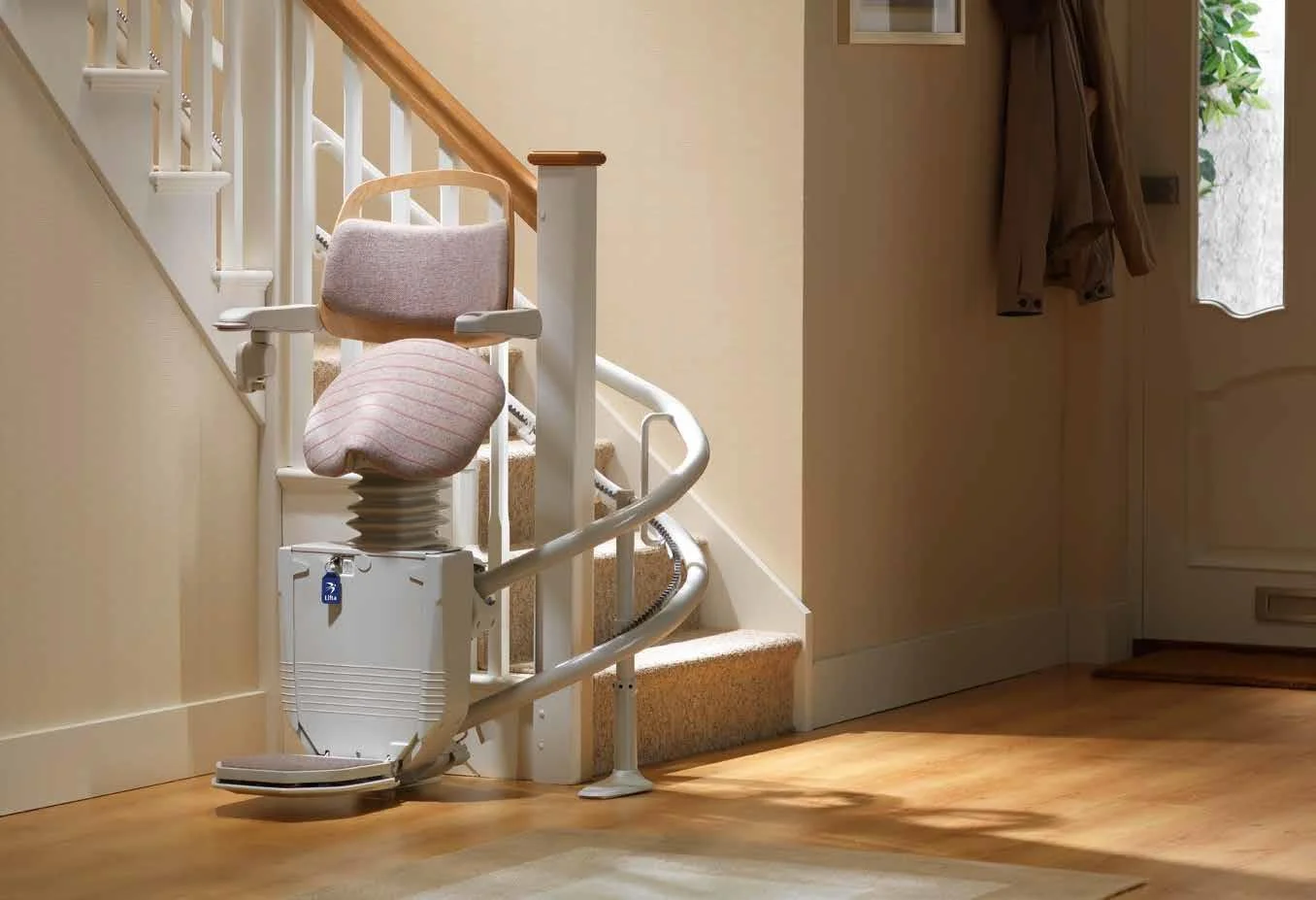
The housing here is mostly single-family and owner-occupied: detached houses, ranch-style homes and split-level homes, with some walk-up apartments. Each of these puts the stairs in a different spot, so the right lift depends on the house in front of us.
A ranch-style home often has just one staircase, usually down to a basement. If that flight runs straight with no turns or landings, a straight stair lift is the simplest and most common fit.
Split-level homes are different. They tend to have short flights between levels, sometimes with a turn, so the choice comes down to which level matters most and whether one curved rail or separate straight lifts makes more sense.
Kalkaska County covers 560 square miles, and elevation runs from 595 feet to about 1,246 feet. That is uneven ground for this part of the northern Lower Peninsula, and it often means homes with porch steps, sloped yards or a raised entry.
When the problem is getting into the house rather than moving between floors, an outdoor stair lift or a platform lift may be worth looking at. Michigan winters complicate exterior access, so snow, ice and how the steps are covered all belong in the conversation before choosing equipment.
About 24.6% of residents are 65 or older, so a lot of households are already thinking about how long the stairs will work for them. For many, the house is paid for or close to it, and staying put is the goal.
If that includes someone in your family, the Kalkaska County Veterans Affairs office at 303 S. Coral Street, P.O. Box 1204, Kalkaska 49646 can explain what VA housing help applies. Their phone is (231) 258-3370.
Median household income in the county is $68,578, and many older homeowners have more equity in the house than cash in the bank. That makes loans and assistance programs worth checking before paying the full cost out of pocket.
The Michigan Assistive Technology Program (MATP) Loan Fund is the one program on our list whose source names stair lifts directly, with loans up to $30,000 and repayment terms up to 7 years. Other options, like MI Choice and USDA Section 504, cover home repairs or modifications but their sources do not name stair lifts, so ask before you count on them.
A good first call is the Kalkaska Commission on Aging at (231) 258-5030 or the Area Agency on Aging of Northwest Michigan at (231) 947-8920. Statewide, you may also hear about the MSHDA Property Improvement Program (PIP) and MI Coordinated Health (formerly MI Health Link).
A Medicaid waiver for Michigan residents 65 and older, or 18 and older with a qualifying disability, who need a nursing facility level of care; home modifications are funded per individual care plan, but the source does not mention stair lifts. Call (800) 442-1713.
A low-interest loan of up to $30,000 with a fixed rate and terms up to 7 years for Michigan seniors and residents with a disability, and stair lifts are listed as eligible. Call (800) 292-4200.
A VA grant with a $6,800 or $2,000 lifetime maximum for home alterations prescribed by a VA physician, but stair glides are specifically excluded. Call (231) 258-3300.
Grants for veterans with certain severe service-connected disabilities to create a barrier-free home; the source does not mention stair lifts. Call (231) 258-3300.
Loans up to $40,000 at a fixed 1% and grants up to $10,000 for homeowners 62 and older with low incomes in rural areas like Kalkaska County; ramps and grab bars are listed, but stair lifts are not named.
A local equipment loan closet for older and disabled residents, not a cash grant, and stair lifts are not listed; it is a useful place to start for referrals. Call (231) 258-5030.
Information, referral and care management for older adults and caregivers in a 10-county region that includes Kalkaska; it does not list stair lift funding itself but connects people to MI Choice. Call (231) 947-8920.
Older adults
1609 Park Drive, Traverse City, 49686
Veterans
303 S. Coral Street, P.O. Box 1204, Kalkaska, 49646
Often, yes. Many ranch-style homes have a single flight to the basement, and if it runs straight without turns or landings, a straight lift is usually the fit.
Split-level homes have short flights between levels, sometimes with turns. We look at which levels you need to reach and whether a curved rail or more than one straight lift makes sense.
No. The HISA source specifically excludes stair glides. Veterans can call (231) 258-3300 or the Kalkaska County Veterans Affairs office at (231) 258-3370 to ask about SAH and SHA grants instead.
Yes. The Michigan Assistive Technology Program (MATP) Loan Fund lists stair lifts as eligible, with loans up to $30,000 and terms up to 7 years. Call (800) 292-4200.
MI Choice is open to people 18 and older with a qualifying disability, and the MATP Loan Fund is open to Michigan residents with a disability. The Kalkaska Commission on Aging serves many programs starting at age 60.
Outdoor access is harder here because of the hilly ground and harsh winters. We look at your entry steps, exposure and covering before recommending an outdoor stair lift or a platform lift.
Tell us about the stairs in your home and we will explain which lift fits, what it costs and how installation works.
