Marion County and the City of Indianapolis have shared one government since Unigov in 1970. Within it sit excluded cities like Beech Grove, Lawrence and Southport, the town of Speedway, and small included towns such as Clermont, Rocky Ripple and Wynnedale. Across all of them, the homes we are asked about tend to share one trait: the stairway is the only way upstairs.
Many older two-story houses in center-township neighborhoods and inner-ring suburbs were built before single-story ranches became the norm. If a parent's bedroom or only full bath is on the second floor, a stair lift is often the simplest way to keep using the whole house. This page covers how local homes fit the different lift types and which programs in Marion County may help with the cost.
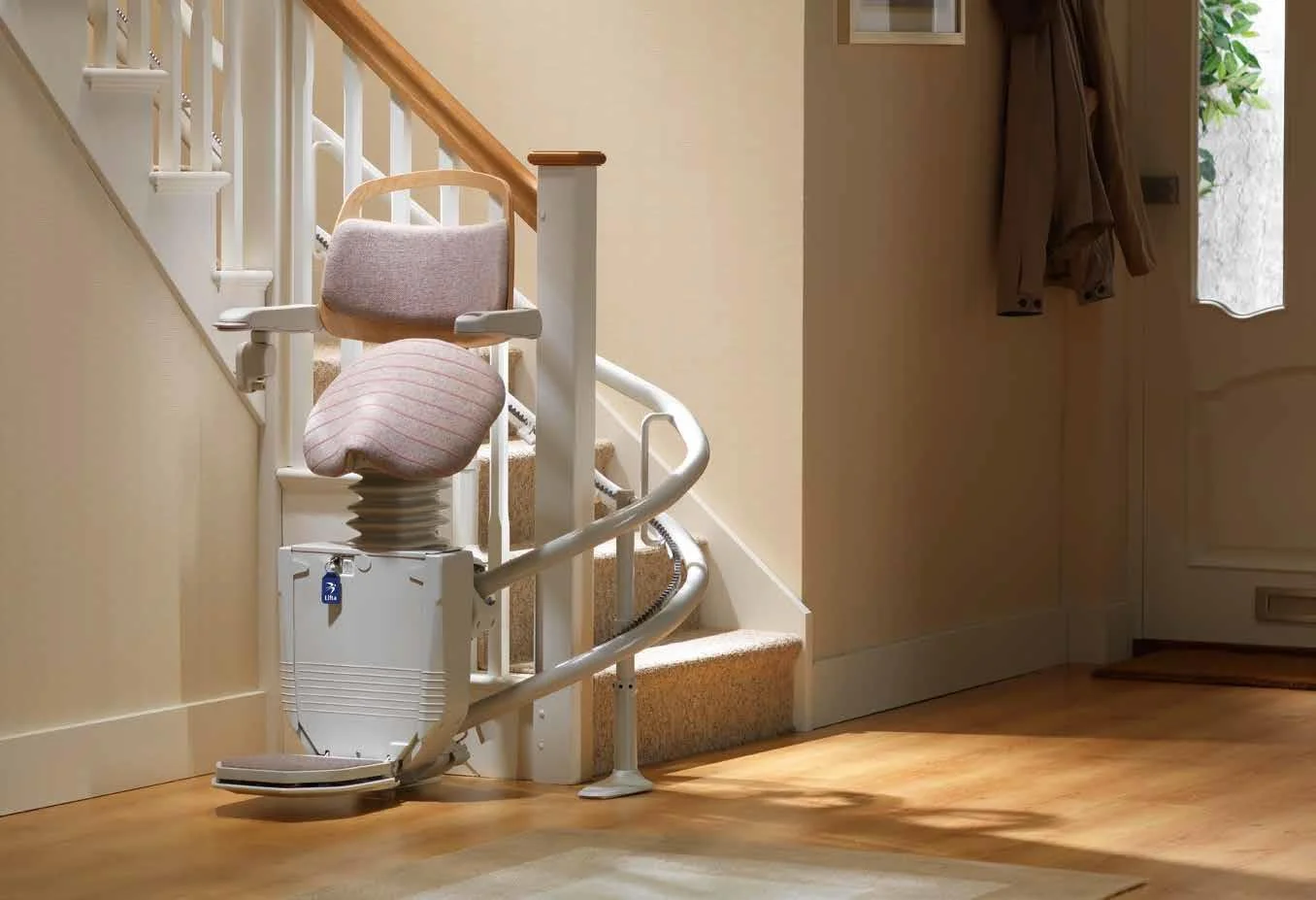
The county's housing runs from single-family homes and detached houses to townhouses, row houses and walk-up apartments. In a detached two-story house with a straight run of stairs, a straight stair lift is usually the most direct fit. It mounts to the stair treads, not the wall, so plaster walls in older houses are not a problem.
Stairs that turn at a landing or wind around a corner need a curved lift, built to follow that specific staircase. Townhouses and row houses often have narrow, steep stairs, so we measure width and headroom closely before recommending a model.
Some homes have steps up to the front door or down into a basement from outside. An outdoor lift is built for weather, and a platform lift can serve a wheelchair user where a seat would not work.
About 55.9% of Marion County households own their home, which is below the national average. Owners can generally decide on a stair lift for themselves. Renters usually need the landlord's agreement before anything is attached to the stairs.
Several local repair programs listed below only serve owner-occupied homes. If your parent rents, ask the landlord first, then ask CICOA which options apply.
Age matters for funding: some programs start at 60, and one local nonprofit starts at 62.
Veterans have their own channels through Roudebush VA Medical Center and the Marion County Office of Veteran Services at (317) 327-8387. Be aware that the VA HISA grant specifically excludes stair glides, so it will not pay for a stair lift.
No program on this page names stair lifts as a covered item. Several do cover home modifications in general, which means a stair lift may be requested and decided case by case.
The best first call is CICOA Aging & In-Home Solutions at (317) 254-5465. CICOA is the county's Area Agency on Aging, and its counselors can check eligibility for the PathWays for Aging waiver and the CHOICE program. Under PathWays, a request goes through a physician-supported plan of care with the assigned Managed Care Entities (Anthem, Humana, UnitedHealthcare).
Lower-income homeowners can also look at the City of Indianapolis Owner-Occupied Home Repair Program and Home Repairs for Good. Statewide, the INDATA Alternative Financing Program (AFP) is another option worth asking about.
A Medicaid waiver for people 60 and older who meet nursing-facility level of care; it covers home modifications, but stair lifts are not listed by name and would be reviewed case by case. Apply through CICOA at (317) 254-5465.
Marion County's Area Agency on Aging offers free counseling that connects residents to Medicaid waivers, CHOICE and modification referrals such as Safe at Home; stair lifts are not named in its materials. Call (317) 254-5465.
A state-funded, non-Medicaid program for people 60 and older or with a disability that lists environmental modification as a service, without naming stair lifts. Call (800) 986-3505.
A VA grant of up to $6,800 or $2,000 for permanent home alterations; it does not cover stair lifts, as stair glides are explicitly excluded. Call (800) 827-1000.
VA grants of up to $126,526 (SAH) or $25,350 (SHA) for veterans who own their home and have qualifying severe service-connected disabilities; stair lifts are not specifically named. Call (800) 827-1000.
Free repairs for homeowners 62 and older or with a disability, at or below 150% of the Federal Poverty Line, mainly inside the I-465 loop; it lists ramps, handrails and grab bars but not stair lifts. Call (317) 286-2740.
A no-repayment grant for owner-occupied homes with income at or below 80% of HUD Area Median Income; accessibility repairs are eligible, but stair lifts are not listed specifically. Call (317) 327-4663.
A center serving people with any disability in Marion County with referral, advocacy and peer counseling rather than funding; it does not list stair lifts. Call (317) 926-1660.
Older adults
8440 Woodfield Crossing Blvd., Ste. 175, Indianapolis, 46240
Veterans
200 East Washington Street, Suite 2141, Indianapolis, 46204
The PathWays for Aging waiver covers home modifications for people 60 and older who meet nursing-facility level of care. Stair lifts are not named, so a request would go through a physician-supported plan of care and be decided case by case. Start with CICOA at (317) 254-5465.
Since July 1, 2024, adults under 60 are served by the Health & Wellness Waiver. The CHOICE program also accepts people with a disability at any age. Home Repairs for Good serves homeowners with a disability as well as those 62 and older.
The HISA grant does not; its rules exclude stair glides. The SAH and SHA grants cover home adaptations for qualifying severe disabilities but do not name stair lifts. Call the Marion County Office of Veteran Services at (317) 327-8387 or the VA at (800) 827-1000.
In most cases, yes. A straight lift fits a single straight flight, and a curved lift is made for stairs with a landing or turn. The lift attaches to the stair treads, so older walls are not an issue.
Rural programs like USDA Section 504 more often reach the surrounding counties than Marion County, which is almost fully urban. City and nonprofit programs are usually a better fit here.
Tell us about the stairs in your home and we will explain which lift fits, what it costs and how installation works.
