DeKalb County covers 779 square miles, and most of it is country. In the 2020 census, 88.3% of residents lived in rural areas, spread across 15 towns from Fort Payne and Rainsville to Henagar, Fyffe, Valley Head and Mentone. Homes here sit far apart, and a trip to the county seat can take a while.
That spread matters when stairs get hard. Fort Payne, the 'Sock Capital of the World,' is the hub for services, but many families live well outside it. A stair lift lets a parent keep using the whole house without moving, and this page explains which lift fits which home and where DeKalb County residents can look for help paying for one.
About 18.3% of DeKalb County's 36,078 residents are 65 or older, and 71.3% of households own their home. Those are the people most likely to stay put and adapt the house they already have.
If someone in your family served, the VA section below is worth reading closely, because one VA grant explicitly rules out stair lifts and another does not name them either way.
Most homes in the county are single-family homes, and a straight staircase in one of these usually takes a straight-rail lift. That is the simplest install and the one we can often finish in a single visit.
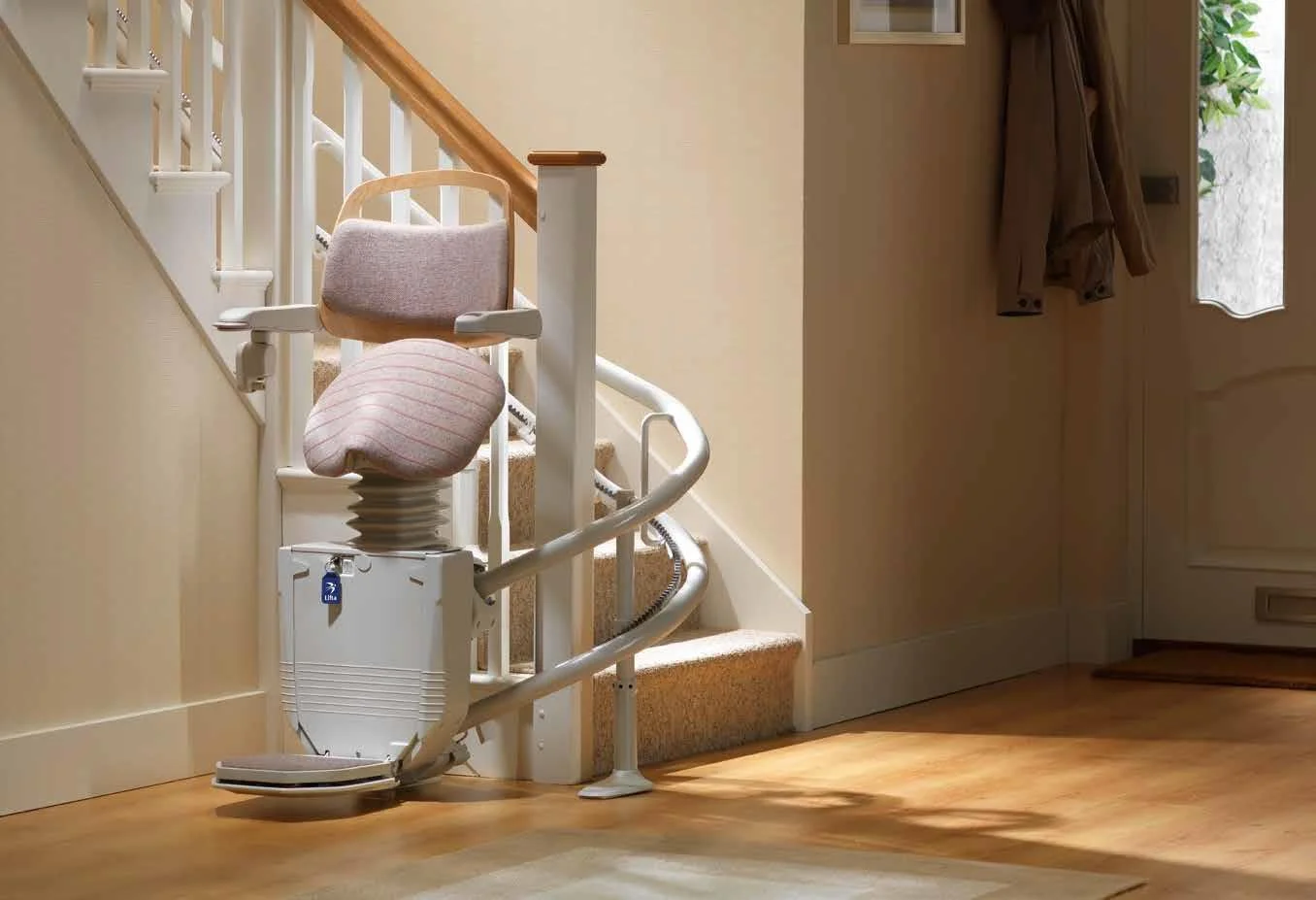
Split-level homes are different. They have short flights between levels, and a person may need a lift on more than one run, or a curved rail if the stairs turn at a landing. We measure each flight before recommending anything.
Townhouses tend to have tighter stairwells, so rail placement and folding seats matter. In walk-up apartments and low-rise buildings, a renter will need the owner's written approval before any rail goes in, and shared stairways may call for a different solution altogether.
Plenty of rural homes have porch or entry steps that are as much of a barrier as the indoor staircase. An outdoor stair lift is built to handle weather, and a vertical platform lift can work where a wheelchair user needs to get from the yard to the door.
Because homes across the county are spread out, we try to look at indoor and outdoor stairs on the same visit. That saves a second drive out to Ider, Sylvania or Hammondville.
Money is a real question here. The county's median household income was $42,267, below the Alabama median of $52,035, so many seniors cannot simply write a check for a lift.
No single program in the list below names stair lifts for the general senior population. The Alabama Medicaid home modification services do list stair lifts, but mainly for people in specific waivers tied to an intellectual-disability diagnosis. For others, the USDA Section 504 repair program, the Southern Disability Foundation loan program and your regional aging office are the places to start asking.
Veterans can reach the state veterans office at 500 Grand Avenue SW in Ft. Payne at (256) 845-8572. The regional aging office, Top of Alabama Regional Council of Governments/AAA in Huntsville, is at (256) 533-3330.
Funds in-home services such as personal care, homemaker help and respite for people who would otherwise need nursing-facility care; home modifications and stair lifts are not listed among its services. Call (800) 243-5463.
Pays for medically necessary modifications, and stair lifts are named, but only for enrolled participants of specific waivers such as the ID and LAH waivers, which generally serve people with an intellectual-disability diagnosis. Confirm eligibility with Alabama Medicaid at (334) 242-5000.
The regional information, referral, waiver-enrollment and case-management point for older adults and people with disabilities in DeKalb County; it does not mention stair lifts or home modifications. Call (256) 830-0818.
Offers very-low-income rural homeowners loans up to $40,000 at 1% for 20 years, and grants up to $10,000 for homeowners 62 and older, to remove health and safety hazards; stair lifts are not specifically listed. Call (256) 835-7821.
Provides up to $6,800 for a service-connected disability or $2,000 for a qualifying non-service-connected disability, but stair glides and porch lifts are explicitly excluded, so it does not cover stair lifts.
Grants of up to $126,526 (SAH) or $25,350 (SHA) for veterans with certain severe service-connected disabilities; the source gives ramps and wider doorways as examples and does not name stair lifts.
Low-interest, extended-term loans for Alabamians with disabilities or someone applying for them, covering home modifications and adaptive equipment; stair lifts are not named individually. Call (334) 759-0918.
A Huntsville-based center that offers information and referral, including to the Southern Disability Foundation loan program; it is not a funding source and does not name stair lifts. Call (256) 403-0033.
Older adults
5075 Research Drive NW, Huntsville, 35805
Veterans
500 Grand Avenue SW, Ft. Payne, 35967
The HISA grant explicitly excludes stair glides and porch lifts. The SAH and SHA grants do not name stair lifts either way, so a veteran with a qualifying severe service-connected disability should ask directly. The state veterans office in Ft. Payne is at (256) 845-8572.
The Elderly and Disabled waiver does not list home modifications or stair lifts. Medicaid home modification services that do name stair lifts are tied mainly to the ID and LAH waivers. Call Alabama Medicaid at (334) 242-5000 to check current rules.
The USDA Section 504 grant is limited to homeowners 62 and older, but the repair loan, up to $40,000 at 1%, has no age limit stated. The Southern Disability Foundation loan program is also open to Alabamians with disabilities regardless of age.
Yes. Split-level homes have short flights between floors, so the lift may need to serve more than one run or use a curved rail at a turn. We measure each flight before quoting.
Possibly, but you will need the owner's written approval first, since the rail attaches to the stairs. In shared stairways of walk-up apartments and low-rise buildings, the owner has the final say.
Start with the TARCOG Area Agency on Aging at (256) 830-0818 or the Top of Alabama Regional Council of Governments/AAA at (256) 533-3330. For disability-related questions, the Disability Resource Network is at (256) 403-0033.
Tell us about the stairs in your home and we will explain which lift fits, what it costs and how installation works.
