In Madison, Danville, Racine and Greenview, a lot of houses were built to fit the land rather than the other way around. Narrow lots along creeks and hillsides pushed homes upward, so many older houses in the coal-camp towns and hollows have a staircase as the only way to reach the bedrooms or a raised front door.
That layout works fine until climbing it gets hard. This page walks through how Boone County homes tend to be built, which kind of stair lift usually fits them, and which state, federal and local programs are worth a phone call before you pay out of pocket.
Most homes here are single-family and detached, with a mix of split-level and ranch-style houses alongside the older multi-story ones. Each layout points toward a different kind of lift.
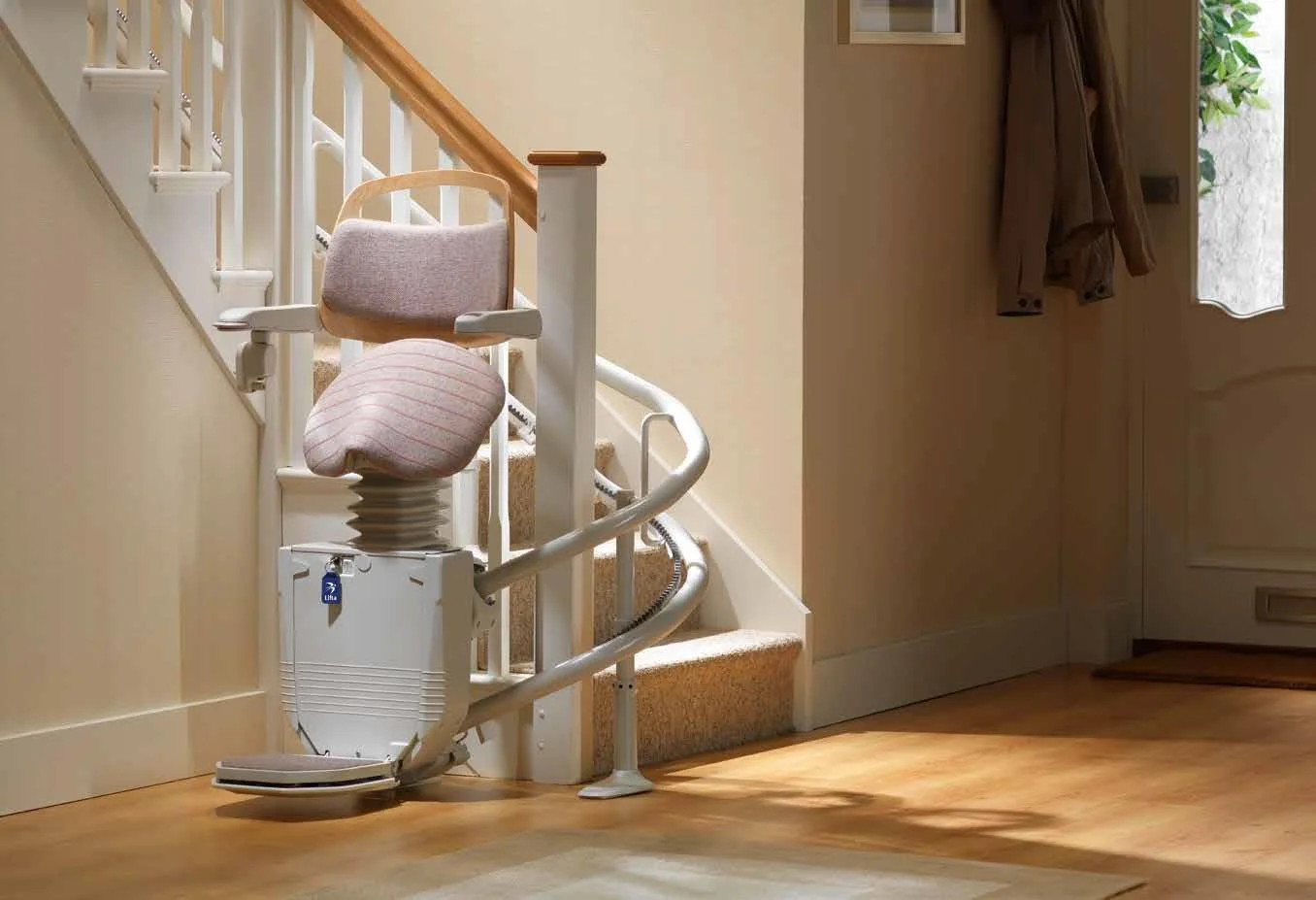
A single straight run of stairs between floors is the simplest job and usually takes a straight stair lift. Split-level homes often have short flights with a landing or a turn, and those usually call for a curved rail built to the staircase.
Where the problem is a raised entry or steps outside the house, an outdoor stair lift or a platform lift may be the better fit. We look at the stairs in person before recommending one over another.
Boone County covers about 503.2 square miles of the Allegheny Plateau, with elevations from 660 feet in the north to nearly 3,400 feet in the southeast. There is little bottomland, so houses sit on narrow valley floors and up the hillsides.
That often means exterior stairways from the road or yard up to the door. An outdoor lift has to handle weather and the slope of the ground, so we check the footing and the path before quoting.
Distance matters too. Outlying hollows mean longer drive times for contractors and in-home service providers, so it helps to plan the visit and any follow-up service ahead of time.
Owner-occupancy is high, at about 81.3% of housing units, so many people are aging in houses they own.
Owning the home matters for funding. Several programs below, including the USDA repair loans and the VA housing grants, require that you own and live in the house.
Money is tight for many households here. Coal mining jobs fell from 4,948 in 1950 to roughly 617 by 2025, and median household income is around $50,598. That squeezes both family budgets and local funding for aging services.
None of the programs below name stair lifts specifically, and the VA HISA grant excludes stair glides outright. Several do cover home modifications in general terms, so ask each one directly whether a stair lift qualifies in your case.
A good first call is the Metro Area Agency on Aging at (304) 720-6858, or the WV Aging and Disability Resource Center at (866) 981-2372. Veterans can also reach the West Virginia Department of Veterans Assistance Logan Benefits Office at (304) 792-7055.
A state Medicaid waiver for people 65+, or 18-64 and disabled, who need nursing-facility level of care; it lists home modifications and EAA-Home adaptations but does not name stair lifts. Apply through the WV Aging and Disability Resource Center at (866) 981-2372.
The local intake and service-coordination point for older adults living in Boone County, not a cash grant; its listing does not mention stair lifts. Call (304) 720-6858 to start.
A state program for people 60+ who can show a need for home modifications or accessibility devices to live more independently; the source does not mention stair lifts or a dollar cap. Call (866) 981-2372.
Repair loans up to $40,000 at 1% for 20 years, and grants up to $10,000 lifetime for homeowners 62+, for owners in rural areas earning no more than 50% of area median income. It covers repair, improvement and modernization in general and does not mention stair lifts.
A VA grant of up to $6,800 or $2,000 lifetime for medically necessary permanent alterations like ramps and roll-in showers; it does not cover stair lifts, since stair glides are excluded. Call (800) 827-1000.
Grants for veterans with qualifying severe service-connected disabilities, up to $126,526 for SAH and $25,350 for SHA in FY2026; stair lifts are not named. Call (800) 827-1000.
Helps people with disabilities who meet income guidelines in a 16-county area that includes Boone County pay for assistive devices and home modifications; stair lifts are not named, funding is limited and there is a waiting list. Call (304) 965-0376.
Older adults
1900 Kanawha Blvd. East, Charleston, 25305
Veterans
120 Nick Savas Drive, Logan, 25601
The Aged and Disabled Waiver lists home modifications and EAA-Home adaptations but does not name stair lifts. Call the WV Aging and Disability Resource Center at (866) 981-2372 to ask whether one could be approved.
The Home Modification and Accessibility Program serves people 60+ who can show a need for home modifications or accessibility devices. Its source does not mention stair lifts, so ask at (866) 981-2372.
No. HISA excludes removable equipment such as porch lifts and stair glides. It can help with permanent changes like entrance ramps, and the SAH and SHA grants are another option to ask about at (800) 827-1000.
Often, yes. Many Boone County homes have exterior stairways or raised entries because of the hillside lots, and an outdoor stair lift or platform lift can be fitted after we check the steps and the ground.
The West Virginia Department of Veterans Assistance Logan Benefits Office at 120 Nick Savas Drive in Logan can help, at (304) 792-7055.
Tell us about the stairs in your home and we will explain which lift fits, what it costs and how installation works.
