Windsor County stretches from the Connecticut River valley up toward the Green Mountains, and its 34 towns run from rail-hub White River Junction to Woodstock, Chester, Ludlow, Bethel and Royalton. Many homes here are multi-story 18th- and 19th-century farmhouses or traditional village-center homes. In most of them, the staircase is still the only way between floors.
That history shapes what kind of stair lift will work. A straight run in a Springfield split-level is a different job from a winding back stair in a Norwich or Hartland farmhouse. This page walks through how local houses and hills affect the choice, and which programs may help with the cost.
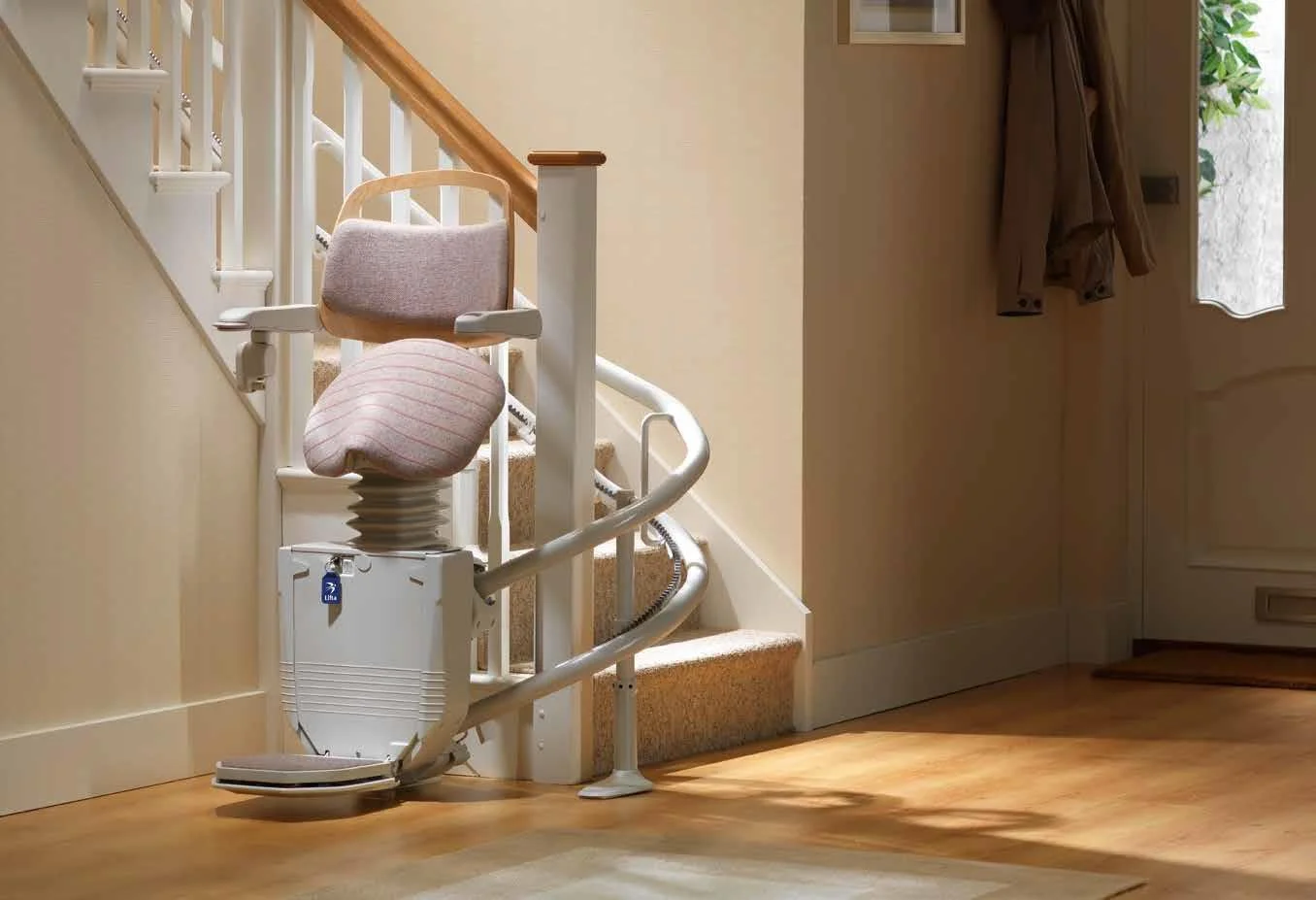
Windsor County was organized in 1781, and a lot of its housing predates any idea of accessibility retrofits. Village centers like Woodstock, Windsor and White River Junction keep their older multi-level houses close together in walkable cores.
Stairs in these homes are often narrow, steep, or turn at a landing. A turn usually means a curved stair lift, which is built to fit that exact staircase. When a stair runs straight from bottom to top, a straight stair lift is simpler and typically the faster install.
Before anything is ordered, we look at stair width, the landings, and what the rail can be fastened to. Older stairs sometimes need a closer look at the treads so the rail sits solid.
Not every home in the county is a farmhouse. Detached houses and single-family homes make up much of the stock, along with townhouses, row houses and split-level homes.
Split-level homes often have two short flights rather than one long one. Each flight can get its own straight lift, or a single curved lift can run the whole route, depending on how the stairs connect. Townhouses and row houses tend to have long straight flights against a shared wall, which usually suits a straight unit.
The terrain here is rural and hilly, with dispersed farms and small villages rather than dense development. Plenty of houses sit on a slope, so getting in the front door can mean a set of outdoor steps before you ever reach the inside stairs.
For those steps, an outdoor stair lift built for weather is one option. If someone uses a wheelchair, a platform lift may make more sense than a seat lift, since the chair rides along. We sort out the entry first, then the stairs inside.
About 24.4% of county residents are 65 or older, a large share by national standards, so many families are dealing with stairs at the same time. Roughly 72.6% of residents own their homes, which matters because several repair and modification programs below are open only to homeowners.
Some VA housing grants exist, but as the next section explains, the main VA modification grant does not cover stair glides.
None of the programs listed below names stair lifts outright, except one VA grant that rules them out. Several do cover home modifications for older or disabled homeowners, so the right move is to ask each one directly whether a stair lift fits.
Senior Solutions at (802) 885-2669 is a good first call, since it can point you toward Medicaid Choices for Care, VCIL, USDA 504 and local repair nonprofits. For homeowners, the Windham & Windsor Housing Trust and USDA Section 504 programs pair loans with grants. Statewide, the Vermont Independence Fund (Assistive Technology Loan) is another name to ask about.
A Medicaid waiver for people 65+ or physically disabled adults 18+ that offers self-directed Flexible Funds usable for home modifications and assistive devices; stair lifts are not named, so confirm with a case manager. Call (800) 642-5119.
A Medicaid waiver for people who need nursing-facility level of care, with home modifications such as ramps, grab bars and wider doorways listed as covered; stair lifts are not mentioned. Call (800) 642-5119.
One of five Area Agencies on Aging in Vermont, offering case management, options counseling and referrals rather than direct grants; it does not list a stair lift benefit but can route you to programs that might. Call (802) 885-2669.
A statewide grant program for physically disabled residents covering home entry and bathroom accessibility modifications; stair lifts are not named. There is no online application, so call (802) 224-1807 for an eligibility screening.
A low-interest loan plus a $7,500 grant for income-qualified owner-occupants, with Windsor County income bands of $61,250–$87,500 depending on household size; it covers modifications for elderly or disabled homeowners but does not name stair lifts. Call (802) 246-2116.
A volunteer nonprofit based in White River Junction that does urgent repairs, mobility ramps and weatherization at no charge for low-income Upper Valley homeowners; stair lifts are not listed, so ask directly. Call (802) 296-7241.
Loans up to $20,000 at 1% for rural homeowners at or below 50% of area median income, and grants up to $7,500 for those 62+, to remove health or safety hazards; stair lifts are not named.
A VA grant of up to $6,800 or $2,000 lifetime for medically necessary home changes, but it specifically excludes stair glides and porch lifts. Entry ramps and bathroom changes can still qualify.
Up to $126,526 (FY2026) for homeowning veterans with qualifying severe service-connected disabilities, with ramps and wider doorways given as examples; stair lifts are not mentioned.
Up to $25,350 (FY2026) to adapt an existing home for veterans with certain service-connected disabilities; the source does not mention stairs or stair lifts.
Older adults
143 Maple St., Rutland, 05701
Veterans
789 Vermont National Guard Road, Colchester, 05446
Often, yes. Turning stairs usually call for a curved stair lift made for that staircase. We measure the width, landings and mounting points first, since older stairs vary a lot from house to house.
The HISA grant explicitly excludes stair glides and porch lifts. The SAH and SHA grants do not mention stair lifts either way. Vermont Veterans Outreach at (802) 338-4321 can help a veteran sort through options.
Choices for Care covers home modifications in both its Moderate Needs and High/Highest Needs groups, but neither names stair lifts. Call (800) 642-5119 and ask a case manager whether a stair lift can be approved.
The Choices for Care Moderate Needs Group is open to physically disabled adults 18 and older, not only people 65+. The VCIL Home Access Program also serves physically disabled residents of any age.
Several programs require you to own the home, including the Green Mountain Home Repair Program and USDA Section 504. Choices for Care and Senior Solutions do not list homeownership as a requirement, so start there.
Senior Solutions at (802) 885-2669 is a practical starting point. It works as a referral hub to Choices for Care, VCIL, USDA 504 and local repair nonprofits.
Tell us about the stairs in your home and we will explain which lift fits, what it costs and how installation works.
