From Strasburg and Woodstock down through Edinburg, Mount Jackson and New Market, a lot of Shenandoah County homes put the bedrooms and the front door on different levels. Out toward Basye, Conicville and Columbia Furnace, houses sit on sloped lots with raised foundations and steps between the yard and the living space.
Those stairs were easy to live with when the house was full and everyone was younger. This page walks through how the county's homes and terrain shape the kind of stair lift that fits, and which local and Virginia programs may help with the cost.
The county covers about 509 square miles of the Shenandoah Valley, including Fort Valley and the western slopes of Massanutten Mountain. Building on that ground means many homes are split-level or sit on raised foundations, with short runs of stairs between levels.
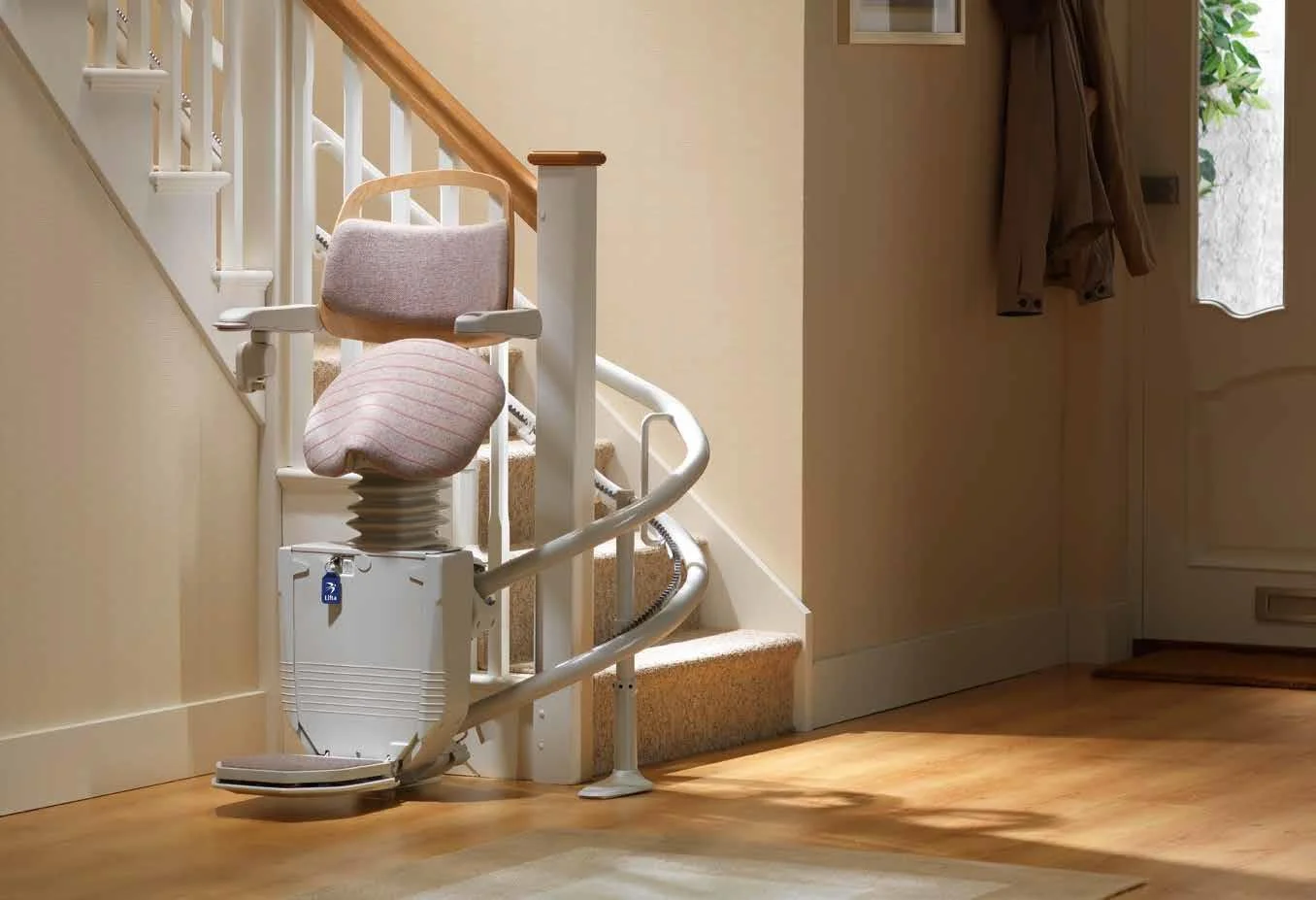
A single straight flight is the simplest case and usually takes a straight stair lift. Split-level homes often have two short flights or a landing, and a run that turns usually calls for a curved rail built to the exact stairway. We measure every flight and landing before recommending anything.
Ranch-style homes look like one level, but many still have steps up from the garage or down to a basement. Those short runs are often a good fit for a straight lift or, where a wheelchair is involved, a platform lift.
Much of the county's housing went up during the 1970s and 80s building boom. Roughly two-thirds of homes have three or more bedrooms, yet 68% of the county's 17,782 households are just one or two people.
That gap leaves many people living in a multi-level house that was never planned for aging in place. A stair lift can keep the upstairs bedroom and bath usable so moving is not the only option. About 19.0% of residents are 65 or older, and 62.7% of households own their home, which matters because most repair programs require owner-occupied homes.
The county has also run an AARP Community Challenge / ADU Housing Design Competition to explore Accessory Dwelling Units and 'missing middle' housing for aging in place. For families who want to stay in the house they have now, a lift is usually the faster change.
In the 2020 census, 69.6% of county residents lived in rural areas. On farms and country lots around places like Maurertown, Toms Brook, Bowmans Crossing and Alonzaville, the hardest stairs are often outside, from the driveway or yard up to the porch.
Outdoor stair lifts are built for weather exposure and are a different unit from an indoor lift. If a wheelchair or scooter has to come along, a vertical platform lift at the porch may make more sense than a seat lift. We look at both before you decide.
The VA Home Improvements and Structural Alterations (HISA) Grant helps with permanent changes like ramps and wider doorways, but it excludes stair glides and porch lifts, so it will not pay for a stair lift.
Veterans can still talk through their options with the Virginia Department of Veterans Services - Front Royal Office at (540) 551-8909. Blue Ridge Habitat for Humanity also serves veterans in Shenandoah County through its home repair program.
Only one program below names stair lifts outright: the Assistive Technology Loan Fund Authority (ATLFA), a Virginia low-interest loan for people with a disability or their caregivers. Its standard rate is approx. 5%, with no stated minimum or maximum loan amount.
Several other programs fund home repairs or accessibility changes without mentioning stair lifts, so coverage has to be confirmed directly. These include the CCC Plus Medicaid waiver, EHARP, USDA Section 504 and CDBG housing rehabilitation. Seniors First, the local Area Agency on Aging, is a good first call for referrals at (540) 635-7141.
A Virginia low-interest loan for residents with a disability or their caregivers, and stair lifts are named as an eligible use. Call (866) 835-5976; approval depends on credit history and debt-to-income ratio.
A VA grant with a lifetime maximum of $6,800 for service-connected disability or $2,000 for non-service-connected disability. It does not cover stair lifts, since stair glides and porch lifts are excluded.
A Medicaid waiver benefit with a $5,000 per year cap for home modifications for people who meet nursing-facility level of care; stair lifts are not listed among its examples, so ask your care coordinator case by case. Call (833) 522-5582, with screening done through the local Department of Social Services.
A state grant of up to $4,000 for owner-occupied homes with household income at or below 80% of Area Median Income, covering repairs and accessibility modifications; stair lifts are not named. Call DHCD at (804) 371-7000.
Offers grants up to $10,000 for very-low-income homeowners 62 and older, and 1% loans up to $40,000, in USDA-eligible rural areas; stair lifts are not mentioned. Call (804) 287-1500 and confirm your address is eligible.
Housing rehabilitation funding for low- to moderate-income owner-occupants, available only when the county or a town holds an active award; stair lifts are not mentioned. Call DHCD at (804) 371-7000 to check current status.
A non-profit repair program for homeowners age 60 and older or veterans in Shenandoah County who meet income limits; listed repairs include handrails and portable ramps, not stair lifts. Call (540) 662-7066.
The local aging agency for adults 60 and older, offering referrals and in-home services but no home modification or stair lift funding. Call (540) 635-7141.
Older adults
207 Mosby Lane, Front Royal, 22630
Veterans
1516 N Shenandoah Avenue Suite E, Front Royal, 22630
Not through the HISA grant, which excludes stair glides and porch lifts. A veteran with a disability may look at the ATLFA loan instead, and the Virginia Department of Veterans Services - Front Royal Office at (540) 551-8909 can talk through other benefits.
It depends on the layout. Some split-level stairs can be handled with one curved rail that runs through the landing, while others work better with separate straight lifts, and we decide after measuring.
USDA Section 504 grants are for homeowners 62 and older, but other eligible very-low-income homeowners may qualify for a 1% repair loan up to $40,000. EHARP and CDBG housing rehabilitation are income-based without that age line, though neither names stair lifts.
The CCC Plus waiver covers up to $5,000 per year in environmental modifications, but its listed examples do not include stair lifts. Ask your assigned care coordinator, or call (833) 522-5582.
Seniors First, the Shenandoah Area Agency on Aging, serves adults 60 and older in Shenandoah County at (540) 635-7141. They do not fund stair lifts but can point you to in-home services and other resources.
Yes, outdoor stair lifts are made for that. If a wheelchair needs to get up the steps, a platform lift may be the better choice, and we can compare both at your home.
Tell us about the stairs in your home and we will explain which lift fits, what it costs and how installation works.
