Outside the town of Appomattox, most homes in the county sit on farmsteads and back roads spread across about 333 square miles of rolling Piedmont hills. Near the town center you still find colonials, Georgians and bungalows from the late 1800s and early 1900s. Elsewhere there are split-levels, ranch-style homes, farmhouses and a fair number of manufactured and mobile homes.
That mix matters when someone starts having trouble with steps. A lot of older households here live in multi-level homes with an entry stair, a stairway to a second floor, or both. This page walks through what that means for a stair lift and which local, state and federal programs may help cover the cost.
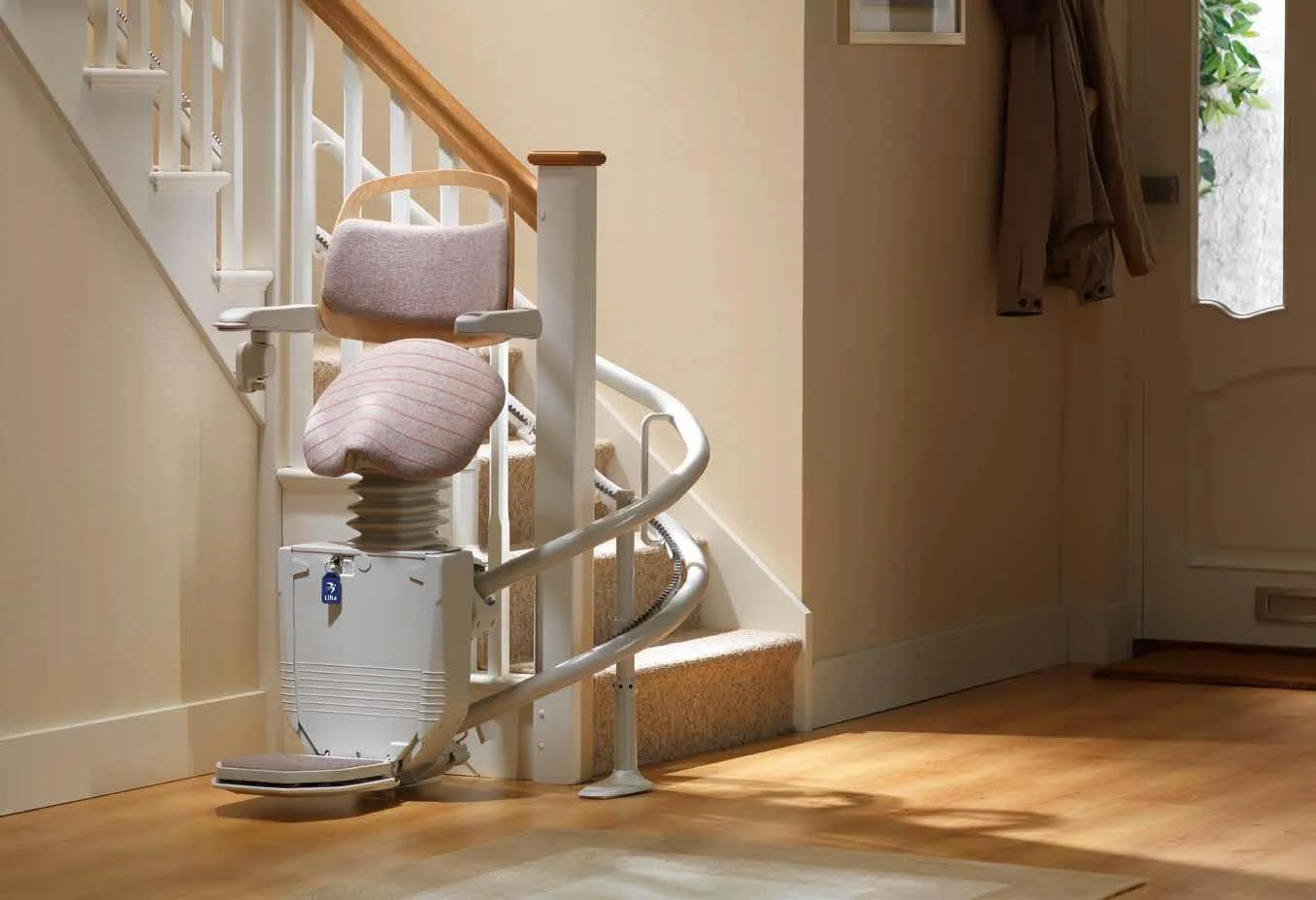
Older colonials and Georgians near the town center often have a full staircase to the bedrooms. If that staircase runs in one straight line, a straight rail is usually the simpler and less costly choice. Stairs that turn at a landing or wind as they climb call for a curved rail built to fit that exact staircase.
Split-level homes bring a different problem: several short flights between levels. Each flight may need its own lift, so it helps to decide which levels the person truly needs to reach every day. Ranch-style homes often have no inside stairs at all, but many still have a few steps up to the front or back door.
Farmhouses and manufactured or mobile homes commonly have steps up to a porch or deck. An outdoor stair lift is built for weather and can handle those entry steps. When someone uses a wheelchair and cannot transfer to a seat, a platform lift is often the better fit than a chair-style lift.
Before we recommend anything, we look at how the steps are built and what they are attached to. Porch and deck steps on a manufactured home need to be solid enough to hold a rail, so the condition of the steps is part of the first visit.
Per the 2020 Census, 100% of county residents live in rural areas. For many families, that means a parent lives alone on a dispersed property, a good drive from help if a fall happens on the stairs. Making the stairs safer is often the change that lets a parent stay in the home they already own.
About 64.7% of households here own their home, and 17.4% of residents are 65 or older. Several programs below are open only to homeowners, so owning the house can widen the funding options.
The 2024 median household income in the county was about $62,853, and the poverty rate was near 14%, above both the Virginia and national averages. For many families, grants and waivers matter more than paying out of pocket. Start by calling the Area Agency on Aging, Central Virginia Alliance for Community Living, at (434) 385-9070.
Only one program below names chairlifts outright: the Virginia Housing Owner-Occupied Accessibility Modification Grant. The others cover accessibility work in general terms, so ask each one directly whether a stair lift qualifies before you apply. Some programs can be combined, which can matter when one grant has a low cap.
The VA HISA grant does not pay for stair glides, so a veteran who needs a stair lift should ask the VA Prosthetic & Sensory Aids Service about a stair glide issued as medical equipment instead. For help sorting out benefits, the Virginia Department of Veterans Services – Lynchburg Office is at 519 Leesville Road, Suite A, Lynchburg, and can be reached at (434) 582-5102.
A grant of up to $4,000 per application for low-income homeowners and tenants in Amherst, Appomattox and Bedford Counties, offered year-round on a first-come, first-served basis. Stair lifts are not named in program materials, so confirm with the agency at (434) 385-9070.
Pays up to $5,000 per calendar year for home modifications for people enrolled in the CCC Plus Waiver who receive at least one other waiver service; the work must be recommended by a qualified professional and prior-authorized. Stair lifts are not listed as covered or excluded; call (844) 374-9159.
A grant of up to $10,000 with no repayment for homeowners with a disability at 60% or less of area median income, and it explicitly lists installing chairlifts. Applications go through a Virginia Housing-accepted agent for the county; call (877) 843-2123.
A state income tax credit of 50% of retrofit costs, capped at $6,500, with unused credit carried forward up to 7 years. Stair lifts are not named, so confirm with the Virginia Department of Housing and Community Development at (804) 371-7000.
Offers loans up to $40,000 at 1% interest and grants up to $10,000 for very-low-income homeowners 62 and older, and Appomattox County qualifies as rural. Stair lifts are not named and would need to be justified as removing a health or safety hazard; call (804) 287-1500.
A lifetime grant of up to $6,800 or $2,000, depending on the veteran's disability, for prescribed home modifications. It does not cover stair glides; ask the VA Prosthetic & Sensory Aids Service about a stair glide as medical equipment instead.
Grants of up to $126,526 (SAH) or $25,350 (SHA) for FY2026 for veterans with specific severe service-connected disabilities, used to buy, build or modify a home. Stair lifts are not named in the program overview.
Grants paid straight to vendors for approved items for people with disabilities living in Appomattox County and nearby areas. Stair lifts are not named among the examples, so ask a case coordinator at (434) 528-4971.
Older adults
501 12th Street, Suite A, Lynchburg, 24504
Veterans
519 Leesville Road, Suite A, Lynchburg, 24502
Yes. The Virginia Housing Owner-Occupied Accessibility Modification Grant lists installing chairlifts, which is another name for a stair lift. It is for homeowners with a disability at 60% or less of area median income and pays up to $10,000. Call (877) 843-2123.
The USDA Section 504 program offers grants up to $10,000 for very-low-income homeowners 62 and older in rural areas, and Appomattox County qualifies. The grant must remove a health or safety hazard, so the stair lift has to be justified that way. Call (804) 287-1500.
The EHARP program from Central Virginia Alliance for Community Living is open to tenants as well as homeowners. It pays up to $4,000 per application. Call (434) 385-9070 to ask whether a stair lift qualifies.
The HISA grant does not cover stair glides. A veteran should ask the VA Prosthetic & Sensory Aids Service about getting a stair glide as medical equipment. The Virginia Department of Veterans Services – Lynchburg Office at (434) 582-5102 can help with the process.
Often, yes. Outdoor stair lifts are made for porch and entry steps. We check that the steps are sturdy enough to hold the rail during the home visit.
It is Central Virginia Alliance for Community Living, reachable at (434) 385-9070. They run the EHARP grant and can point you to other local help.
Tell us about the stairs in your home and we will explain which lift fits, what it costs and how installation works.
