Albany County runs from the Hudson River at 62 feet above sea level to Hilltown ridges near 2,160 feet. A row house in Cohoes or Watervliet and a home up in Berne, Knox, Westerlo or Rensselaerville sit in the same county, but they ask very different things of a stair lift.
This page walks through what the county's homes and hills mean for choosing a lift, and which local and state offices can help you sort out the cost. It covers all 23 communities, from Albany, Colonie and Guilderland to Bethlehem, Coeymans, Voorheesville and Altamont.
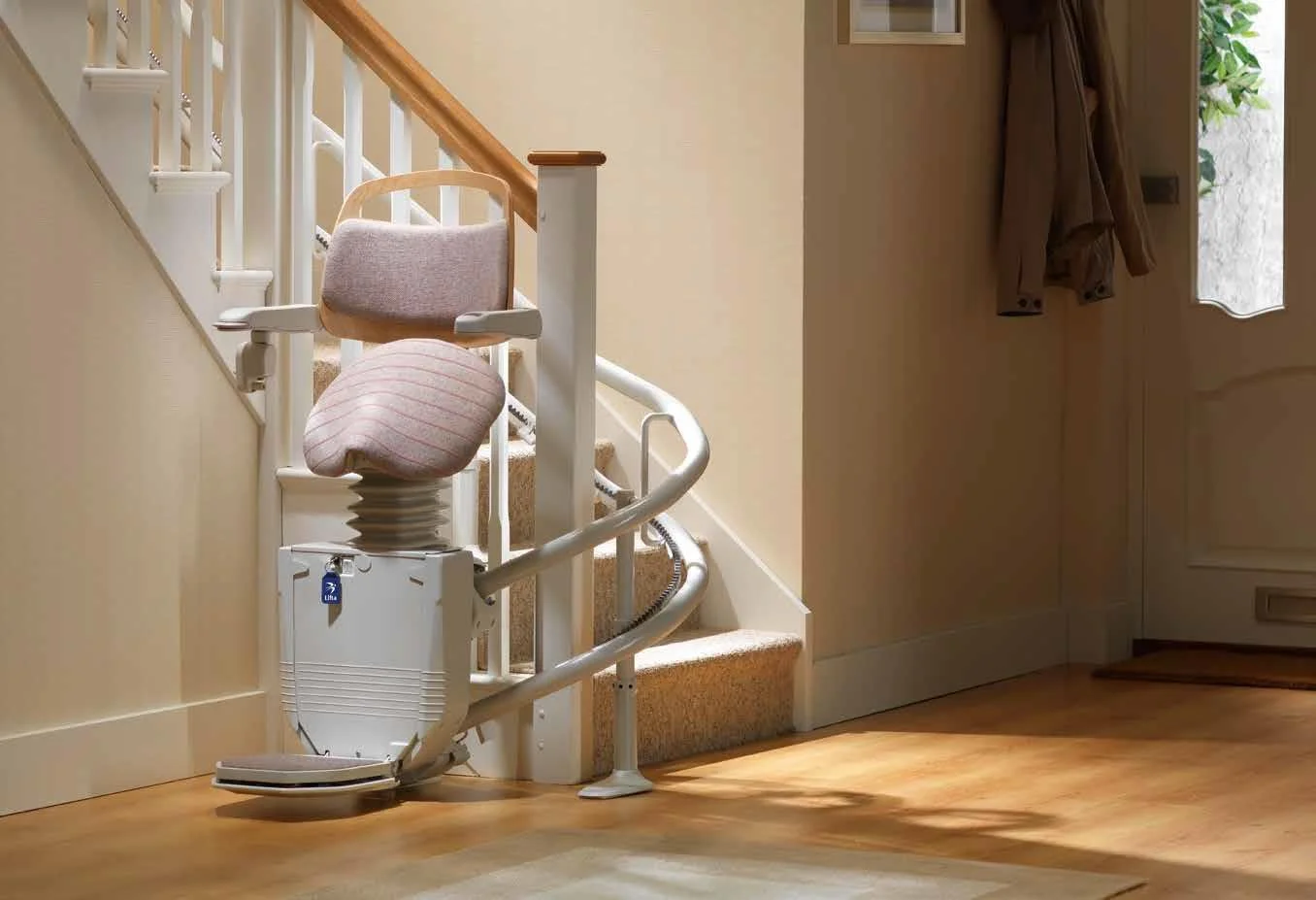
The older river communities of Albany, Cohoes and Watervliet hold many row houses and townhouses. Those homes often have a single straight run of stairs between floors, which is usually the simplest case for a stair lift. The rail mounts to the treads, not the wall, so plaster walls in older houses are rarely a problem.
Suburban towns like Colonie and Guilderland are mostly single-family and detached houses. The average Albany County home was built in 1970, and many houses from that era have split levels or a turn at a landing. A staircase with a turn or a landing usually needs a curved rail built to fit that exact stair.
In low-rise buildings, the stairs may be shared. In that case, talk with the building owner before planning any lift, since it affects other residents.
Near the Hudson and Mohawk Rivers, the land is flat lowland. Climb toward the Helderberg Escarpment, roughly 11 miles west of the city of Albany, and the ground rises about 700 feet over a horizontal distance of about 2,000 feet.
On that kind of slope, a house may sit well above or below its driveway, with long exterior steps to the door. An outdoor stair lift, built to handle weather, can follow those steps. Where someone uses a wheelchair, a vertical platform lift at the porch can make more sense than a ramp that would need a lot of length to cover the rise.
We look at the inside stairs and the outside entry together. Fixing one without the other still leaves a person stuck.
About 17.8 percent of the county's 374,047 residents are 65 or older, and 59.1 percent of households own their homes. Many of those owners want to stay on the same street they have lived on for years rather than move to a one-floor home.
If that includes someone in your family, the VA and the county veterans office are worth a call before you pay out of pocket, though the rules are specific, as explained below.
Be prepared for a straight answer: none of the programs below name stair lifts as a covered item, and the VA HISA benefit specifically excludes stair glides. Some programs fund home modifications in general, so it is still worth asking.
A good first call is the Albany County Dept for Aging at (518) 447-7198, 162 Washington Avenue in Albany. Ask about New York EISEP and the New York Medicaid Home Modifications (NHTD Waiver & MLTC) options, and whether a Local Program Administrator for the state Access to Home Program serves your town.
Veterans can reach the Albany County Veterans Service Bureau at (518) 447-7710, 420 Western Avenue in Albany, to ask about Specially Adapted Housing and Special Home Adaptation grants.
A state grant for home accessibility changes such as ramps, lifts, handrails and doorway widening, for households at or below 80 percent of area median income (120 percent for certain disabled veterans); the source does not mention stair lifts specifically. You apply through a Local Program Administrator serving your area, not directly to the state.
Emergency repair grants up to $20,000 for homeowners age 60 or older with income at or below 100 percent of area median income, limited to hazards and code problems. Stair lifts are not mentioned, and applications go through a Local Program Administrator.
A lifetime benefit of up to $6,800 for service-connected disabilities or $2,000 for other qualifying disabilities, for medically necessary accessibility work. HISA explicitly excludes stair glides, so it does not cover stair lifts.
Grants for veterans with qualifying severe disabilities, up to $126,526 for SAH and $25,350 for SHA, usable up to 6 different times. The VA source gives ramps and wider doorways as examples and does not name stair lifts.
A free information and referral service for older adults, people with disabilities and caregivers that helps connect you to home modification and aging services; it does not fund stair lifts itself. Call (518) 447-7177.
A membership nonprofit for elderly or disabled members offering handyman help at $20.00/hour and an annual home safety inspection with a written report; stair lifts are not mentioned. Call (518) 346-5249.
Offers independent living skills training, advocacy, peer support and referrals for people with disabilities; it is not listed as a home modification or stair lift fund. Call (518) 320-7100.
Older adults
162 Washington Avenue, Albany, 12210
Veterans
420 Western Avenue, Albany, 12203
Often, yes. Row house stairs are frequently one straight run, which suits a straight rail. We measure the width and look at the top and bottom landings before recommending anything.
An outdoor stair lift can follow exterior steps, and a vertical platform lift can work where a wheelchair is involved. Homes near the Helderberg Escarpment often have big height changes at the entry, so we look at the outside approach as well as the indoor stairs.
The HISA benefit specifically excludes stair glides. SAH and SHA grants fund home adaptations for qualifying veterans but do not name stair lifts, so call the Albany County Veterans Service Bureau at (518) 447-7710 to ask about your situation.
The RESTORE Program serves homeowners age 60 or older, but it covers emergency repairs and does not mention stair lifts. The Albany County Dept for Aging at (518) 447-7198 can tell you what else may apply.
No. Homeowners and renters go through a Local Program Administrator, a municipality or nonprofit serving their area. NY Connects at (518) 447-7177 or the Dept for Aging can help you find the right one.
Tell us about the stairs in your home and we will explain which lift fits, what it costs and how installation works.
