From the adobe homes around the old plaza in Taos to houses in Questa, Peñasco, Arroyo Seco and Red River, Taos County sits higher than any U.S. county outside Colorado, with a mean elevation of 8,510 feet. Homes here range from Spanish colonial and Pueblo Revival adobe to split-level houses, townhouses and walk-up apartments.
This page walks through how those homes and that terrain affect the choice of a stair lift, and which state and federal programs might help with the cost. Several programs have changed their intake status recently, so we point you to the right phone numbers to check before you plan around any of them.
Historic adobe construction still shapes residential building across the county, with Spanish colonial and Pueblo Revival influences in many homes. These houses often have thick walls and stairways that do not follow a standard layout.
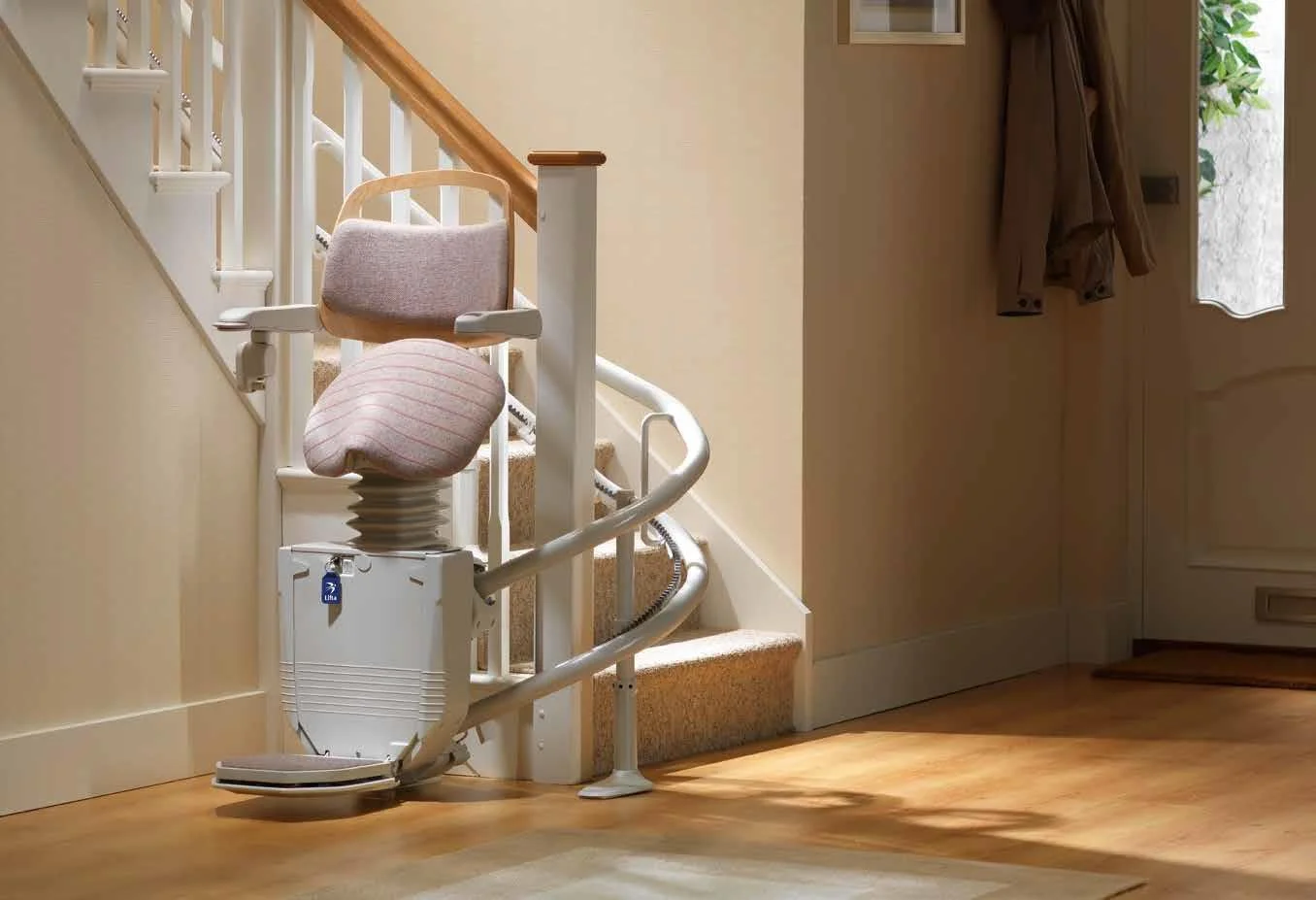
A straight stair lift mounts to the stair treads, not the wall, so it can work on a plain run of stairs in an adobe house. Where a staircase turns or has a landing, a curved rail is built to fit that specific stairway, which takes careful measuring on site.
Split-level homes usually have short flights between floors. Each flight may need its own straight lift, or a curved rail if the stairs connect around a corner.
Townhouses and detached single-family homes often have one main staircase to a bedroom floor, which is the most common straight lift job. In a walk-up apartment the stairs are usually shared, so the building owner has to approve any installation before work starts.
With Wheeler Peak reaching 13,161 feet inside the county, many properties sit on slopes with steps up to the front door or down to a garage. An outdoor stair lift is built for weather exposure, and a vertical platform lift can help where a wheelchair user needs to reach a raised entry.
The county is 54.6% rural, which means fewer home-modification contractors and mobility specialists close by. If you live outside Taos itself, it helps to gather stair measurements, photos and any doctor's notes before the first visit so the trip covers as much as possible.
About 27.6% of Taos County residents are 65 or older, and the median age is about 52.6 years. Roughly 75.4% of households own their home, which matters because most funding programs require the applicant to own and live in the house.
If that includes someone in your family, read the VA program notes below carefully, since stair lifts are treated differently from ramps.
None of the programs below lists stair lifts as a covered item, and the VA HISA grant explicitly excludes stair glides. That does not always rule out help, but it means you should call and ask about your situation directly before counting on any funding.
For older adults, the Non-Metro AAA (Region I) at 2550 Cerrillos Rd., Santa Fe, NM 87505, (505) 827-7640, is the regional aging office. Veterans can reach the New Mexico Department of Veterans' Services – Taos Field Office at 145 Roy Rd, Taos, NM 87571, (505) 709-5263. Other statewide options to ask about include Access Loan New Mexico (NM Technology Assistance Program).
An individualized service plan for full-coverage NM Medicaid members in a Managed Care Organization who need a Nursing Facility Level of Care; the source does not mention stair lifts. Call (800) 283-4465 to confirm current scope.
A last-resort home modification program for New Mexico residents with a documented physical disability; it names ramps and bathroom modifications, not stair lifts. Call (505) 476-0412 to confirm intake status.
For homeowners age 60+ under 300% of Federal Poverty Guidelines; it lists ramp and stair modifications but does not name stair lifts, and as of Feb 1, 2024 it was not accepting applications. Call (866) 699-4927 for current status.
For homeowners or renters with landlord permission age 62+ who meet 2025 HUD income limits; it lists grab bars, handrails, ramps and flooring repairs, not stair lifts, and as of Feb 1, 2024 it was at capacity. Call (866) 699-4927 to check.
Provides up to $6,800 or up to $2,000 lifetime for qualifying veterans, but the VA explicitly excludes stair glides. Call (800) 827-1000 for details on covered items such as ramps and entrance changes.
Grants for veterans with severe qualifying service-connected disabilities, up to $126,526 for SAH or $25,350 for SHA on a permanent home; stair lifts are not mentioned. Call (800) 827-1000.
A 0% interest, deferred-payment forgivable loan for owner-occupants at or below 80% of Area Median Income, covering repair and safety work; accessibility changes and stair lifts are not mentioned. Call (575) 322-2141.
Older adults
2550 Cerrillos Rd., Santa Fe, 87505
Veterans
145 Roy Rd, Taos, 87571
Not through the HISA grant, which explicitly excludes stair glides. The SAH and SHA grants do not mention stair lifts, so call (800) 827-1000 or the Taos Field Office at (505) 709-5263 to ask about your case.
The senior programs start at age 60 or 62. RAMP serves New Mexico residents with a documented physical disability, and the Medicaid Community Benefit Program is based on care needs, so call (505) 476-0412 or (800) 283-4465.
As of Feb 1, 2024, both the Senior Home Repair and Modification Program and the Older Adult Home Modification Program said they had reached service capacity. Call (866) 699-4927 for the current status.
The Older Adult Home Modification Program accepts renters age 62+ with landlord permission. The building owner would also need to approve any stair lift on shared stairs.
Usually, yes. A straight lift mounts to the stair treads, and a curved rail is made to fit stairways that turn, so the main step is measuring the stairs on site.
The Non-Metro AAA (Region I) is at 2550 Cerrillos Rd., Santa Fe, NM 87505. Its phone is (505) 827-7640.
Tell us about the stairs in your home and we will explain which lift fits, what it costs and how installation works.
