Foster County covers 634.08 square miles of low rolling hills in east-central North Dakota, with the James River running through the middle and Carrington serving as the county seat. Many of the older farmhouses and small-town homes here date from the county's early-20th-century agricultural settlement era, and a lot of them were built with narrow, steep interior staircases.
Those stairs are often the first real obstacle when someone wants to keep living in a home they have owned for decades. This page walks through how local homes and the rural layout of the county affect a stair lift project, and which state, federal and veteran programs a Foster County household can call about funding.
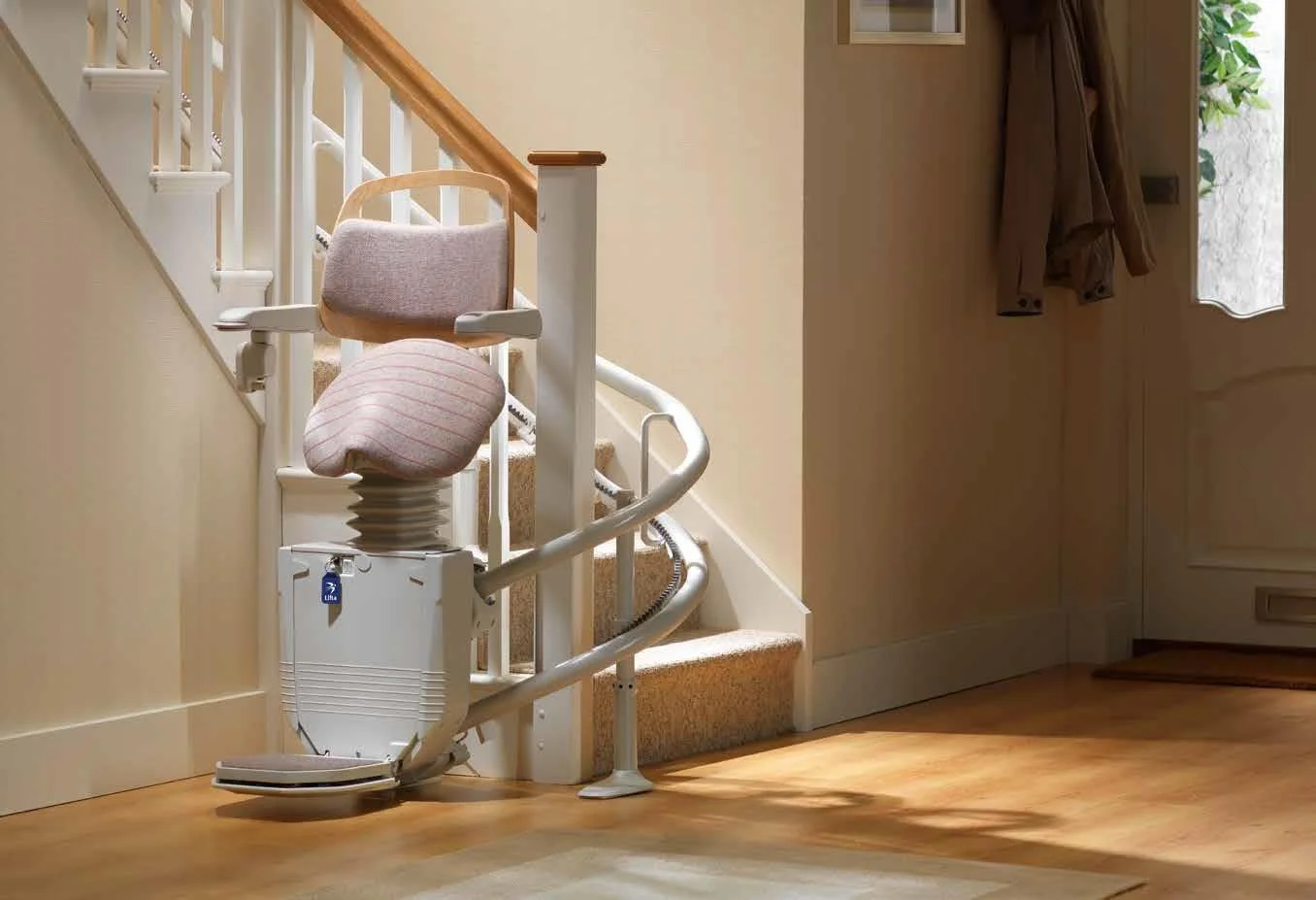
A narrow, steep staircase in an older farmhouse is usually still a candidate for a straight stair lift, as long as the run has no turns. The rail mounts to the stair treads, not the wall, so plaster walls in an old house are not a problem. We measure the width carefully, since a tight stairway leaves less room for the folded seat and for anyone else using the stairs.
If the staircase turns at a landing or winds near the top, a curved stair lift with a custom-bent rail is the usual answer. These take longer to build and install than straight units, so plan on extra lead time.
Ranch-style homes often look stair-free until you count the basement stairs, where the laundry, freezer or furnace room may be. A straight lift on the basement run can keep that space usable. Split-level homes are trickier because they have several short flights, and each flight may need its own lift or a curved rail that ties them together.
In walk-up apartments, the building owner has to approve any installation in a shared stairwell. For steps at a porch or side door, an outdoor stair lift built for weather exposure is one option, and a vertical platform lift can work where a wheelchair user needs to get up a few exterior steps.
Foster County averages about 5.24 people per square mile, so many older residents live on farmsteads well outside Carrington. Distance from home-modification contractors and assessors adds to the practical cost and the time it takes to finish a project. Calling early, before a fall or a hospital discharge forces the issue, gives everyone time to schedule an assessment, any required funding approvals and the installation itself.
Housing here tends to be held for a long time. The 2020 census showed a very low 1.1% homeowner vacancy rate, and about 20.6% of residents are age 65 or older. That combination means many people are aging in homes they plan to stay in, which is exactly the situation a stair lift is built for.
Carrington is a small agricultural trade center, and a farm-dependent local tax base limits how much senior home-modification help can be funded locally. In practice, state and federal programs are the main paths: the North Dakota Medicaid HCBS waiver, SPED and Ex-SPED, USDA Section 504, VA grants, the ND Assistive loan program and CDBG housing rehab.
None of the sources behind these programs name stair lifts as a covered item, and the VA HISA grant specifically excludes stair glides. A phone call is the only way to confirm what a program will fund in your case. The Central Prairie Human Service Zone, which serves Foster County, is the practical local starting point for ND HHS programs, and veterans can start with the Foster County Veterans Service Office at (701) 652-2170.
Other statewide programs worth asking about include North Dakota Medicaid State Plan Personal Care and the North Dakota Homestead Property Tax Credit for Seniors and Disabled. The Aging Services Division in Bismarck can be reached at (701) 328-8910.
North Dakota's statewide front door for aging and disability services, routing Foster County residents to local Human Service Zone case managers; the source does not mention stair lifts or home modifications. Call (855) 462-5465 to ask what a given program will fund.
A Medicaid waiver that may help pay for changes to the home for people age 65+ or with qualifying disabilities who meet level-of-care and financial criteria; stair lifts are not named, and changes over $500 need a professional assessment and written pre-approval. Call (855) 462-5465.
An ND HHS in-home services program with a sliding-fee cost share and a $50,000 liquid-asset limit, covering personal care, respite and case management; the source does not mention stair lifts or home modifications. Call the Central Prairie Human Service Zone at (701) 547-3694.
The local ND HHS office serving Eddy, Foster and Wells counties, with its host office in Fessenden, where Foster County residents apply for the HCBS waiver, SPED and other programs; it is an access point rather than a funding source, and stair lifts are not listed. Call (701) 547-3694.
Rural repair help for very-low-income homeowners: grants up to $10,000 for those age 62+ and loans up to $40,000 at 1% interest, which can make a home accessible for a household member with a disability. Stair lifts are not named specifically, and Foster County qualifies as a rural area.
Loans up to $50,000 at a 2% fixed rate for North Dakota residents with a disability, including home modifications such as walk-in showers and ramps for homeowners; stair lifts are not named among the examples. Call (800) 895-4728 to confirm eligibility for a stair lift.
State-administered federal funds for rehabilitating homes of very low- and low-income households, granted to local governments such as Foster County or the City of Carrington that run local projects; stair lift coverage is not listed. Call (701) 328-5300.
A VA grant of up to $6,800 or $2,000 lifetime for medically needed home modifications, but it explicitly does not cover stair glides, porch lifts or portable ramps. Veterans can ask the Foster County Veterans Service Office at (701) 652-2170 about other options.
Up to $126,526 for FY2026 for veterans with severe qualifying service-connected disabilities to buy, build or modify a home, with modifications described as ramps and wider doorways; stair lifts are not named. Contact the Foster County Veterans Service Office at (701) 652-2170.
Up to $25,350 for FY2026 for veterans with a different set of severe service-connected disabilities, such as certain burns or respiratory injuries; stair lifts are not named among covered modifications. Contact the Foster County Veterans Service Office at (701) 652-2170.
Older adults
600 E Boulevard Ave, Dept 325, Bismarck, 58505
Veterans
1000 5th Street North, Carrington, 58421
Often, yes. Many early-20th-century farmhouses around Carrington have narrow, steep stairs, and a straight stair lift mounts to the treads. We measure width and angle at the home to confirm the fit, and a staircase with turns would need a curved rail.
No. The HISA grant explicitly excludes stair glides, porch lifts and portable ramps. Veterans with severe service-connected disabilities can ask about the SAH or SHA grants, and the Foster County Veterans Service Office in Carrington is at (701) 652-2170.
The USDA Section 504 program offers grants up to $10,000 lifetime to very-low-income rural homeowners age 62+, and Foster County qualifies as rural. Grant funds must be repaid if the home is sold within 3 years.
Foster County is served by the Central Prairie Human Service Zone, reachable at (701) 547-3694. The statewide ADRL line at (855) 462-5465 can also route you to a case manager.
If home changes cost more than $500, the waiver requires a professional assessment, such as from an occupational therapist, plus written pre-approval before work starts. Build that step into your timeline.
It can add cost and lead time, because contractors and assessors have to travel. Starting the process early helps keep the assessment, funding approvals and installation on track.
Tell us about the stairs in your home and we will explain which lift fits, what it costs and how installation works.
