Harnett County stretches across 601.22 square miles of central North Carolina, from Lillington, the county seat, out to Dunn, Angier, Coats, Erwin, Buies Creek, Anderson Creek, Spout Springs, Bunnlevel, Barbecue and Mamers. About 64.2% of residents live in rural areas, so many of the homes we see sit on country roads or at the edge of small towns rather than in dense neighborhoods.
That spread matters when a parent starts struggling with the stairs. A farmhouse outside Mamers, a split-level in Angier and a walk-up apartment near Buies Creek each call for a different kind of lift. This page walks through what fits the homes here and which programs may help with the cost.
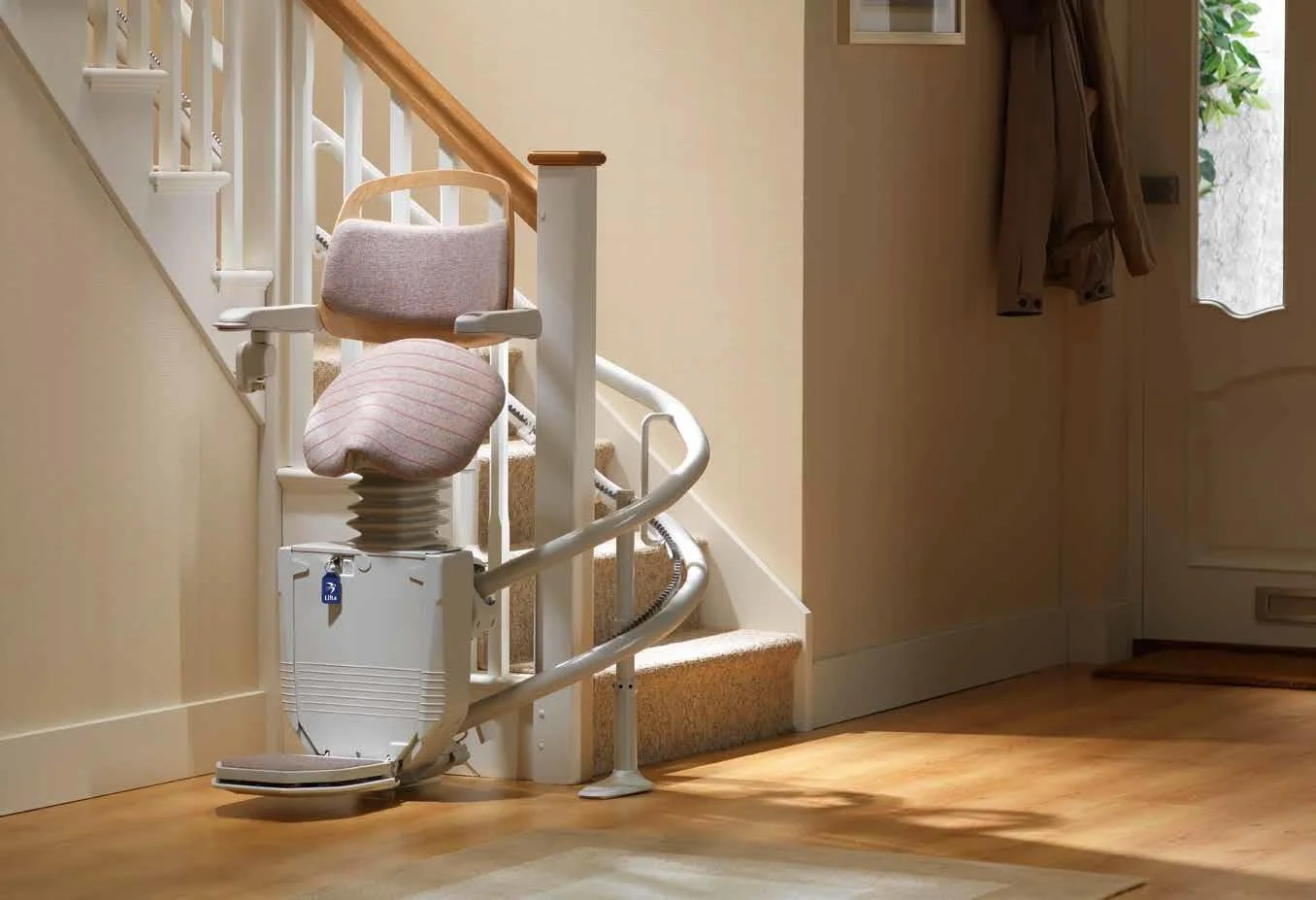
Most homes in the county are conventional single-family homes, and many of those have one straight staircase between floors. A straight stair lift is usually the simplest fit: the rail mounts to the stair treads, not the wall, and the house does not need structural work.
Split-level homes are a different job. They often have two or three short flights with a landing or a turn, so the choice comes down to a curved rail that follows the turns or separate straight lifts on each flight. We measure every run before recommending either one.
Townhouses tend to have narrow, steep stairways. A compact straight lift with a folding seat and footrest can leave room for others to walk past when it is parked.
In a mostly rural county, the first obstacle is often outside: front porch steps or a raised entry. Outdoor stair lifts are built with weather covers and sealed parts for that kind of run.
When someone uses a wheelchair, a seat lift is not enough. A vertical platform lift at the porch or garage entry carries the person and the chair together, and it is worth comparing against a ramp when yard space is limited.
Both groups have specific programs that may help, which is why we cover them below.
Walk-up apartments and low-rise buildings also appear in the county's housing mix. If your parent rents, the landlord needs to approve any installation before we can schedule it, so start that conversation early.
Only one program in our list names stair lifts outright: the NC Medicaid Innovations Waiver, which lists lifts used inside the home and porch stair lifts as covered modifications. It serves people with intellectual or developmental disabilities, not the general senior population.
For most older homeowners, the better starting points are the Mid-Carolina Area Agency on Aging, the state's Housing and Home Improvement Assistance funds, which list mobility and accessibility improvements, and the NC Housing Finance Agency repair programs. None of these spell out stair lifts by name, so ask directly before you count on them.
Veterans should know that the VA HISA grant excludes stair glides. Harnett County Veterans Services can help a veteran file claims and look at other VA options.
A statewide Medicaid waiver for adults 18 and older who need a nursing facility level of care; its service list includes equipment, modification and technology, but stair lifts are not named. Call (888) 245-0179, or the Harnett County Department on Aging at 910-893-7578, which lists CAP/DA among its programs.
The regional aging agency for people 60 and older and their spouses, coordinating in-home and caregiver services through local providers; it does not list stair lifts or home modifications. Call (910) 323-4191 for current provider referrals.
Funds of up to $7,000 per person per program year for people 60 and older, with mobility and accessibility improvements as one allowed category; stair lifts are not named and local funding varies each year. Call (800) 662-7030.
A county office in Lillington that matches residents with available housing rehabilitation funding; it does not say whether accessibility work or stair lifts are included. Call (910) 893-7536 for eligibility details.
A free county service at 455 McKinney Parkway, Suite 108, Lillington, that helps veterans and their families file VA benefit claims; it does not list stair lifts. Call (910) 893-7574.
A VA grant of up to $6,800 for a service-connected disability or $2,000 for other non-service-connected disabilities, for medically necessary home changes. The VA specifically excludes stair glides and porch lifts from HISA.
Up to $126,526 for FY2026 for veterans with certain permanent, total service-connected disabilities who own or will own the home; the VA page does not mention stair lifts. Call (800) 827-1000.
Up to $25,350 for FY2026 for veterans with qualifying permanent, total service-connected disabilities, with ramps and wider doorways as examples; stair lifts are not named. Call (800) 827-1000.
Loans up to $40,000 at 1% interest, and grants up to $10,000 for homeowners 62 and older, in eligible rural areas for very-low-income owners; funds cover accessibility improvements, but stair lifts are not mentioned. Eligibility depends on the exact address.
An interest-free deferred loan, forgiven at $5,000 per year, for elderly or special-needs homeowners below 50% of area median income; it can pay for accessibility modifications, though stair lifts are not named. Call (919) 877-5700 and ask about a local partner serving Harnett County.
An interest-free deferred loan for major repairs for elderly or disabled homeowners at or below 80% of area median income, forgiven at $8,000 to $14,000 per year; stair lifts are not named. Call (919) 877-5700.
For people enrolled in the NC Innovations waiver for intellectual or developmental disabilities; it covers in-home lifts and porch stair lifts within a combined $50,000 lifetime limit. Call (888) 245-0179.
Older adults
1307 Glenwood Ave., Suite 200, Raleigh, 27605
Veterans
455 McKinney Parkway, Suite 108, Lillington, 27546
The NC Innovations Waiver lists stair lifts as covered, but only for people with intellectual or developmental disabilities. For most seniors, CAP/DA is the relevant waiver; it covers equipment, modification and technology but does not name stair lifts. Call (888) 245-0179 to ask.
Several aging programs start at 60, and the USDA grant starts at 62. CAP/DA serves disabled adults 18 and older, and the NC Housing Finance Agency programs serve homeowners with special needs or disabilities, not only elderly owners.
Not through HISA, which excludes stair glides. The SAH and SHA grants do not name stair lifts either. Harnett County Veterans Services at (910) 893-7574 can help him file claims and review his options at no cost.
It may. USDA Section 504 repair loans and grants serve very-low-income owners in eligible rural areas, and eligibility is checked by address. Funds cover accessibility improvements, though stair lifts are not named.
Split-level homes usually have short flights with landings or turns. That often means a curved rail or a separate straight lift on each flight, and we decide after measuring each run.
For a parent 60 or older, the Mid-Carolina Area Agency on Aging at (910) 323-4191 is a good first call for local referrals. For repair funding, try Harnett County Community Development at (910) 893-7536.
Tell us about the stairs in your home and we will explain which lift fits, what it costs and how installation works.
