Middlesex County holds some of the oldest housing stock in the country. Of roughly 670,331 housing units, about 214,509 were built in 1939 or earlier, and only about 65,000 date from 2010 or later. Walk into a two-decker in Somerville, a triple-decker in Lowell or an older single-family house in Newton and you will usually find a narrow, steep staircase that was never built with a chair rail in mind.
The county stretches across 60 towns, from dense Cambridge and Malden to the I-495 suburbs around Westford, Acton and Marlborough. This page covers which kind of stair lift tends to fit the homes here, what the river-valley neighborhoods add to the job, and the Massachusetts programs that can help cover the cost.
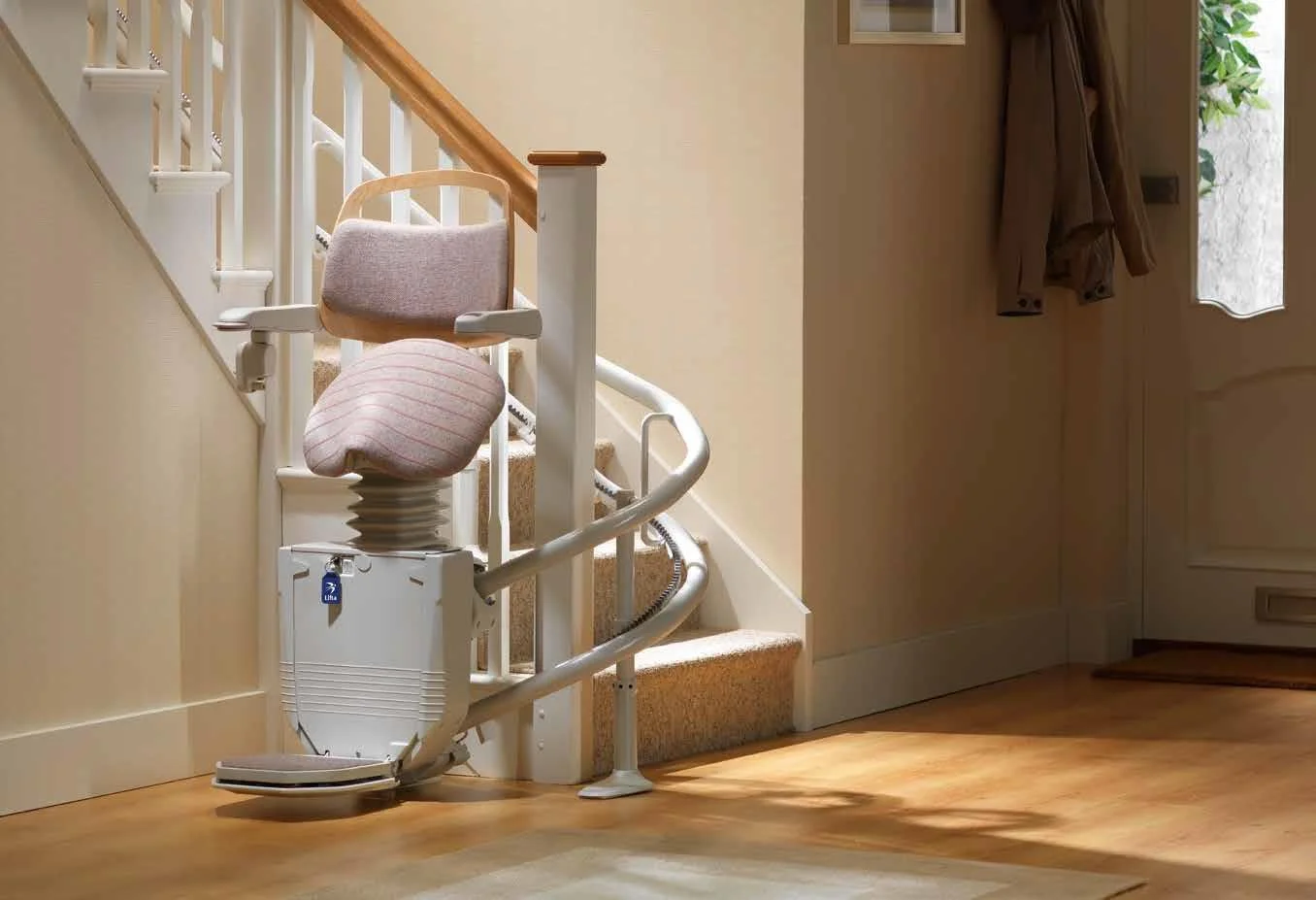
Homes here are multi-story by default. Pre-war stairs in this county are often narrow, steep and turned, which matters more than anything else when choosing a lift.
A straight staircase with no landing can usually take a straight-rail lift, which is the simpler install. A stair that turns at a landing or winds near the top needs a curved rail built to that exact staircase. Both come up constantly across Middlesex County, so the first step is always measuring the stairs you actually have.
About 134,000 units in the county sit in two-family or three-and-four-family buildings, the classic two-deckers and triple-deckers of Cambridge, Somerville, Lowell and Malden. These buildings often have shared entry stairs, so getting from the sidewalk to the front door can be as hard as getting to the second floor.
In a shared hallway, the rail and the folded chair have to leave room for other residents to pass. If the building is owned by a landlord, the owner needs to agree to the work. The Home Modification Loan Program described below is open to landlords of a person with a disability as well as to owners who live in the home.
The county covers about 847 square miles, 818 of them land. The Merrimack, Nashua and Concord rivers drain the north and west, and the Charles River forms much of the southeastern boundary. The older mill neighborhoods in those river valleys tend to be hillier and lower-lying than the towns around them.
Farther out, around Billerica, Chelmsford, Tewksbury and Hudson, you see more single-family homes, townhouses and split-level homes. A split-level has short runs of stairs between levels, so one lift rarely solves the whole house. It helps to decide which floors you truly need to reach every day before picking a model.
About 16.1 percent of the county's 1,648,885 residents are 65 or older, and about 62.7 percent of households own their home. The median property value is roughly $727,800, so many older homeowners have equity that can fund aging-in-place work instead of a move to assisted living.
Owning the home also opens the door to several of the loan programs below, since the Home Modification Loan Program and the USDA repair program both require homeowners.
Two statewide programs name stair lifts outright. The Home Modification Loan Program offers a 0% interest, deferred-payment loan up to $50,000 that is not repaid until the home is sold or transferred. The Massachusetts Assistive Technology Loan Program through Easterseals MA offers smaller 0% loans and larger loans at 4.75% interest.
MassHealth waivers and the local Aging Services Access Points fund home modifications, but their published descriptions do not name stair lifts, so approval is case-by-case. Veterans should know the VA HISA grant excludes stair glides. Start with the agency for your town, listed below, and ask about every program you might qualify for.
A MassHealth waiver for people 65+ (or 60-64 with a physical disability) who meet financial and nursing-facility level of care rules, with approximately a $10,000 lifetime cap for home modifications such as ramps and grab bars. Stair lifts are not named in the benefit descriptions, so ask your local ASAP care manager or call (800) 243-4636.
Transition support for residents who have spent at least 90 consecutive days in a qualified nursing facility or hospital and want to move back home, including home modifications in general; stair lifts are not specifically itemized. Call (617) 573-1647 and verify amounts with the assigned care coordinator.
A state-funded 0% interest, deferred-payment loan up to $50,000 for homeowners (up to $30,000 for manufactured or mobile homes) with a household member who has a disability or is 60+, and the program explicitly lists stair-lifts and platform lifts. MetroWest Center for Independent Living handles intake for the MetroWest towns at (508) 875-7853.
Statewide loans for residents with disabilities of any age or elders, from a 0% Mini Loan of $100-$4,000 to a 4.75% Financial Loan for purchases over $4,000; stair lifts are explicitly listed. Apply via MassATLoan.org or call (800) 244-2756.
Offers a free in-home assessment to adults 60+ or people with a disability, plus Adaptive Housing help with minor modifications and adaptive equipment; stair lifts are not specifically named. Call (617) 926-4100.
Provides care management and links to Frail Elder Waiver enrollment for its sixteen communities but does not itself grant stair lift funds. Call (781) 272-7177 or the toll-free line 888-222-6171.
Its Home Care Program includes Home Safety Adaptations on a sliding scale, with no co-payment for MassHealth recipients; stair lifts are not specifically named. Call (617) 628-2601.
A care-management agency that connects older adults to MassHealth waivers and state home-modification funding, without a stair lift fund of its own. Call (800) 892-0890.
Up to $6,800 lifetime for service-connected cases or $2,000 for non-service-connected, but the VA explicitly excludes stair glides and porch lifts. Veterans can call Middlesex County Veterans’ Services at (617) 679-6800 to look at other options.
Grants of up to $126,526 (SAH) or $25,350 (SHA) for veterans with qualifying severe service-connected disabilities, meant for major structural work; stair lifts are not specifically mentioned. Middlesex County Veterans’ Services at (617) 679-6800 can help with the application.
1% loans up to $40,000 and grants up to $10,000 for very low-income homeowners 62+ in USDA-designated rural areas; stair lifts are not specifically named. Most addresses in the county's cities and larger towns will not qualify, so check the USDA eligibility map first.
Older adults
125 Hartwell Avenue, Lexington, 02421
Veterans
40 Thorndike Street, Cambridge, 02141
Often, yes. Many pre-war staircases in Middlesex County are narrow, steep and turned, and any stair that turns at a landing needs a curved rail. A straight run with no turn can take a straight-rail lift.
The Home Modification Loan Program (HMLP) and the Massachusetts Assistive Technology Loan Program through Easterseals MA both explicitly list stair lifts. HMLP offers a 0% deferred loan up to $50,000, and Easterseals MA can be reached at (800) 244-2756.
Yes. HMLP covers households with a member who has a disability, the Easterseals MA loan serves residents with disabilities of any age, and the Frail Elder Waiver accepts people 60-64 with a physical disability.
The VA HISA grant explicitly excludes stair glides. SAH and SHA grants do not mention stair lifts, so veterans should also look at HMLP and the Easterseals MA loan, and can call Middlesex County Veterans’ Services at (617) 679-6800.
Start with your Aging Services Access Point: Somerville-Cambridge Elder Services at (617) 628-2601, Springwell at (617) 926-4100 for southern towns like Newton and Framingham, Minuteman Senior Services at (781) 272-7177 for towns like Lexington and Woburn, or AgeSpan at (800) 892-0890 for Lowell and nearby towns.
Probably not. About 96.5 percent of residents live in urban areas, and most addresses in the cities and larger towns will not qualify as USDA-rural. Check your address on the USDA eligibility map before applying.
Tell us about the stairs in your home and we will explain which lift fits, what it costs and how installation works.
