In Anderson, the Madison County seat, roughly two-thirds of the houses were built before 1970. Many are modest post-war homes with one stairway leading to a second floor or down to a basement. That single, straight staircase is the most common place we put a stair lift in this county.
The same pattern shows up beyond the city, in Elwood, Alexandria, Pendleton, Lapel, Chesterfield and the smaller towns along the White River and Fall Creek. This page walks through what your stairs likely need and which Indiana and local programs may help with the cost.
In Anderson, 23.6% of homes were built before 1939 and another 39.8% went up between 1940 and 1969. Only 7.9% date from 2000 or later. Single-family detached homes make up 69.5% of all units.
For a stair lift, an older house with one straight run of steps is usually good news. A straight rail mounts to the stair treads, not the wall, so plaster walls and narrow older staircases are rarely a barrier. Basement stairs in these homes are often straight too, which helps if laundry or a furnace is down there.
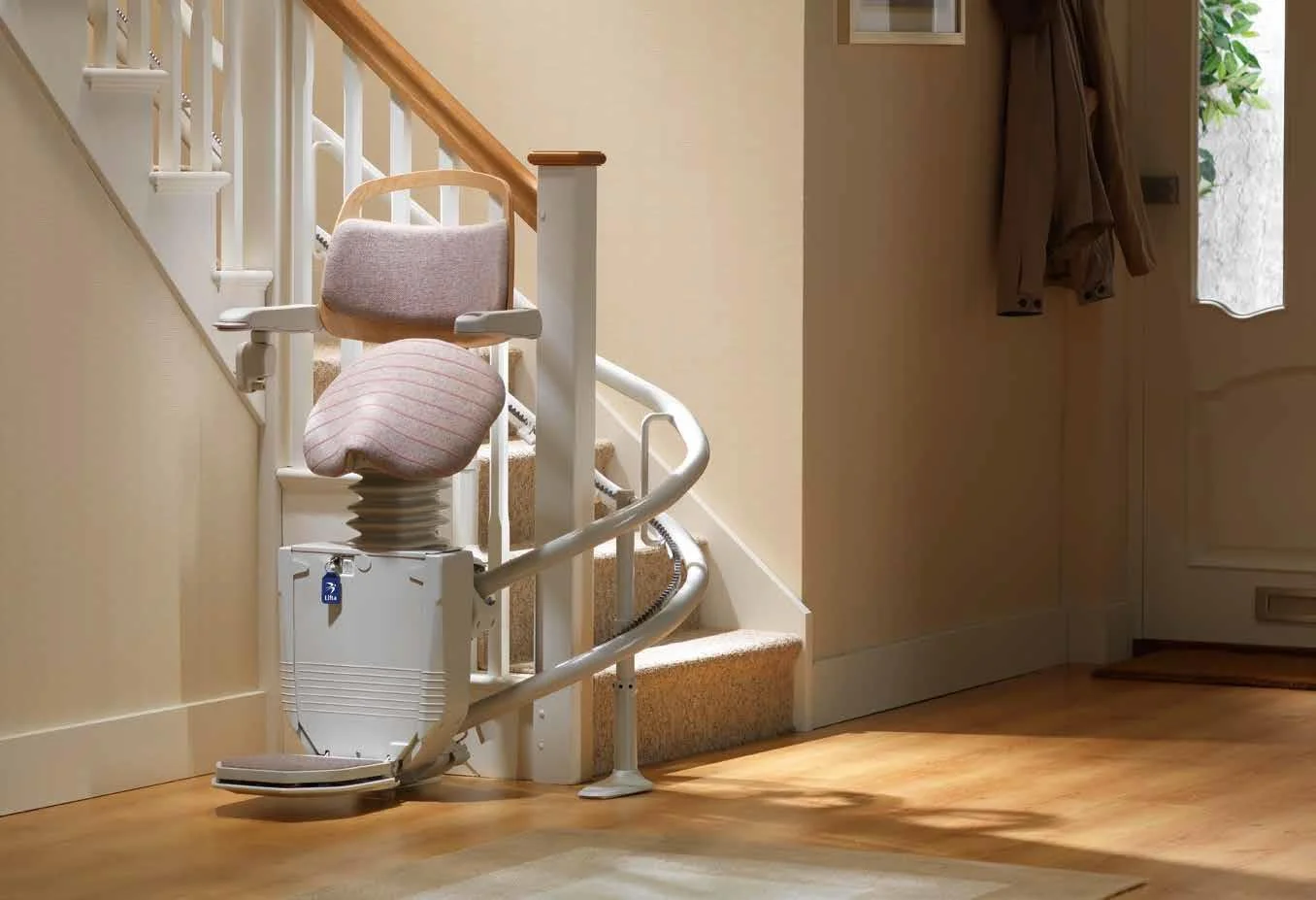
Older stairways do sometimes have a landing, a turn at the top or bottom, or a tight space at the foot of the steps. Those cases may call for a curved rail built to the exact shape of your staircase, which we measure in person.
Madison County also has split-level homes, townhouses, walk-up apartments and low-rise buildings. A split-level often has two short flights instead of one long one. Depending on how they connect, that can mean two straight lifts or one curved lift.
In a townhouse or walk-up apartment, the stairs may be shared or owned by someone else. If you rent, talk with your landlord before anything is installed. Entry steps outside the home are a separate question from indoor stairs, and an outdoor-rated lift or a platform lift may fit better there.
Madison County has 87,669 residents across 13 towns. In Anderson, homeownership is lower at 53.4%.
From 1939 to 2007, General Motors and related plants provided steady jobs here, peaking at almost 25,000 employees in 1974. Many longtime workers now live in older, paid-off homes on reduced incomes. That is why several of the funding programs below are means-tested, and why it is worth checking them before paying out of pocket.
The clearest source of help is the Indiana PathWays for Aging Waiver for people 60 and older, and the Health & Wellness Waiver for people under 60. Both are Medicaid programs, and the source names stair lifts among covered home modifications. You apply through LifeStream Services, the Area Agency on Aging for Madison County, at (765) 759-1121.
LifeStream also handles the CHOICE Program, which covers environmental modification but does not name stair lifts on its page. Veterans should know the VA HISA grant excludes stair glides, though the Madison County Veterans Affairs Office at 739 Main Street in Anderson can help you apply for other benefits. USDA Section 504 repair funds and the Indiana CDBG Owner-Occupied Rehabilitation Program cover accessibility work, but stair lifts are not named specifically. The INDATA Alternative Financing Program (AFP) is another statewide option to ask about.
Medicaid home and community services for Indiana residents who meet nursing-facility level of care, with PathWays for age 60+ and Health & Wellness for under 60 with a qualifying disability; stair lifts are listed as a covered home modification. Apply through LifeStream Services, or call (800) 403-0864.
A state-funded program for people 60+ or with a disability who are at risk of losing independence, with an asset limit of $250,000 plus a $20,000 exclusion and sliding-scale co-pays. It covers environmental modification, but stair lifts are not named on the source; call (800) 986-3505.
The local intake and case-management office for CHOICE, the PathWays and Health & Wellness waivers, and Older Americans Act services; its page does not list a stair lift benefit. Call (765) 759-1121 for a needs assessment.
A VA grant of up to $6,800 for service-connected disabilities or $2,000 for other non-service-connected disabilities, for permanent changes like entrance ramps and bathroom modifications. It does not cover stair lifts, which the VA lists as excluded stair glides; call (800) 827-1000.
Helps Madison County veterans and surviving spouses apply for federal and Indiana veterans benefits; its page does not list a stair lift or home-modification benefit. Visit 739 Main Street in Anderson or call (765) 641-9651.
Loans up to $40,000 at 1% for 20 years, and grants up to $10,000 for very-low-income homeowners 62+ in eligible rural areas, including accessibility improvements; stair lifts are not named specifically. About 38.8% of the county, mainly parts of Anderson, falls outside rural eligibility, so check your address first.
Grants that Madison County or its cities and towns apply for on behalf of low- and moderate-income homeowners, at roughly $5,000 per beneficiary, with interior accessibility modifications allowed; stair lifts are not named specifically. Funding depends on whether a local government holds an active award.
Older adults
1701 Pilgrim Blvd., Yorktown, 47396
Veterans
739 Main Street, Anderson, 46016
Start with LifeStream Services at (765) 759-1121. It is the intake point for the PathWays and Health & Wellness waivers and the CHOICE Program, and can assess which one fits.
Yes. The Health & Wellness Waiver serves Indiana residents under 60 with a qualifying disability who meet nursing-facility level of care, and the source lists stair lifts as a covered home modification.
Not through the HISA grant, which specifically excludes stair glides and porch lifts. The Madison County Veterans Affairs Office at (765) 641-9651 can help you look at other VA and Indiana veterans benefits.
Maybe not. About 38.8% of Madison County, mainly parts of Anderson, is outside USDA rural eligibility, so confirm your address qualifies before applying.
No. CHOICE has an asset limit of $250,000 plus a $20,000 exclusion and no hard income limit, though co-pays apply on a sliding scale.
Often, yes. Many older Anderson homes have a single straight stairway to the basement, and a straight lift mounts to the steps. A turn or landing may require a curved rail.
Tell us about the stairs in your home and we will explain which lift fits, what it costs and how installation works.
