Shelby County spreads across about 768 square miles of central Illinois, with Shelbyville as the county seat and nine smaller towns around it: Moweaqua, Windsor, Stewardson, Findlay, Cowden, Strasburg, Sigel, Herrick and Tower Hill. Interstate 57, U.S. Highways 45 and 51, and Illinois Routes 16, 32 and 128 tie these towns together, but the distances between them are real.
That spread-out, low-density layout shapes how people here age at home. Single-story houses and assisted-living spots are scarce, so for many families the practical question is not where to move, but how to keep using the house they already own. A stair lift is often the answer when the bedrooms or the only full bath sit up a flight of stairs.
Shelbyville's historic core grew up around early blacksmith shops, a general store, a stagecoach stop and a grist mill. Older multi-story buildings still stand there, including the Shelby County Courthouse, the Chautauqua Auditorium and the Tallman House on West Main Street, now the Shelby Inn and listed on the National Register of Historic Places.
Out in the neighborhoods and the other towns, most of what we measure falls into four groups: single-family homes, detached houses, ranch-style homes and split-level homes. In the older established towns, it is common to find a two-story house where every bedroom is upstairs.
A straight stairway with no turns takes a straight stair lift, the simplest rail to fit. Many split-level homes have short, straight runs between levels, and each run can be handled on its own terms.
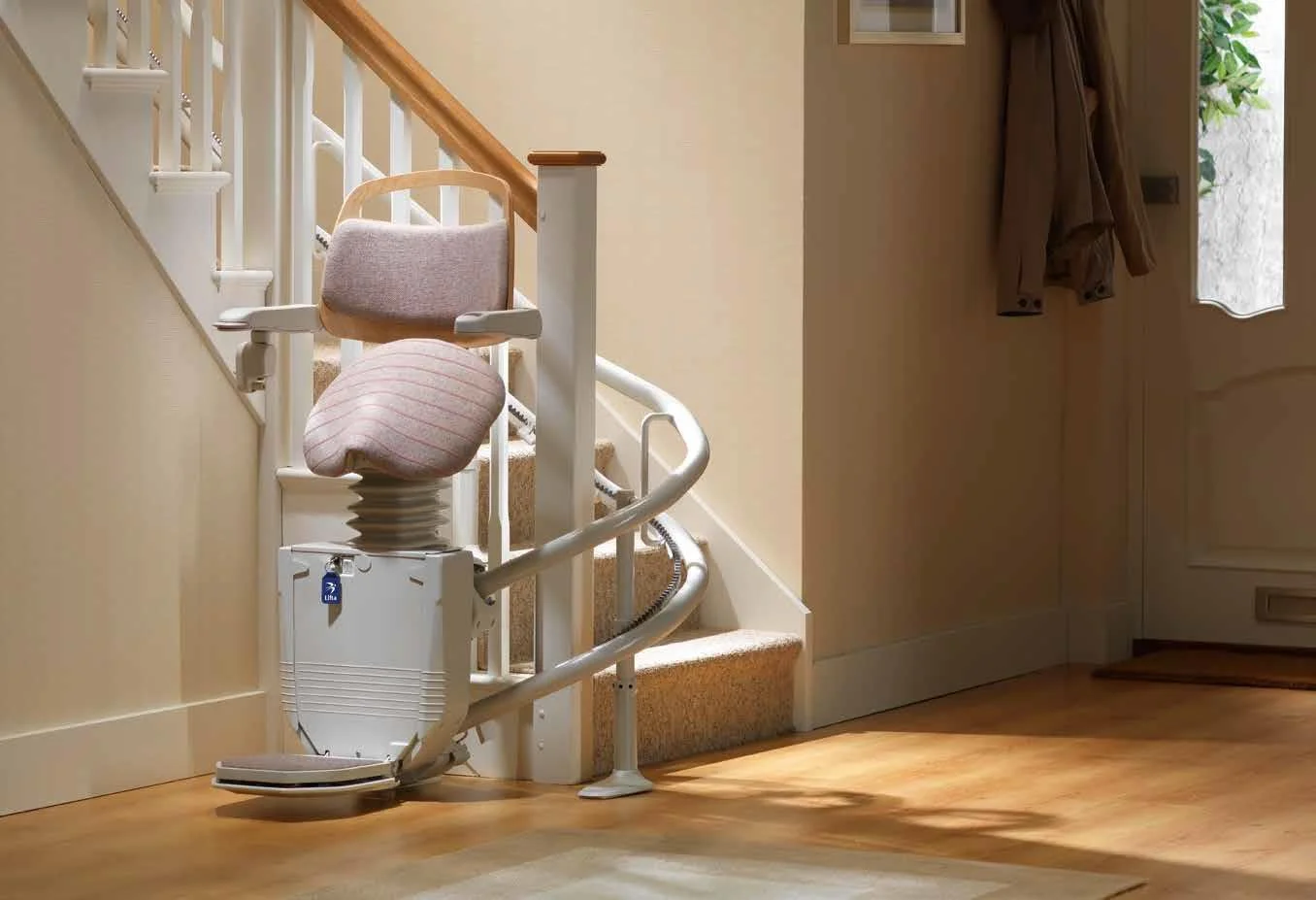
Older multi-story houses often have a landing, a turn or a narrow winding section. Those stairs need a curved rail built to the shape of that staircase, so we measure on site before quoting anything.
Ranch-style homes usually keep daily life on one floor, yet the front porch or a side entry can still have steps. For those spots, an outdoor lift or a vertical platform lift can be the better fit, especially when a wheelchair or walker is involved.
About 21.9% of Shelby County's 11,152 residents are 65 or older, and the housing stock is largely owner-occupied and long-tenured. The 2020 Census counted 10,015 housing units, with 79.7% of occupied units owned by the people living in them.
With a median home value of $137,100, moving or doing a major renovation is a big step relative to what the house is worth. Adding a stair lift leaves the house as it is and lets the owner keep using the upstairs.
No program in our notes for this county names stair lifts as a covered item, so the honest advice is to call and ask before you buy. The agencies below can tell you what applies to your situation and refer you onward.
South 1st St. in Shelbyville, (217) 342-8493. Be aware that the VA HISA grant specifically excludes stair glides, while the SAH and SHA grants do not mention them either way.
Statewide, other programs worth asking about include the Home Services Program - Persons with Disabilities Waiver, the IATP ATLOAN$ Program, the DRS Home Modification Program (Centers for Independent Living) and the Senior Citizens Assessment Freeze Homestead Exemption.
An Illinois Department on Aging program for residents 60 and older with non-exempt assets of $17,500 or less, offering in-home service, emergency home response, adult day service and medication dispensers; stair lifts and home modifications are not listed. Call (800) 252-8966.
The designated Area Agency on Aging for Shelby County, a referral and information hub for adults 60 and older and people with disabilities; no stair lift program is listed. Call (309) 829-2065.
A handicapped-accessible center at 325 E. North Ninth Street in Shelbyville for residents 60 and older, with activities, a Peace Meal nutrition site and information for seniors; it does not list stair lift or home modification funding. Call (217) 774-2251.
A Center for Independent Living with an office at 1604 W. Main Street, Suite 100, Shelbyville, serving people with disabilities of any age through advocacy, referral and peer counseling; stair lift funding is not listed, so ask directly about home modification help. Call (217) 774-4322.
Federal loans and grants for very-low-income homeowners in eligible rural areas to improve or modernize a home or remove health and safety hazards; stair lifts are not named and no dollar cap is stated, so check with USDA Rural Development.
A VA benefit of $6,800 or $2,000 lifetime, depending on disability status, for items like entrance changes, accessible bathrooms and ramps. It does not pay for stair lifts, which the VA excludes as stair glides.
Up to $126,526 (FY2026) for veterans with certain severe service-connected disabilities to buy, build or modify a permanent home; stair lifts are not mentioned specifically.
Up to $25,350 (FY2026) for veterans with qualifying service-connected disabilities to buy, build or adapt a permanent home; stair lifts are not mentioned specifically.
Older adults
1003 Maple Hill Road, Bloomington, 61704
Veterans
212 E. South 1st St., Shelbyville, 62565
Not through the HISA grant, which excludes stair glides. The SAH and SHA grants fund home modifications for certain service-connected disabilities but do not mention stair lifts, so ask the Illinois Department of Veterans Affairs office in Shelbyville at (217) 342-8493.
Yes, it is worth calling SAIL at (217) 774-4322. Its Shelbyville outreach office serves people with disabilities of any age, and ECIAAA also works with individuals with disabilities.
Its listed services are in-home service, emergency home response, adult day service and medication dispensers, and stair lifts are not mentioned. Applicants must be 60 or older, have non-exempt assets of $17,500 or less and apply for Medicaid.
The Shelby County Senior Center at (217) 774-2251 acts as an information resource for county residents 60 and older. ECIAAA at (309) 829-2065 is the regional referral agency for Shelby County.
Usually, yes. Straight runs take a straight rail, while stairs with a landing or turn need a curved rail fitted to that staircase, which is why we measure in person.
The USDA Section 504 Single Family Housing Repair Loans & Grants serve very-low-income homeowners in eligible rural areas for repairs and removing safety hazards. Stair lifts are not named, so confirm with USDA Rural Development.
Tell us about the stairs in your home and we will explain which lift fits, what it costs and how installation works.
