Schuyler County spreads across 441 square miles of west-central Illinois, and the 2020 Census counted every resident as rural. Rushville is the county seat and the one town on this page, surrounded by farmland and small roads. Here, the closest single-story housing or assisted living can be a long drive from home.
That distance is why many longtime owners here would rather fix the stairs than move. Single-family, ranch-style and split-level homes are common, along with some walk-up apartments, and many of them have just one stairway between the floors people use every day. A stair lift can keep both levels of the house in use.
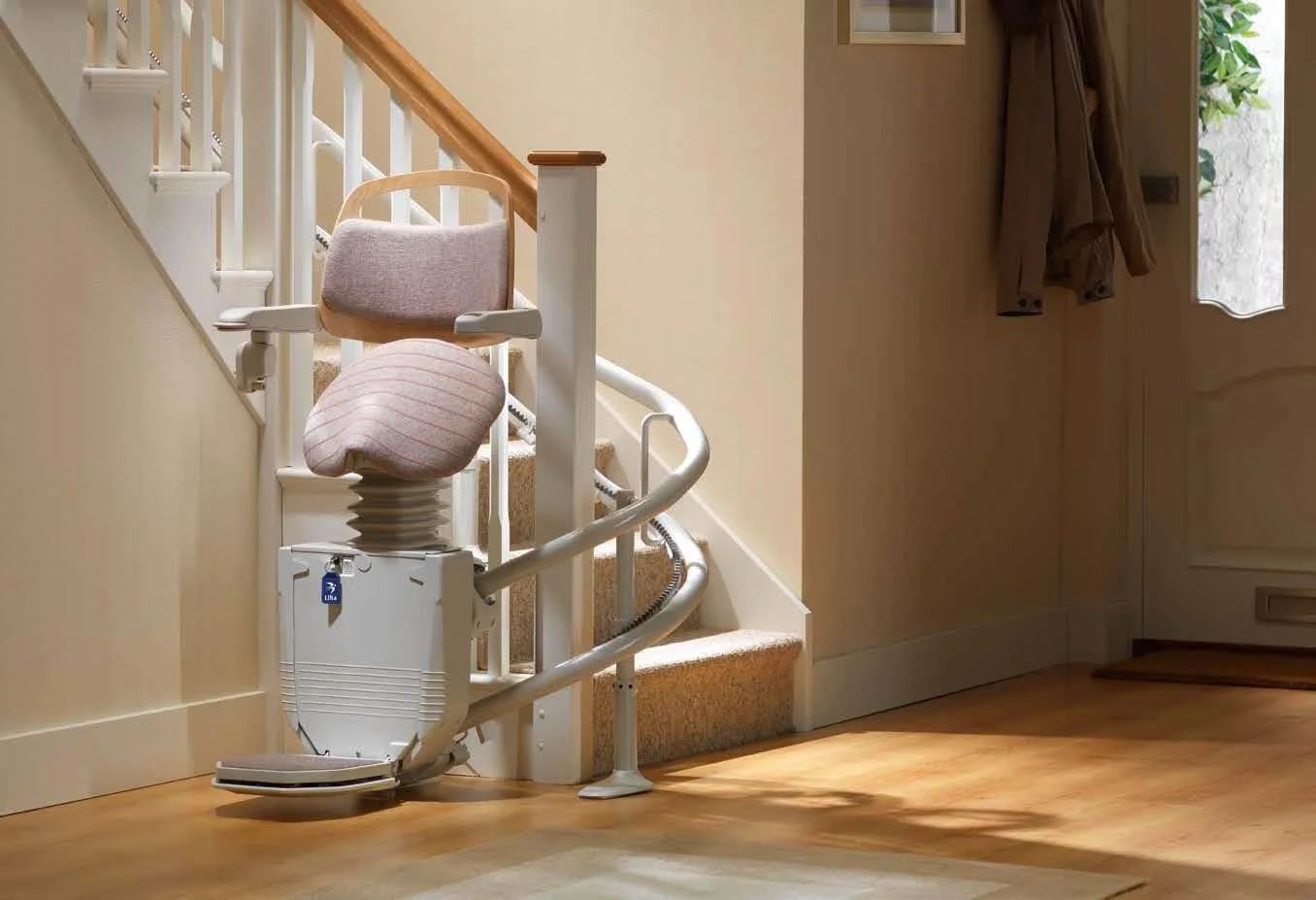
A single straight stairway is the simplest job. A straight rail mounts to the stair treads, not the wall, and usually goes in without changing the house.
Split-level homes are different. They have several short flights, and each one may need its own lift, or a curved rail that follows the turns. We measure every flight before recommending either.
Ranch-style homes often look like they have no stairs, but steps can still show up at the entry or between levels. Outdoor lifts and platform lifts are options where steps are outside or where someone uses a wheelchair.
Nearly a quarter of Schuyler County residents, 23.6%, are 65 or older, and the median age is 47.5. Of 2,807 households, 79.2% own their home.
Owning matters here. An owner can approve rail mounting on the stairs without waiting on a landlord, and several of the programs below are written for homeowners. If you rent, ask your landlord first, since at least one program accepts renters with landlord approval.
The 2020 Census showed a 15.5% housing-unit vacancy rate in the county. That points to an aging housing stock that turns over slowly, typical of west-central Illinois county seats.
Selling one house and finding a single-story place nearby is not always realistic in a setting like this. For many families, a lift on the existing stairs is the more practical choice.
Incomes here run below state and national medians, so it makes sense to check for help before paying out of pocket. The right first call depends mostly on age and veteran status.
Under 60 with a lasting disability and Medicaid eligibility? The Illinois Home Services Program is the one source on our list that names stair lifts outright. Age 60 and older? Start with the West Central Illinois Area Agency on Aging at (217) 223-7904 for referrals.
The VA HISA benefit excludes stair glides, so ask the VA about the Specially Adapted Housing or Special Home Adaptation grants instead. Homeowners with very low income can also look at USDA Section 504 repair loans and grants. Each program is listed below.
A statewide Medicaid waiver for Illinois residents under 60 with a severe, lasting disability who are at risk of nursing facility placement, and its home modification service lists stair lifts by name. Call (800) 843-6154.
The Department of Healthcare and Family Services overview of the Persons with Disabilities waiver under the Home Services Program; this page does not list stair lifts or itemize services. Call (866) 468-7543.
A grant-funded program at no cost to the applicant for income-qualified Illinois residents with a disability who are not served by the Home Services Program; stair lifts are not listed, and the waiting list is long. Call (217) 525-1308 or apply through WCICIL.
The independent living center serving Schuyler County, with a Transition Program that can help with home accessibility for people moving out of nursing homes; stair lifts are not listed, so ask directly. Call (217) 223-0400.
The aging agency for Schuyler County and the first call for seniors 60 and older looking for a home modification referral; the Community Care Program itself does not fund home modifications. Call (800) 252-8966 or (217) 223-7904.
Loans up to $40,000 at 1% fixed interest and grants up to $10,000 (age 62 or older) for very-low-income rural homeowners; stair lifts are not named, though modifications are allowed. Call (217) 403-6200 and confirm your address is eligible.
A VA benefit of up to $6,800 or $2,000 for medically necessary home accessibility work, but it explicitly excludes stair glides. Call (800) 827-1000.
VA grants of up to $126,526 (SAH) or $25,350 (SHA) for veterans with qualifying severe disabilities who own the home; stair lifts are not named among the listed modifications.
Older adults
639 York Street, Suite 333, Quincy, 62301
Veterans
111 E Washington St, Rushville, 62681
Yes, possibly. The Illinois Home Services Program covers people under 60 with a severe disability who are Medicaid-eligible and at risk of nursing facility placement, and it lists stair lifts by name. Call (800) 843-6154.
The West Central Illinois Area Agency on Aging in Quincy, at (217) 223-7904 or (800) 252-8966. It serves Schuyler County and can make home modification referrals, though its Community Care Program does not pay for modifications itself.
The HISA benefit specifically excludes stair glides. Veterans with qualifying severe service-connected disabilities can ask about the Specially Adapted Housing or Special Home Adaptation grants, though those sources do not name stair lifts either. Locally, Rushville City Hall can be reached at (309) 836-2243.
The whole county was classified as rural in the 2020 Census, so it is very likely eligible for USDA Section 504 repair loans and grants. Eligibility still has to be confirmed for your exact address. Call (217) 403-6200.
Usually, yes. Split-level homes have several short flights, so the answer may be a lift on each flight or a curved rail. We measure each flight before suggesting one.
The West Central Illinois Center for Independent Living, which serves Schuyler, Adams, Brown, Hancock, McDonough and Pike counties. It is also the local intake point for the Illinois Home Modification Program. Call (217) 223-0400.
Tell us about the stairs in your home and we will explain which lift fits, what it costs and how installation works.
