From the older in-town homes around Macomb to farmhouses outside Bushnell, Colchester and Prairie City, a lot of McDonough County housing was built with the bedrooms upstairs. In many of these early-20th-century homes and multi-story farmhouses, the stairs also lead to the only full bathroom in the house.
That layout is usually what brings families to us. A stair lift can keep the whole house usable without a move or a major remodel. This page covers how local homes affect the choice of lift and which programs in the county and state may help with the cost.
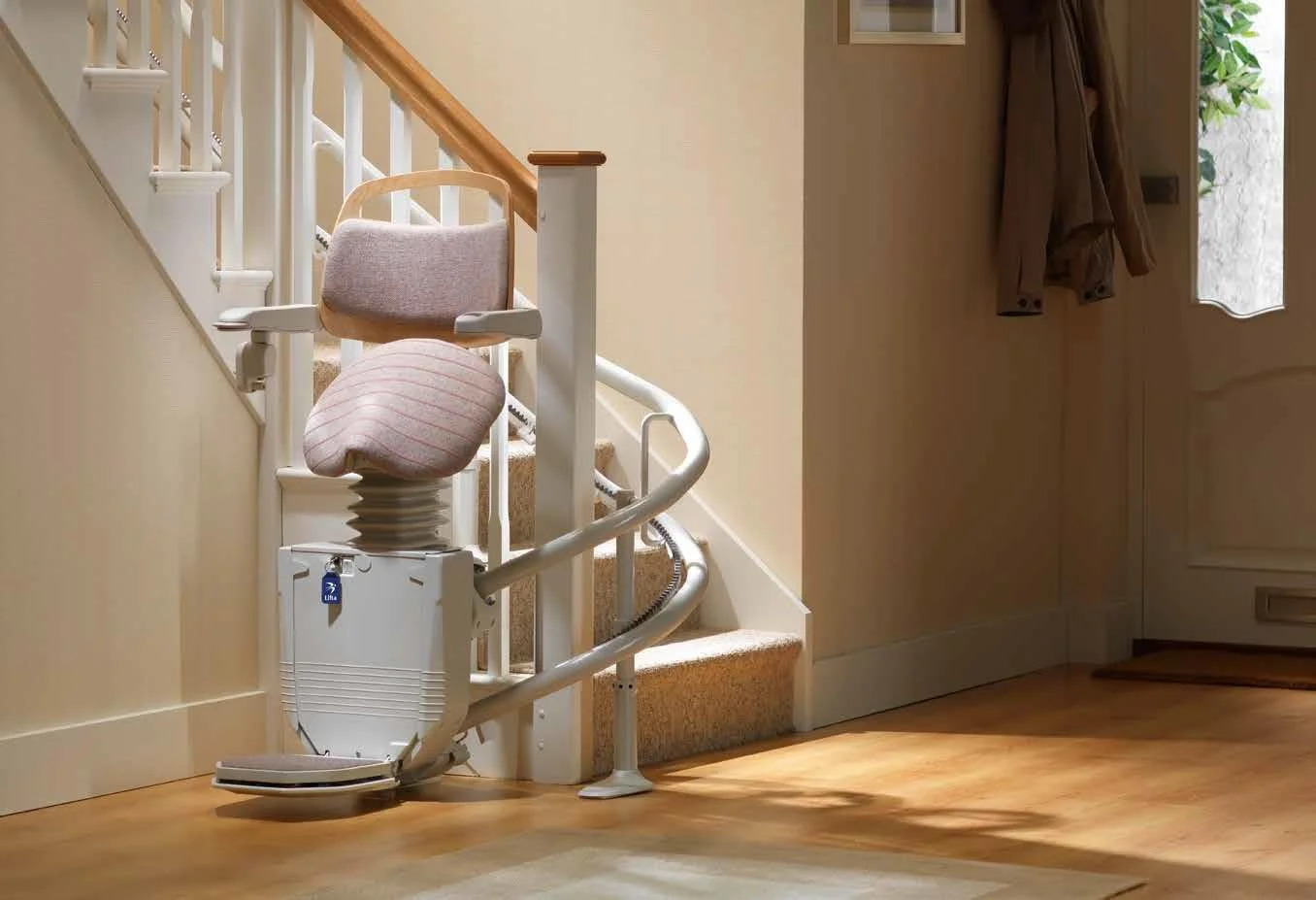
The housing stock here is modest and older, closer to a county-seat and college town than to newer suburban construction. Long-held family homes in Macomb and the smaller towns often have one straight staircase between floors. A straight staircase is the simplest and usually the quickest to fit with a straight stair lift.
Farmhouses can be a different story. Stairs with a turn, a landing or a narrow top step often call for a curved lift, which is built to the exact shape of the staircase. We measure on site before recommending either type.
Split-level homes have short flights between levels, and a family may need a lift on more than one of them. Ranch-style homes keep most rooms on one floor, but entry steps can still be a problem, and an outdoor lift or a platform lift may be the better fit there.
Townhouses and walk-up apartments are common in Macomb, partly because of the rental market around Western Illinois University. About 37.8% of occupied homes in the county are renter-occupied per the 2020 Census. If you rent, talk with the property owner before any lift is installed.
McDonough County covers about 589 square miles of flat prairie, with Macomb near the center. As of the 2020 Census, 42.5% of residents lived in rural, unincorporated areas rather than in town.
For a parent on a farm near Blandinsville, Industry, Good Hope or Bardolph, that can mean a longer wait for in-home service from providers based in Macomb. It helps to plan the measurement visit, installation and any follow-up service together so fewer trips are needed.
The median household income was $52,795 in 2024, and the poverty rate of 17.2% runs well above the national figure of 12.5%.
Because of this, many older residents are more likely to qualify for income-based programs than to pay the full cost themselves. None of the programs below name stair lifts outright, so coverage has to be confirmed with each one before work starts.
For someone 60 or older, the usual first call is the Western Illinois AAA (PSA 3) at (309) 793-6800. It runs the Aging and Disability Resource Center and connects residents to the Illinois Community Care Program. Adults under 60 with a severe disability can ask about the Home Services Program waiver.
Homeowners with low incomes can look at the USDA Section 504 repair program, the WIRC Homeowner Assistance Fund and the IHDA Home Repair and Accessibility Program. Veterans should call the McDonough County Veterans Assistance Commission at (309) 833-3275, at the courthouse in Macomb. Keep in mind that the VA HISA grant specifically excludes stair glides.
A state in-home services program for Illinois residents 60 and older with non-exempt assets of $17,500 or less and an assessed need for long-term-care-level support. Home modifications are among its authorized services, but stair lifts are not named, so ask the local Care Coordination Unit through the Western Illinois Area Agency on Aging; the program line is (800) 252-8966.
A Medicaid waiver for Illinois residents under 60 with a severe disability who meet Medicaid financial rules; its Environmental Modification service covers changes that make up for lost mobility or strength, but stair lifts are not named. Confirm with a waiver caseworker by calling (800) 843-6154.
A VA grant for medically needed home modifications, up to $6,800 lifetime for service-connected disabilities or $2,000 for other eligible disabilities. It specifically excludes stair glides, so it will not pay for a stair lift.
VA grants for veterans with certain serious service-connected disabilities who own or will own the home: SAH up to $126,526, SHA up to $25,350, and Temporary Residence Adaptation up to $50,961 or $9,100 (FY2026 figures). Home modifications are covered in general, but stair lifts are not named.
Repair loans up to $40,000 at 1% fixed interest and grants up to $10,000 for very-low-income rural homeowners, with grants limited to those 62 and older; the McDonough County and Macomb area qualifies as rural. Grants can go toward accessibility improvements, but stair lifts are not specifically named.
Up to $60,000 per household for owner-occupied homes in McDonough and nearby counties where the household had COVID-19-era financial hardship and meets income limits. WIRC inspectors decide what can be fixed and stair lifts are not named; call (309) 837-2997.
A state-funded program for low- and very-low-income homeowners that covers accessibility improvements, though stair lifts are not named and most local grantees keep waitlists. Call IHDA at (312) 836-5200 to find the current grantee for McDonough County.
Case-by-case help for people with a documented disability in McDonough and nearby counties, including home accessibility for those moving out of nursing homes, plus loans of walkers, canes and wheelchairs. Stair lifts are not named; call (217) 223-0400.
The information and care-coordination hub for older adults and adults with disabilities in ten western Illinois counties, including McDonough County, and the door to CCP and fall-prevention classes like A Matter of Balance. It does not list a separate stair lift benefit; call (309) 793-6800.
Older adults
729 34th Avenue, Rock Island, 61201
Veterans
c/o McDonough County Courthouse, 1 Courthouse Square, Macomb, 61455
The VA HISA grant specifically excludes stair glides, so it will not cover one. The SAH and SHA grants cover home modifications in general but do not name stair lifts, so ask the VA or the McDonough County Veterans Assistance Commission at (309) 833-3275.
Yes, possibly. The Home Services Program waiver serves Illinois residents under 60 with a severe disability who meet Medicaid financial rules, and its Environmental Modification service may apply after a caseworker confirms it. Call (800) 843-6154.
Call the Western Illinois AAA (PSA 3) at (309) 793-6800. It runs the Aging and Disability Resource Center and handles care coordination for the Illinois Community Care Program in McDonough County.
Usually, yes. Stairs with a turn or landing generally need a curved lift built to the shape of the staircase, and we measure in the home to confirm what will fit.
Many service providers are based in Macomb, so rural homes can mean longer travel and wait times. Rural homeowners may also qualify for USDA Section 504 repair loans and grants, since the county is classified as rural.
Renters should get the property owner's approval before any installation. Most of the repair programs listed here, such as the WIRC fund and USDA Section 504, are limited to owner-occupied homes.
Tell us about the stairs in your home and we will explain which lift fits, what it costs and how installation works.
