From Morris and Minooka to Mazon, Gardner, Carbon Hill and Verona, Grundy County is a place of long-owned single-family homes, split-levels and older farmhouses spread across flat, open country. The land may be level, but plenty of the houses are not. A farmhouse with a steep upstairs or a split-level with short runs between floors can become the hardest part of staying home.
About 75.9% of households in the county own their homes, and 13.6% of residents are 65 or older. For many families, the question is not whether to move but how to keep using every floor of a house they have lived in for years. This page walks through how local homes affect the choice of lift and where Grundy County residents can look for help paying for one.
Older two-story farmhouses and small-town homes in places like Coal City, Diamond and South Wilmington often have a single flight of stairs. If that flight runs straight from bottom to top with no turn, a straight stair lift is usually the simplest fit and the quickest to install.
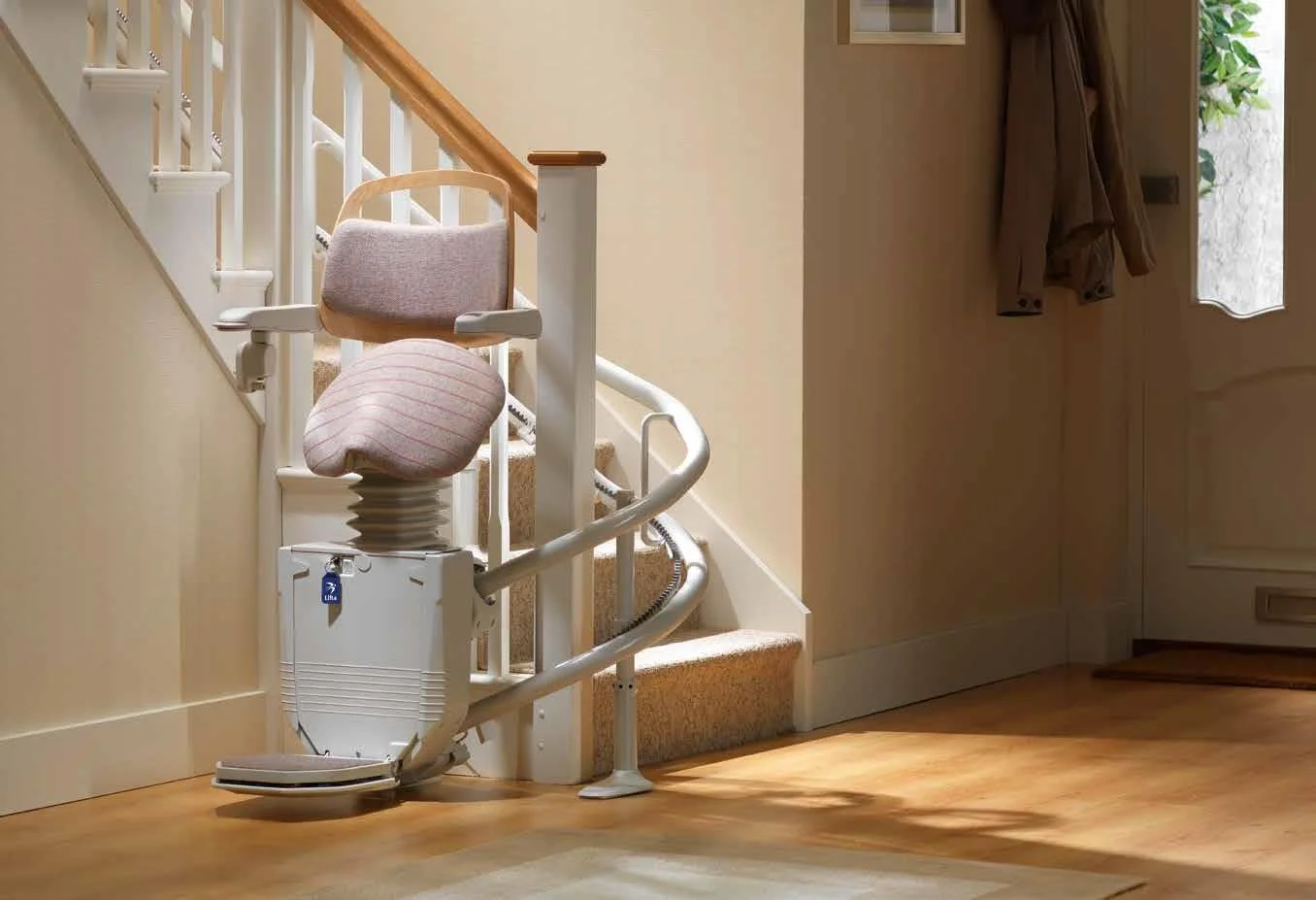
Many older staircases turn at a landing or wind near the top. Those need a curved lift with a rail built to follow that exact staircase. We measure on site before quoting, because no two older stairways are quite the same.
Split-level homes are common here, and they usually have two or more short flights instead of one long one. Depending on how the levels connect, that can mean one curved rail or separate straight lifts on each run. It helps to decide first which levels the person truly needs to reach every day.
Townhouses tend to have narrower stairs, so rail placement and a folding seat matter for keeping the stairs usable for everyone else. In low-rise buildings, a lift inside a private unit is possible, but shared stairways and entry steps usually need approval from whoever manages the building.
Sometimes the problem starts outside, with porch or entry steps. An outdoor stair lift is built for exposed steps and is a different unit from an indoor model.
For someone who uses a wheelchair, a seated lift may not be enough. A platform lift carries the chair itself and can be a better answer at an entry or a short rise. Because about 25.0% of county residents live in rural areas, where getting to services can take a car and some planning, adapting the home often makes more sense than moving far away.
Help depends mostly on age, disability, veteran status and income. For people under 60 with a severe disability who are Medicaid-eligible, the Illinois Home Services Program is the one source here whose state page names stair lifts directly.
Residents 60 and older should start with the Grundy County Health Department Senior Services line at (815) 941-3121 or AgeGuide. Veterans can call the Grundy County Veterans Assistance Commission at (815) 941-3152, at 1320 Union St in Morris. Homeowners with low income in rural areas can also look at USDA Section 504 and the IHDA repair program. Each program below lists what the source says about coverage.
A state Medicaid waiver for Illinois residents under 60 at application with a severe disability; the IDHS home modification page lists stair lifts among its examples. Call the IDHS Help Line at (800) 843-6154.
The HFS description of the same waiver covers home changes for loss of function but does not list stair lifts by name. The operating agency contact is (877) 581-3690.
For people with a developmental disability enrolled in a DDD waiver; adults on the Home-Based Services waiver can get up to $15,000 per five-year period for modifications and equipment, though stair lifts are not listed by name. Call (800) 843-6154.
Free care coordination and in-home needs assessment for residents 60 and older; the county page does not mention stair lifts or home modifications. Call (815) 941-3121 as a first step for a senior.
The regional aging agency serving Grundy County, offering referrals, caregiver support and help with the Community Care Program; it is not a confirmed stair lift funding source. Call (800) 252-8966, or the AgeGuide (PSA 2) office in Lombard at (630) 293-5990.
The local Center for Independent Living for people with disabilities in Will and Grundy counties, offering advocacy, peer counseling and independent living skills; its site does not mention stair lifts. Call (815) 729-0162.
Funds health, safety and accessibility repairs for low- and very low-income homeowners through local grantee organizations, and stair lifts are not listed by name. Demand far exceeds funding and waitlists are common, so contact IHDA to find the current local grantee.
Loans up to $40,000 at 1% and grants up to $10,000 for very low-income homeowners age 62 and older in USDA-eligible rural areas; accessibility changes qualify, but stair lifts are not named. Eligibility is checked address by address.
A VA benefit for medically necessary home accessibility changes, with lifetime caps of $6,800 or $2,000; it explicitly excludes stair glides, so it does not cover stair lifts. Call (800) 827-1000.
Grants for veterans with qualifying severe service-connected disabilities, up to $126,526 for SAH and $25,350 for SHA in FY2026; stair lifts are not named among covered changes. Local help is available at (815) 941-3152.
The county office in Morris that helps veterans and dependents with VA enrollment, claims, transportation and basic-needs assistance; it does not list stair lift help. Call (815) 941-3152 to get help with VA applications.
Older adults
1910 S. Highland Ave., Suite 100, Lombard, 60148
Veterans
1320 Union St, Morris, 60450
Yes, possibly. The Illinois Home Services Program serves residents under 60 at application who are Medicaid-eligible and have a severe disability, and the IDHS page lists stair lifts as an example. Call (800) 843-6154.
For anyone 60 or older, the Grundy County Health Department Senior Services line at (815) 941-3121 can set up a needs assessment through the Community Care Program. AgeGuide at (800) 252-8966 is the regional aging agency.
The VA HISA benefit explicitly excludes stair glides. SAH and SHA grants cover home adaptations for qualifying veterans but do not name stair lifts, so ask the Grundy County Veterans Assistance Commission at (815) 941-3152 to help review your options.
It might. USDA Section 504 offers repair loans and, for very low-income homeowners 62 and older, grants up to $10,000 in eligible rural areas. Eligibility is set by address, not by county, so check your specific home.
Split-levels usually have several short flights. Depending on the layout, that can mean one curved rail or a straight lift on each flight, so an on-site measurement is the best way to decide.
HRAP funds accessibility improvements for low- and very low-income homeowners, but it does not list stair lifts by name and has waitlists. Contact IHDA to find the local grantee and ask whether a stair lift qualifies.
Tell us about the stairs in your home and we will explain which lift fits, what it costs and how installation works.
