North Dakota spreads 608,158 people across 177 towns, from Cass County and Grand Forks County in the east to Williams County and McKenzie County in the west. A lot of those homes have a bedroom or bathroom on a second floor or a laundry room in the basement, and the stairs to reach them do not get easier with time.
This page covers the basics for families anywhere in the state: which kind of stair lift fits which kind of staircase, and which North Dakota and federal programs can help pay for one. For details closer to home, each county below has its own page.
About 15.4% of North Dakotans are 65 or older. For many of them, the home they raised a family in still works fine on the main floor, and the trouble starts at the staircase.
Homeownership matters for this decision. Around 57.2% of households in the state own their home, which means they can install a lift without asking anyone. If your parent rents, talk with the landlord before an installer comes out, since the rail mounts to the stair treads.
A straight staircase with no turns or landings is the simplest case. A straight rail is usually the quickest install and the easiest to remove later if the house is sold.
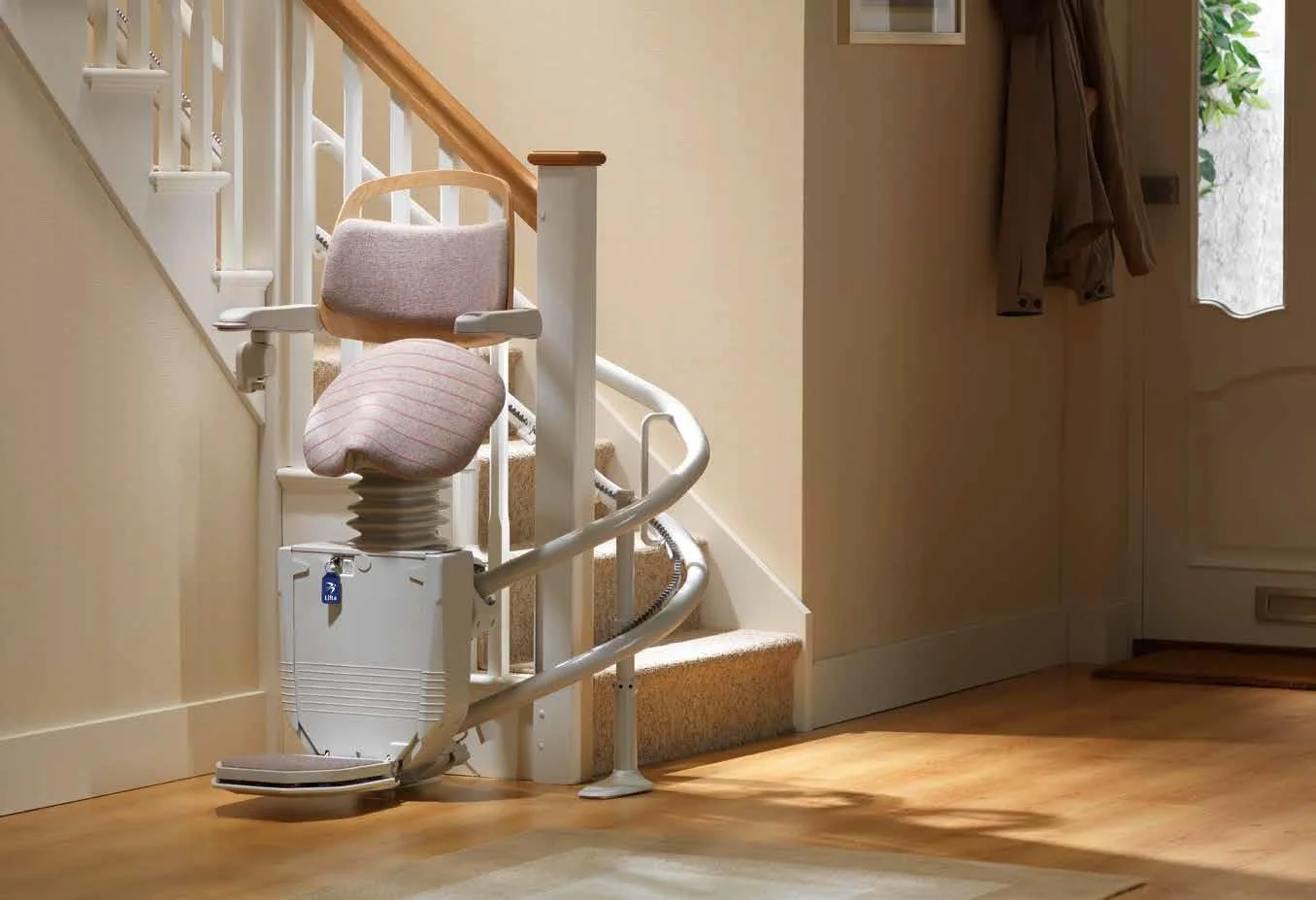
Stairs that turn, wrap around a landing or curve need a curved rail built to fit that exact staircase. Expect a measuring visit first and a longer wait for the rail to be made.
Steps outside, such as a back porch or a stairway down from a deck, call for an outdoor model built to handle the weather. For someone who uses a wheelchair and cannot transfer to a seat, a platform lift may be the better fit than a chair.
The VA can be a real source of help, but it helps to know which part of the VA does what.
The HISA grant pays for structural changes like ramps, up to $6,800 for service-connected conditions or $2,000 for non-service-connected ones. The stair lift itself comes through VA Prosthetics (PSAS) when it is medically prescribed, with no set dollar cap. Call (877) 222-8387 to start.
North Dakota has two programs that can pay for a stair lift as an Environmental Modification. The Medicaid HCBS Aged and Disabled Waiver covers people on Medicaid, and SPED covers seniors who are not on Medicaid, with a cost share based on income. Both use the same limit: the lesser of the highest-cost skilled-nursing-facility monthly rate or 20% of the home's tax-assessed value. Both can be reached at (855) 462-5465.
If those do not fit, ND Assistive offers a 2% APR loan with terms from 3 to 60 months, sized to what the household can repay. Medicaid State Plan Personal Care and the Homestead Property Tax Credit do not pay for equipment, though the tax credit can free up household money. Each program is summarized below.
We have pages for counties across the state, including Burleigh County, Morton County, Ward County, Stark County, Stutsman County, Richland County and Walsh County. Each one looks at that county in more detail.
If your county is in the list, start there. The payment programs on this page apply statewide.
A Medicaid home and community-based waiver that covers stair lifts as an Environmental Modification, limited to the lesser of the highest-cost skilled-nursing-facility monthly rate or 20% of the home's tax-assessed value, with prior authorization required. Call (855) 462-5465.
A state-funded program for seniors not on Medicaid that covers home modifications, including stair lifts, with an income-based cost share and the same limit as the Medicaid waiver. Call (855) 462-5465.
A direct loan at 2% APR with 3 to 60 month terms that can finance a stair lift as assistive technology, with the amount set case by case based on ability to repay. Call (800) 895-4728.
VA Prosthetics (PSAS) covers a medically prescribed stair lift with no set dollar cap, while the HISA grant covers ramps and structural changes up to $6,800 (service-connected) or $2,000 (non-service-connected), not the lift. Call (877) 222-8387.
A Medicaid benefit that pays for caregiving hours based on an assessment and does not cover stair lifts or other equipment. Call (844) 854-4825.
A property-tax reduction scaled to income for seniors and people with disabilities; it does not pay for stair lifts, but the savings can go toward home changes. Call (701) 328-7088.
Through the HCBS Aged and Disabled Waiver, yes, as an Environmental Modification with prior authorization. Regular Medicaid State Plan Personal Care does not fund equipment. Call (855) 462-5465 about the waiver.
SPED is a state-funded program that covers home modifications, including stair lifts, for seniors who are not on Medicaid. There is an income-based cost share. Call (855) 462-5465.
There is no fixed dollar amount. The limit is the lesser of the highest-cost skilled-nursing-facility monthly rate or 20% of the home's tax-assessed value.
Both can be covered, through different offices. HISA pays for ramps and structural changes, up to $6,800 or $2,000 depending on service connection. The lift itself comes through VA Prosthetics when it is medically prescribed. Call (877) 222-8387.
ND Assistive offers a loan at 2% APR with terms from 3 to 60 months. The amount depends on ability to repay. Call (800) 895-4728.
Yes. Stairs with a turn or landing need a curved rail made to fit your staircase, so plan on a measuring visit before the rail is ordered.
Tell us about the stairs in your home and we will explain which lift fits, what it costs and how installation works.
