Oliver County covers about 722 square miles of rolling farm country, and most people live on farmsteads or in small agricultural communities around Center, the county seat. With roughly 2.6 people per square mile, a neighbor or relative may be a long drive away when someone has trouble on the stairs.
Many homes here are older standalone houses, often built on more than one level with interior stairs. Those stairs are the reason we get calls from Oliver County: a parent wants to stay on the farm, but the trip to the bedroom or laundry has started to feel risky.
The local housing is mostly single-family homes and detached houses, including ranch-style homes and split-level homes. Site-built and manufactured homes both show up on farmsteads around Center. Each type changes how we measure and what kind of lift fits.
A straight staircase with no turns or landings is the simplest case and usually takes a straight rail. Split-level homes often have short runs of steps between floors, so we look at whether one lift can serve the trip a person makes most often, or whether a different setup makes more sense.
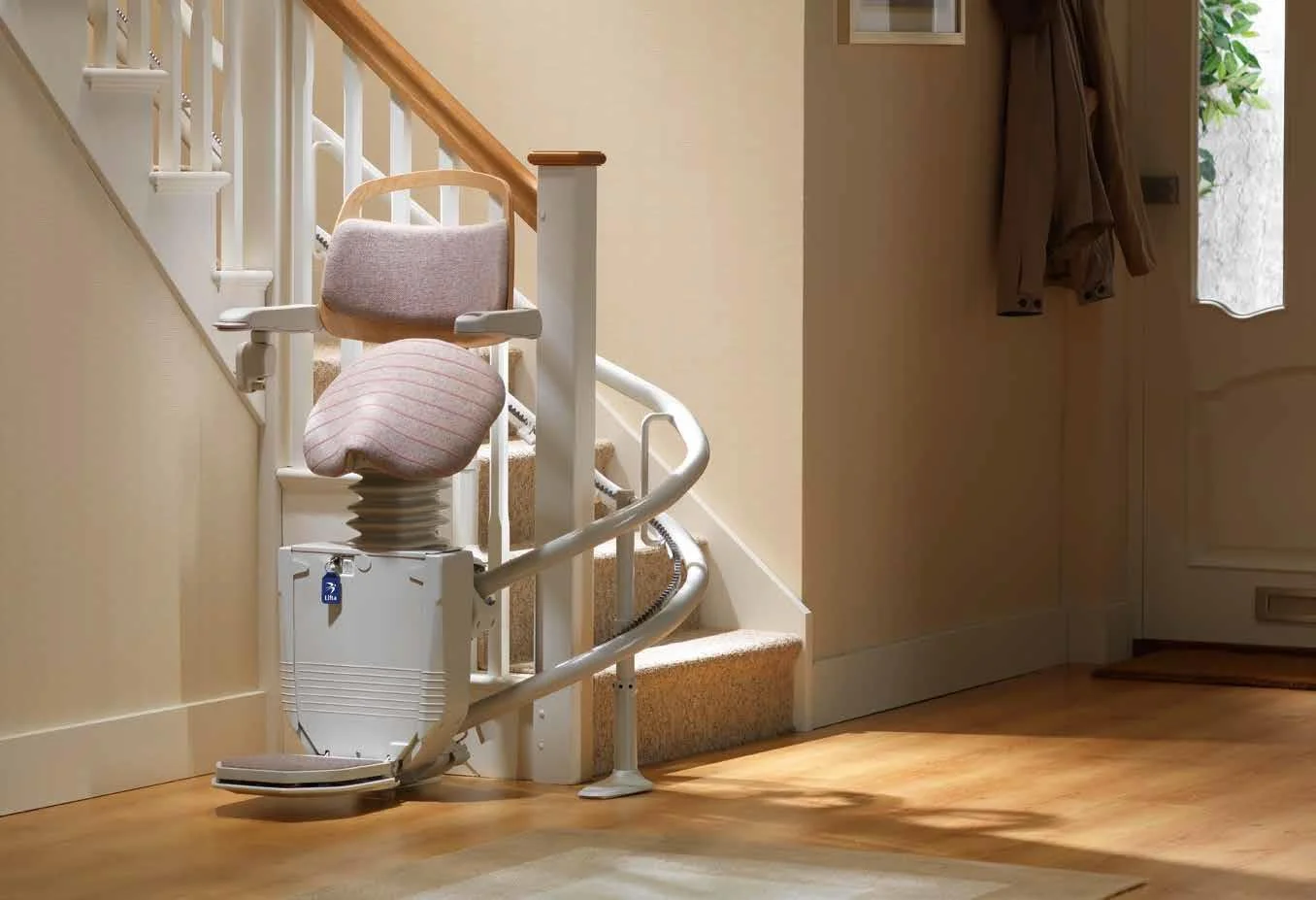
If a staircase turns, has a landing in the middle or curves, a curved rail built to that stair is needed. We check stair width, the condition of the treads and where the rail can mount before recommending anything.
Upper Midwest winters bring snow, ice and extreme cold. For an older person, icy entry steps can be as dangerous as the stairs inside.
An outdoor stair lift is built for weather exposure, and a platform lift can help when someone uses a wheelchair or walker and needs to get from the yard to the door. We talk through how the lift will be cleared of snow and used in cold before suggesting one.
Winter weather also slows travel across a rural county. Planning a measurement and install outside the worst stretch of the season can make the process easier on everyone.
About 22.7 percent of residents are 65 or older, and 97.3 percent own their homes. That combination means many people are aging in houses they own and can modify, rather than moving to a single-story apartment.
If that includes your parent or spouse, the VA programs below are worth a call before you pay out of pocket.
Agriculture drives the local economy, and the reported median household income of $62,308 does not leave much room for large home upgrades. Outside help is worth checking first.
Veterans can start with the Oliver County Veterans Service Office at the Courthouse, 115 West Main Street, Center, ND 58530, phone (701) 794-3404. The office can talk through the VA Specially Adapted Housing (SAH) Grant and the VA Special Home Adaptation (SHA) Grant, which the VA describes for home modifications but which do not name stair lifts in the source.
For non-veterans, the Aging Services Division in Bismarck at 600 E Boulevard Ave, Dept 325, 58505, phone (701) 328-8910, and the ADRL line can point you to state programs. Other statewide programs to ask about include Service Payments for the Elderly and Disabled (SPED / Ex-SPED), North Dakota Medicaid State Plan Personal Care and the North Dakota Homestead Property Tax Credit for Seniors and Disabled. Ask each office directly whether a stair lift qualifies.
A federal VA grant of up to $126,526 (FY2026 cap) for veterans or service members with certain severe service-connected disabilities who own or plan to own the home; the source mentions ramps and wider doorways but does not list stair lifts. Call the Oliver County Veterans Service Office at (701) 794-3404 to ask about eligibility.
A federal VA grant of up to $25,350 (FY2026 cap) for veterans with qualifying disabilities such as loss or loss of use of both hands, certain severe burns or certain breathing injuries, where the veteran or family member owns or will own the home. Stair lifts are not listed in the source, so confirm with the Oliver County Veterans Service Office at (701) 794-3404.
A state information and referral hub that connects older adults and adults with physical disabilities to long-term care, caregiver support and related programs; it does not list stair lifts or home modifications specifically. Call (855) 462-5465.
A free assistive equipment loan and reuse program for North Dakota residents, especially those who do not qualify for other funding, with inventory that depends on donations. Stair lifts are not listed, so call (800) 895-4728 to ask what is available.
A nonprofit offering information, referral, peer support, advocacy, skills training and transition services for North Dakotans with disabilities; stair lifts and specific counties served are not listed. Call (701) 222-3636 to confirm whether it serves Oliver County.
Older adults
600 E Boulevard Ave, Dept 325, Bismarck, 58505
Veterans
Courthouse, 115 West Main Street, Center, 58530
Often, yes. Split-level homes have shorter runs of stairs, so we measure each run and look at which trip matters most to the person using it before recommending a straight or curved rail.
Most Oliver County residents live on scattered farmsteads and in small communities around Center, so a rural address is normal for us. Winter weather can slow travel, so plan ahead when you can.
The VA SAH and SHA grants fund home modifications for qualifying service-connected disabilities, but the source does not name stair lifts. Call the Oliver County Veterans Service Office at (701) 794-3404 to ask about your situation.
Start with the ADRL at (855) 462-5465 or the Aging Services Division at (701) 328-8910. They can point you to state programs, though none of the listed sources name stair lifts directly.
Harsh winters with snow and ice make entry steps a real hazard. An outdoor stair lift or a platform lift may fit, and we look at your steps and how the lift will be kept clear before suggesting one.
Tell us about the stairs in your home and we will explain which lift fits, what it costs and how installation works.
