From the older bungalows and Cape Cods near downtown Waukesha to the midcentury split-levels of Brookfield, New Berlin and Menomonee Falls, Waukesha County has a lot of homes with stairs in awkward places. Many of those houses were built during the county's post-war suburban boom, when half-levels and garage-to-kitchen steps were standard.
This page covers 29 communities, from Butler and Elm Grove near Milwaukee out to Lake Country towns like Oconomowoc, Chenequa and Okauchee Lake. Below, we explain how local home styles affect the kind of stair lift you need, and which Wisconsin and county programs may help pay for one.
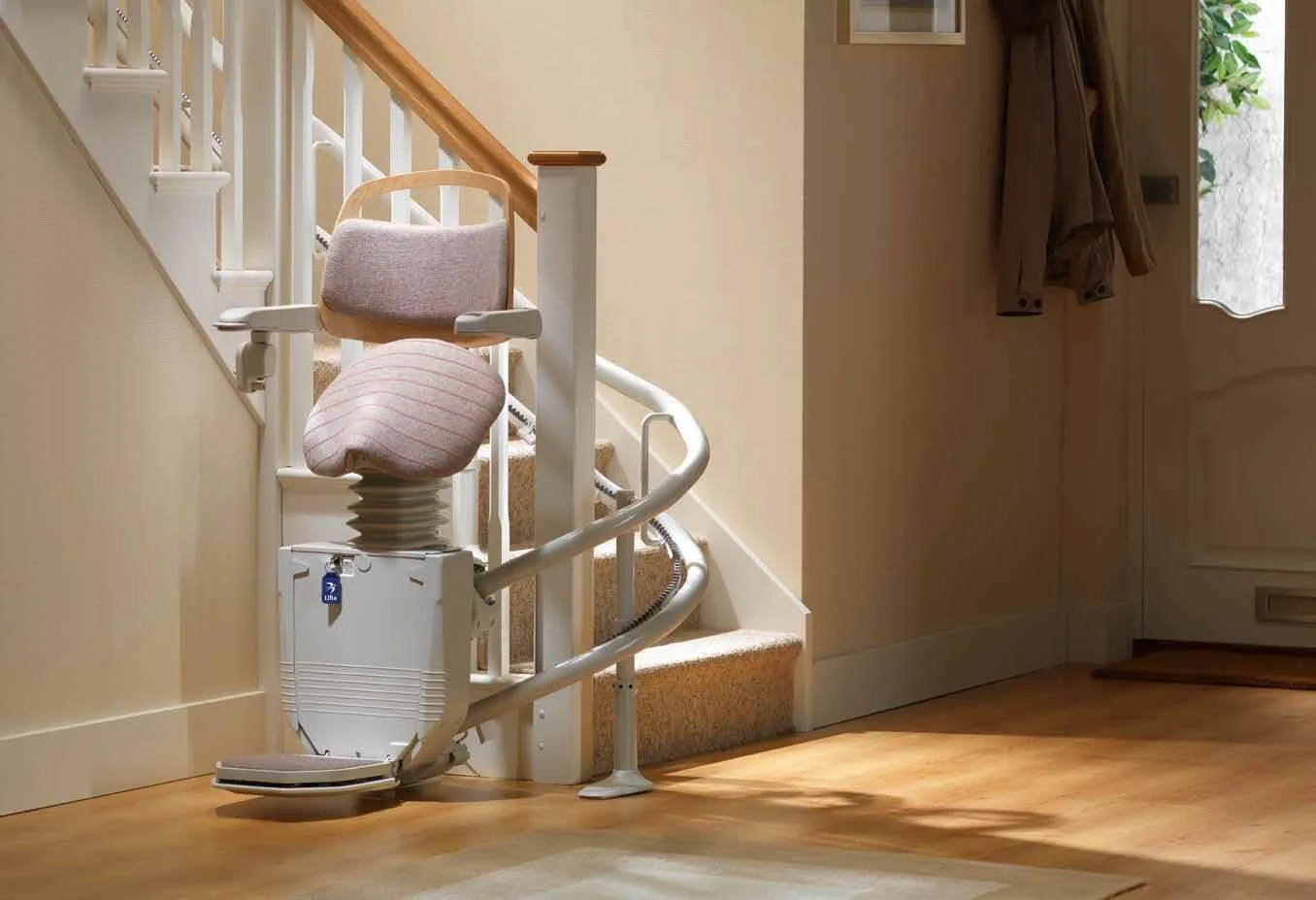
The split-level and multi-story ranch homes built across the county after the war often have short interior stairways between half-levels, or a few steps from the garage up to the living space. These are some of the most common places we fit a stair lift in this area.
A short, straight run is usually the simplest job. A straight stair lift mounts to the treads, not the wall, and travels one level at a time. If a split-level has more than one set of steps, each flight is handled on its own.
Older homes near downtown areas, such as the turn-of-the-20th-century bungalows, Cape Cods and National Folk-style houses in the city of Waukesha, can call for a custom rail. When a staircase turns or has a landing partway up, a curved lift built to that staircase is the usual answer.
Waukesha County covers about 581 square miles west of Milwaukee, and it is not all the same. The inner-ring suburbs along Interstate 94 are close together, while the lake-dotted northwest corner known as Lake Country and the land along the Fox River are more spread out.
That spread matters for planning. In-home aging services and home-modification contractors have farther to travel to places like Merton, North Prairie, Dousman or Eagle, so it helps to schedule the in-home measurement early and line up any program paperwork at the same time.
Newer, larger homes on the county's outer edges can have longer or grander staircases than the midcentury houses closer to Milwaukee. Those are measured individually before we recommend a straight or curved unit.
About 19.6% of county residents are 65 or older, and the median age is 43.6. About 75.2% of residents own their homes, so most families are deciding whether to adapt a house they already own rather than move.
The county's 2020 median household income of $88,985 ranked 97th nationally, the only Wisconsin county among the 100 highest-income counties in the U.S. Many households here pay for a stair lift privately. Public programs still exist, but several are limited to lower incomes, which is worth knowing before you apply.
Two Wisconsin Medicaid waivers, IRIS and Family Care, name stair lifts as a covered home modification. Both start at the ADRC of Waukesha County, 514 Riverview Ave. in Waukesha, at (262) 548-7848. The ADRC checks financial eligibility and arranges the functional level-of-care screen.
If you do not qualify for Medicaid, WisLoan offers low-interest loans for home modifications with no income requirement, applied for through Independence First. Lower-income homeowners can also ask about the county's CDBG deferred loan, which covers accessibility improvements. Neither program names stair lifts specifically, so confirm with them before you commit.
Veterans should know that the VA HISA grant does not cover stair lifts. Waukesha County Veterans Services at (262) 548-7732, at 514 Riverview Avenue in Waukesha, can explain which VA benefits fit your situation.
A self-directed Medicaid waiver whose covered services explicitly include stair lifts as a home modification, with any modification over $1,000 needing an independent assessment first. Enroll through the ADRC of Waukesha County; the IRIS line is (888) 515-4747.
A managed long-term care Medicaid waiver that lists stair lifts among covered home modifications, approved case by case by the member's care team. Enrollment begins at the ADRC, (262) 548-7848.
Low-interest loans from $500 up to $80,000 for home modifications and assistive technology, with no income requirement; the program page does not name stair lifts specifically. Waukesha County residents apply through Independence First at (414) 291-7520.
A 0% interest deferred loan up to $24,999 for owner-occupants at or below 80% of area median income, covering accessibility improvements; stair lifts are not named on the program page. Call (262) 896-8170.
Loans up to $40,000 at 1% over 20 years, and grants up to $10,000 for homeowners 62 or older, for very-low-income owners in USDA-eligible rural areas; stair lifts are not mentioned. Most incorporated areas near Milwaukee are likely ineligible.
A VA grant of up to $6,800 or $2,000 lifetime for permanent home alterations, which specifically excludes stair lifts and stair glides. Waukesha County Veterans Services at (262) 548-7732 can point you to other options.
Grants of up to $126,526 (SAH) and $25,350 (SHA) for FY2026 for veterans with qualifying severe service-connected disabilities; stair lifts are not named on the source page. Ask Waukesha County Veterans Services at (262) 548-7732.
The county's required starting point for IRIS and Family Care, offering benefits counseling to adults 60 and older, adults with disabilities and caregivers; it does not list a stair lift grant of its own. Call (262) 548-7848.
Older adults
514 Riverview Ave., Waukesha, 53188
Veterans
514 Riverview Avenue, Waukesha, 53188
It can, through IRIS or Family Care, both of which list stair lifts as a covered home modification. You must meet Wisconsin Medicaid financial limits and a nursing-facility level-of-care screen, and the process starts at the ADRC of Waukesha County at (262) 548-7848.
For 2026, a single applicant can have income up to $2,982 a month and assets up to $2,000, with a home equity limit of $752,000. The ADRC can review your specific situation.
Yes. The ADRC serves adults with physical or developmental disabilities as well as those 60 and older, and Family Care is open to adults 18 and up with a qualifying disability. WisLoan also serves Wisconsin residents 18 and older with a disability.
The VA HISA grant specifically excludes stair lifts and stair glides. SAH and SHA grants fund major adaptations, but their source page does not name stair lifts, so call Waukesha County Veterans Services at (262) 548-7732 to ask.
No monthly payments are required on the Waukesha County CDBG deferred loan. The full balance is due when the home is sold or transferred, refinanced with cash out, or no longer owner-occupied.
Possibly, if the home sits in a USDA-eligible rural area and the household has very low income. Most incorporated cities and villages near Milwaukee are likely ineligible, so check the address before applying.
Tell us about the stairs in your home and we will explain which lift fits, what it costs and how installation works.
