Taylor County is farm and forest country. About 79.3% of residents live in rural areas, spread between Medford, Rib Lake, Stetsonville, Gilman and Westboro and the dairy land around them. Many of the homes here are standalone farmhouses built long before anyone thought about getting a walker up a staircase.
If a parent is still living in the house they farmed for decades, the stairs are often the first thing that starts to limit them. This page walks through what Taylor County homes and terrain mean for a stair lift, and which local, state and federal programs are worth a phone call before you pay out of pocket.
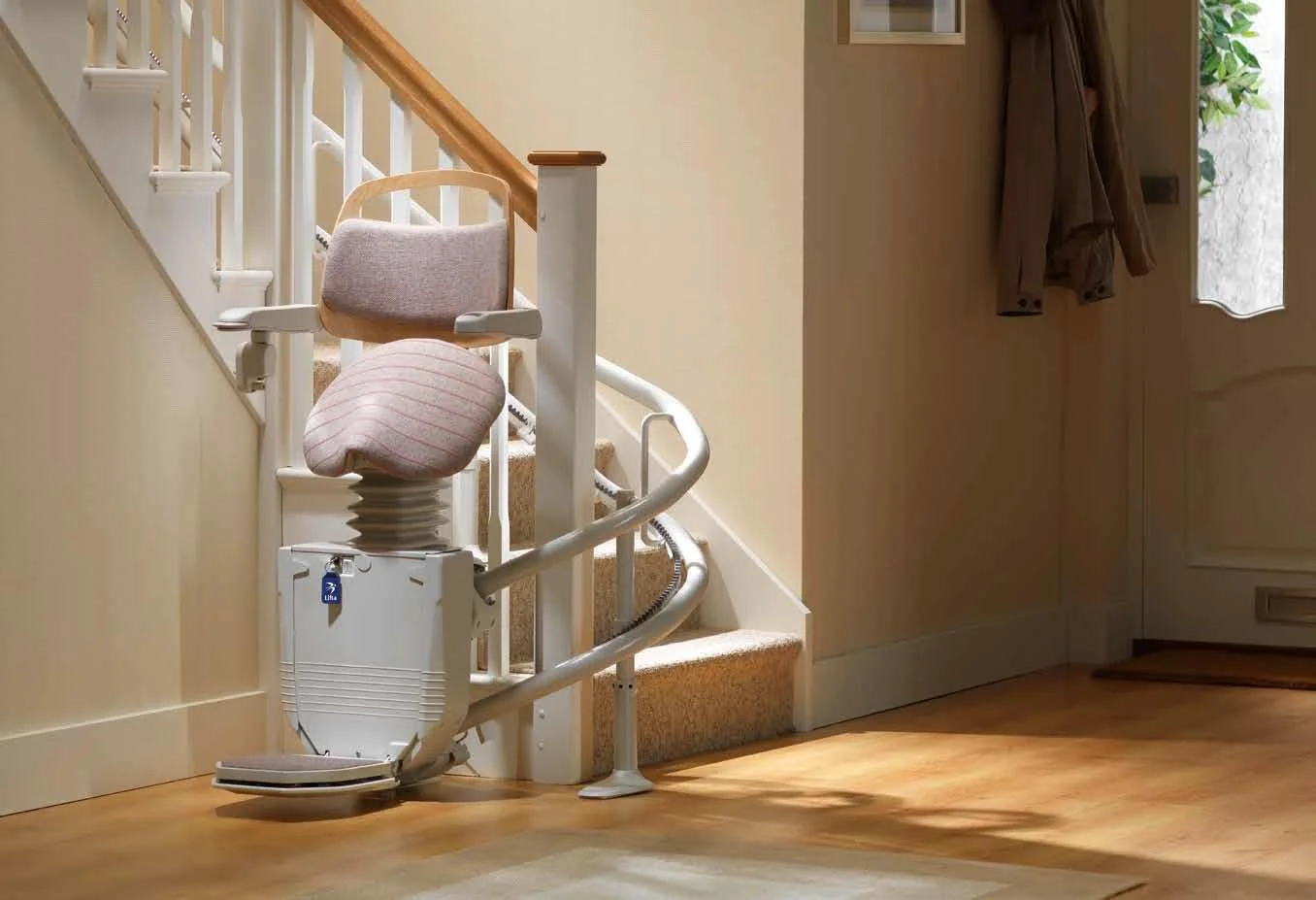
The housing stock in Taylor County leans toward single-family homes and detached houses, many of them older farmhouses scattered across the countryside. A lot of these have a single straight staircase to the bedrooms, which is the simplest and usually the least costly kind of lift to fit.
Older farmhouses do not always follow that pattern. Stairs that turn at a landing or wind around a corner need a curved rail built to that exact staircase, which takes longer to measure and make.
Split-level homes bring a different question: several short runs of stairs instead of one long one. Sometimes one lift on the run your parent uses most is enough. Ranch-style homes are mostly on one floor, but a basement laundry or a few steps at the entry can still be a daily hurdle.
The Perkinstown terminal moraine runs across the county as a band of hills, with rolling glacial till, boulders and eskers to the north and west toward the Jump River. Farmland to the south gives way to forest and swamp up north. Many homes sit on uneven ground rather than a flat lot.
That terrain, plus a wet and harsh climate, makes ramps and long walkways hard to build and maintain around a rural house. For a multi-level farmhouse, an interior stair lift often solves the bigger problem with less exterior work.
When the trouble is the porch steps or a few steps down to the yard, an outdoor-rated stair lift or a vertical platform lift is the usual answer. We look at the slope, drainage and how snow and water collect before recommending either one.
About 23.9% of Taylor County residents are 65 or older, and 59.9% of households own their home. Many of those owners are long-time farm families and people who worked in the creameries, window plants, plastics and food processing jobs centered in Medford.
Because these are individually owned rural homes, a stair lift is a private investment, not a building-wide upgrade paid for by a landlord. Distance from larger service centers can also add travel time to an installation, so it helps to plan the visit and the funding at the same time.
Start with the Taylor County ADRC in Medford. It is the required intake point for the Wisconsin IRIS and Family Care programs, and it does the functional screen that decides eligibility for both.
Of the programs listed below, IRIS is the only one whose source names stair lifts as a covered home modification. Family Care lists grab bars, wheelchair ramps and widening doorways, so ask before assuming a stair lift is included. The USDA Section 504 program and the Northwest Affordable Housing loans are aimed at rural homeowners with limited incomes, though neither source names stair lifts.
Veterans should know that the VA HISA grant specifically excludes stair glides. The Taylor County Veterans Service Office can help sort out which other VA or Wisconsin veteran programs fit. You can also ask the ADRC about statewide options such as the Community Options Program (COP), WisLoan (WisTech Alternative Loan Program) and the WHEDA Home Improvement Loan Program (HILP).
A county information and benefits counseling office for older adults, adults 18-59 with disabilities, and caregivers, and the local starting point for Family Care and IRIS applications. Its page does not list a stair lift or home-modification grant, so call (715) 748-1491 or the Medford office at (715) 748-3332 to ask about current options.
A self-directed Medicaid long-term care waiver that explicitly lists stair lifts as a home modification within the participant's individualized budget, for those who meet nursing facility level of care and the 2026 limits of $2,982 per month income and $2,000 in assets for an individual. Applications begin with the ADRC functional screen; the IRIS line is (888) 515-4747.
A Medicaid managed long-term care program with the same age, level-of-care and 2026 financial limits as IRIS; its source lists grab bars, wheelchair ramps and widening doorways but does not mention stair lifts. Apply through the ADRC and confirm coverage with the managed care organization, or call (800) 362-3002.
Federal repair loans up to $40,000 at 1% fixed interest over 20 years, and grants up to $10,000 for very-low-income owners aged 62 and older, in rural areas such as Taylor County. Grants can go toward accessibility modifications, but stair lifts are not named in the source; apply through the USDA Rural Development state office locator.
A VA medical home-modification grant with a lifetime maximum of $6,800 or $2,000 depending on disability status. The VA explicitly excludes stair glides, so HISA does not pay for a stair lift.
VA grants of up to $126,526 (SAH) or $25,350 (SHA) for veterans with specific severe service-connected disabilities who own their home. The source does not say whether stair lifts are covered or excluded; the Taylor County Veterans Service Office at (715) 748-1488 can help with an application.
A general state home improvement loan for Wisconsin veterans that requires at least 10% home equity; the source does not mention stair lifts or accessibility work. Call (800) 947-8387 or apply through the County Veterans Service Officer.
A nonprofit independent living center serving Taylor County that offers accessibility assessments, advocacy, peer support and assistive technology loans of up to 45 days. Stair lifts and home-modification grants are not listed among its services; call (715) 344-4210.
Zero percent, deferred-payment rehabilitation loans for income-eligible homeowners in served counties including Taylor County, used for things like roofing, windows, wells and furnaces. The source does not mention stair lifts or accessibility work; call (715) 635-2197.
The county office in Medford, led by Sheila Sutton, CVSO, that helps veterans and dependents apply for and appeal VA and Wisconsin veteran benefits, including housing grants. It is not a funding source itself and does not mention stair lifts; call (715) 748-1488.
Older adults
224 S. 2nd St., Medford, 54451
Veterans
224 S 2nd St, Room 140, Medford, 54451
Yes, in most cases. Stairs that turn need a curved rail made to fit that staircase, which takes more measuring and lead time than a straight lift. Many older farmhouses in the county have this kind of layout.
IRIS lists stair lifts as a covered home modification within a participant's budget, if the person meets nursing facility level of care and the 2026 income and asset limits. Family Care does not list stair lifts among its named home modifications, so confirm before counting on it. Both start with a functional screen at the Taylor County ADRC.
The Taylor County ADRC is at 224 S. 2nd St., Medford, WI 54451. You can call (715) 748-3332 or (715) 748-1491.
No. The VA excludes stair glides from HISA funding. The Taylor County Veterans Service Office at 224 S 2nd St, Room 140, Medford, phone (715) 748-1488, can check whether SAH, SHA or the Wisconsin DVA Veterans Home Improvement Loan might fit instead.
IRIS and Family Care accept adults 18-64 with a physical, developmental or intellectual disability who meet the level-of-care requirement. The ADRC serves adults 18-59 with disabilities, and MILC serves people with disabilities in Taylor County.
An outdoor-rated stair lift or a vertical platform lift can handle entry steps. With the county's uneven glacial ground and wet weather, we check slope and drainage first, since a long ramp is often hard to fit and keep up around a rural home.
Tell us about the stairs in your home and we will explain which lift fits, what it costs and how installation works.
