Baraboo's downtown grew up around early sawmills near the Baraboo and Wisconsin Rivers. That history left the county seat with a core of older multi-story homes that still have their original stairways. Out on the city's edges, the newer construction is mostly single-story.
Beyond Baraboo, Sauk County's 16 towns run from Reedsburg and Prairie du Sac to Spring Green, Plain, Loganville and Lime Ridge. Between them sit the Baraboo Range bluffs, river valleys and old farmhouses with stairs. This page covers what those homes mean for a stair lift and where local families can look for help paying for one.
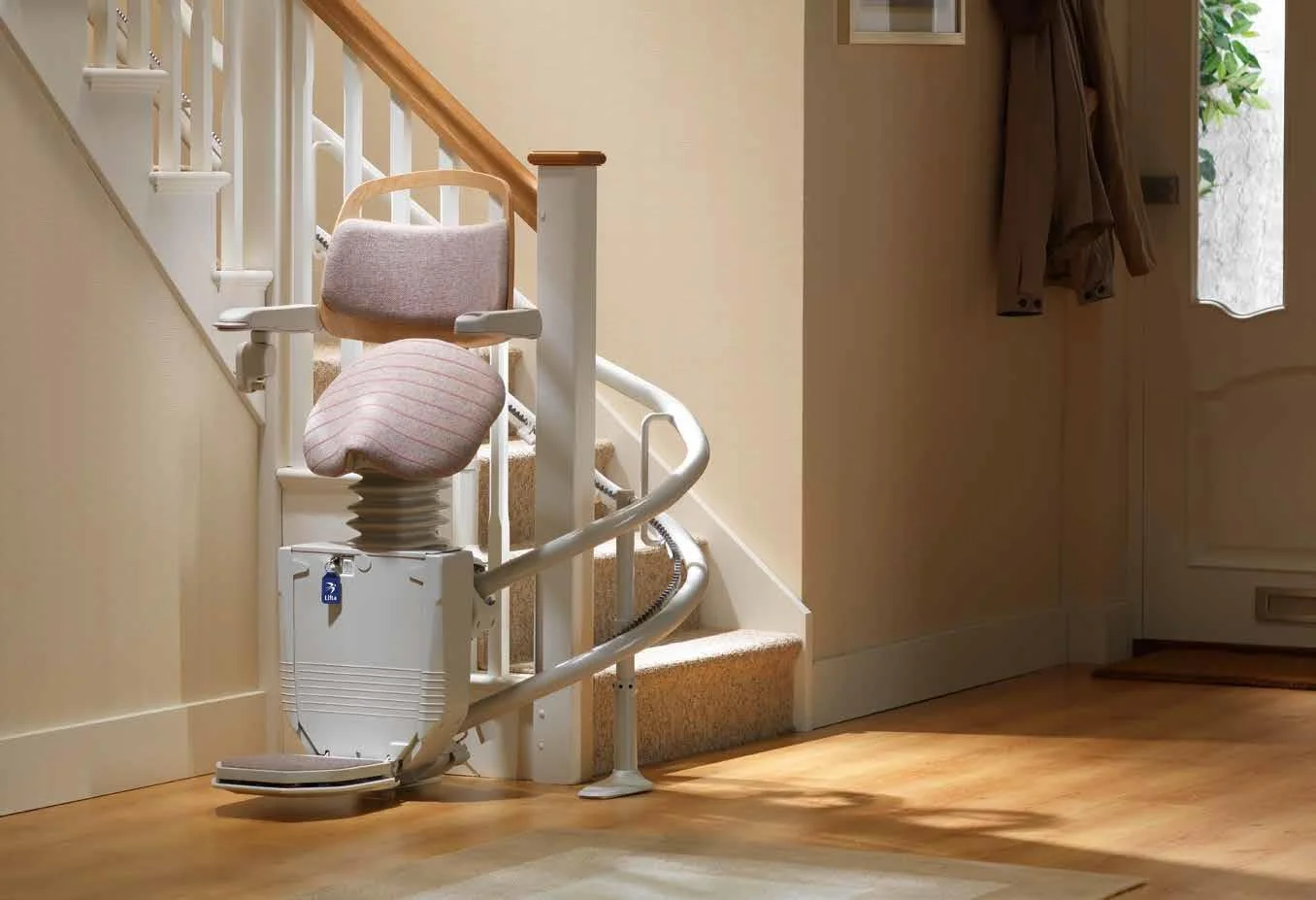
Original stairways in older multi-story homes are the most common retrofit we look at. Many of these staircases run straight from one floor to the next, and a straight stair lift is usually the simplest and least costly fit.
Older stairs can also turn at a landing or have a winder at the top. Those need a curved rail that is built to that exact staircase. Measuring the full run, the landings and the space at the top and bottom tells you early which type you are dealing with.
Sauk County covers about 849 square miles, and Sauk Point in the Baraboo Range reaches 1,593 feet. Homes built into hillsides and older farmhouses often have more than one level, with steps outside as well as inside.
When the problem is the steps from the driveway or yard up to the door, an outdoor stair lift or a platform lift may make more sense than an indoor unit. Distance and terrain can also affect service visits to rural townships, so ask about service coverage before you buy if you live far from the Baraboo, Lake Delton and Wisconsin Dells corridor.
Split-level homes have short flights between levels, and a person may need to cross more than one of them in a normal day. Sometimes one lift on the flight to the bedrooms solves most of it. Sometimes two short lifts are needed.
Townhouses, walk-up apartments and low-rise buildings are also part of the county's housing. Per the 2020 census, 70.3% of Sauk County housing units are owner-occupied and 29.7% are renter-occupied, so renters should confirm who can approve an installation before planning one.
The clearest public source is the Wisconsin IRIS Medicaid Waiver, which names stair lifts among the home modifications a self-directed budget can cover. Family Care, USDA repair loans, CDBG housing rehabilitation and the local Habitat for Humanity repair program fund home accessibility work but do not name stair lifts, so ask each one directly.
As of the 2020 census, 19.8% of county residents were age 65 or older, and the Sauk County ADRC is the single point of entry for screening for IRIS and Family Care. Note that the VA HISA grant excludes stair glides.
A Medicaid waiver with a self-directed budget for Wisconsin residents 65+ or ages 18-64 with a disability who need a Nursing Facility Level of Care; home modifications including stair lifts are a covered item. Call (888) 515-4747.
A Medicaid managed care program whose home modification benefit lists grab bars, wheelchair ramps and widening doorways; stair lifts are not listed, and all services need care-team approval. Call (800) 362-3002.
Offers options counseling, benefits screening and application help for IRIS, Family Care and other funding for residents 60+ and adults with disabilities; it is not a funder and stair lifts are not listed. Call (608) 355-3289.
Loans up to $40,000 at 1% fixed over 20 years and grants up to $10,000 for very-low-income homeowners 62+ in eligible rural areas; accessibility examples include ramps and walk-in tubs, but stair lifts are not listed. Call (715) 345-7614.
A lifetime grant of up to $6,800 or $2,000 for medically necessary home alterations for veterans, but it excludes stair glides and porch lifts, so it does not cover stair lifts. Call (608) 355-3260.
Grants for veterans with qualifying severe service-connected disabilities, up to $126,526 (SAH) or $25,350 (SHA) for a permanent home in FY2026; stair lifts are not specifically listed. Call (608) 355-3260.
Helps veterans and dependents with VA claims and refers them to programs such as HISA and SAH/SHA; it does not fund modifications itself and stair lifts are not listed. Call (608) 355-3260.
Funds housing rehabilitation and removal of architectural barriers for households at or below 80% of county median income; specific items like stair lifts are not listed. Call (608) 266-7744.
Provides volunteer labor and a 0% interest materials loan capped at $5,000 for qualifying homeowners; covered repairs include accessibility ramps and step and handrail replacement, but stair lifts are not listed. Call (608) 448-2888 to confirm your home is in the service area.
Older adults
505 Broadway, Room 525, Baraboo, 53913
Veterans
505 Broadway, Room #102 (First Floor), Baraboo, 53913
The IRIS Medicaid Waiver lists stair lifts as a covered home modification for people who qualify, including a Nursing Facility Level of Care. Family Care does not list stair lifts among its home modifications, so ask the care team. The Sauk County ADRC at (608) 355-3289 can screen you for both.
The Wisconsin Medicaid application process can take up to 3 months, or even longer, from application to determination letter. Starting early helps if a stair lift is part of the plan.
Yes, possibly. The ADRC serves adults with disabilities as well as people 60+, and IRIS and Family Care cover ages 18-64 with a physical, developmental or intellectual disability who meet the level-of-care requirement.
The HISA grant specifically excludes stair glides. The SAH and SHA grants fund accessibility remodeling but do not name stair lifts. The Sauk County Veterans Service Office at (608) 355-3260 can review what you may qualify for.
Both the Sauk County ADRC and the Sauk County Veterans Service Office are at 505 Broadway in Baraboo, WI 53913. The Veterans Service Office is in Room 102 on the first floor.
Tell us about the stairs in your home and we will explain which lift fits, what it costs and how installation works.
