Racine County runs from the city of Racine at the mouth of the Root River on Lake Michigan west to Burlington, with villages and lake communities like Wind Lake, Waterford, Union Grove and Browns Lake in between. Across those 18 towns, the homes vary a lot, and so do the staircases inside them.
In Racine's older neighborhoods, including the Old Main Street and Southside Historic Districts, many houses are early-20th-century two-story homes with interior stairs typical of pre-war Midwest construction. Out in the villages and towns you see more single-story ranch homes built later in the century, plus split-level homes and townhouses. This page walks through what each of those means for a stair lift, and where Racine County families can look for help paying for one.
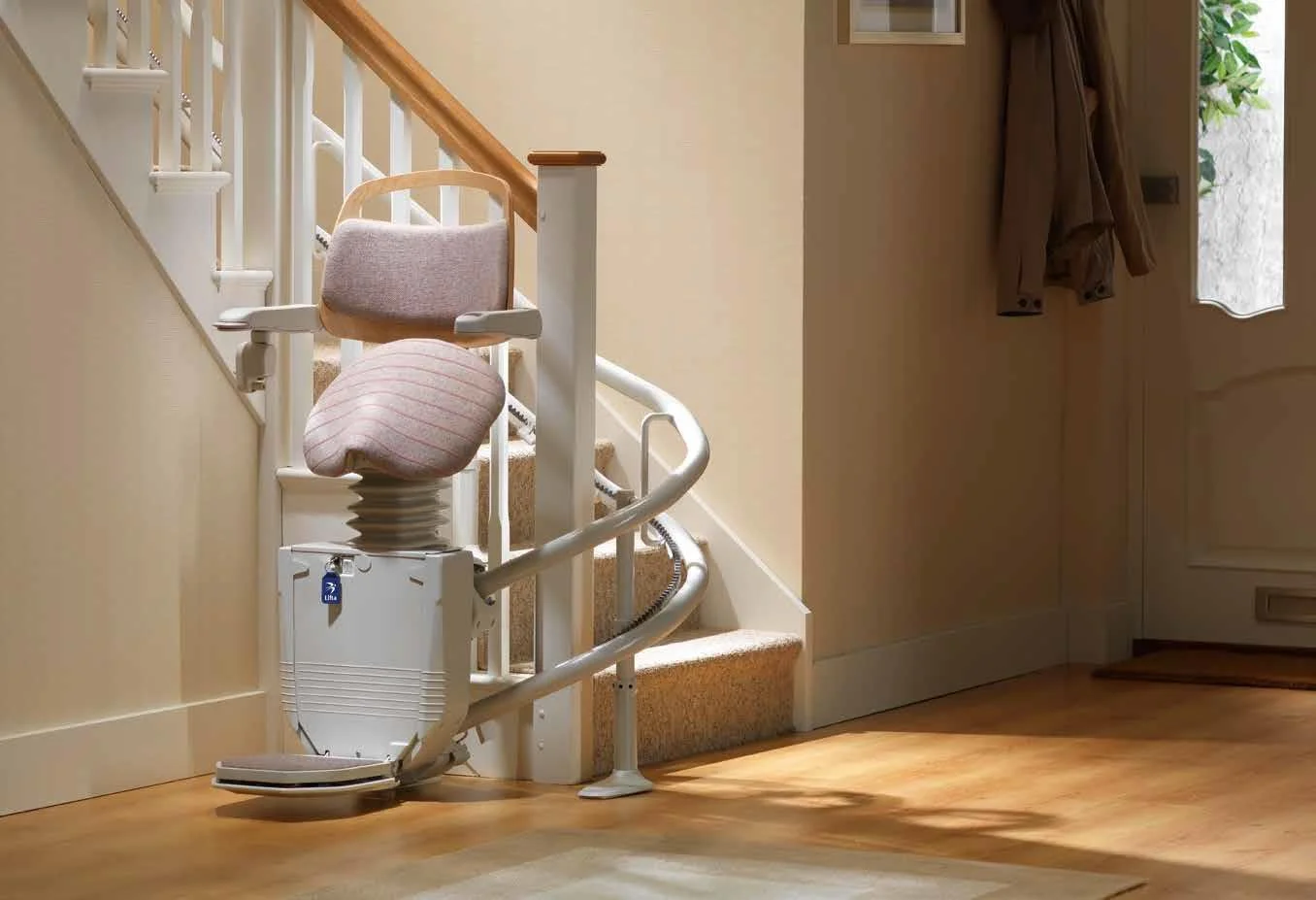
A pre-war two-story house usually has one main staircase between the first floor and the bedrooms. If that staircase runs in a single straight line, a straight stair lift is often the simplest fit. The rail mounts to the stair treads, not the wall, so plaster walls in an older home are generally left alone.
Many older homes, though, have a landing or a turn partway up. Those stairs need a curved rail built to the shape of the staircase. We measure the stairs in person before recommending either type, because the layout decides the lift, not the age of the house.
Split-level homes are common in parts of the county and bring their own question: there are often several short flights instead of one long one. Depending on which floors a person actually needs to reach, that can mean one lift on the most-used flight or a curved rail that links levels.
Townhouses tend to have straight, narrow stairs, which suit a straight lift with a folding seat and footrest. A single-story ranch may not need an indoor lift at all, but a basement stair or a few entry steps can still be a barrier. Outdoor stair lifts are made for exterior steps, and a platform lift is an option when someone uses a wheelchair and cannot transfer to a seat.
About 17.6% of Racine County's 187,011 residents are 65 or older, and 70.5% of households own their homes. For many of those homeowners, the house is paid down and familiar, and the stairs are the main thing standing in the way of staying.
If that includes someone in your family, the Racine County Veterans Service Office at (262) 638-6702 is a good early call, since VA benefits have specific rules about stair lifts covered below.
The clearest public funding route for a stair lift here is IRIS, Wisconsin's self-directed Medicaid waiver, which names stair lifts among its home modifications. Family Care, the other long-term care program, lists home modifications such as grab bars and ramps but does not mention stair lifts. Both start with a call to the Racine County ADRC in Sturtevant at (262) 833-8777.
If you do not qualify for Medicaid programs, WisLoan offers low-interest loans with no income limit, and Society's Assets in Racine helps people apply. Homeowners in rural parts of the county may also check the USDA Section 504 program, and city of Racine residents can ask about the City of Racine Housing Repair Program.
Other statewide programs worth asking the ADRC about include the Community Options Program (COP) and the WHEDA Home Improvement Loan Program (HILP). Each program is listed below with what its source says about stair lifts.
A Medicaid managed long-term care program for people 65+ or adults with disabilities who meet nursing facility level of care; its home modifications benefit lists grab bars, ramps and doorway widening, and stair lifts are not listed. Enroll through the Racine County ADRC at (262) 833-8777.
A self-directed Medicaid waiver whose home modifications explicitly include stair lifts, written into the participant's support plan with an IRIS consultant. It is an entitlement program with no waitlist; start with the ADRC at (262) 833-8777.
The county's information, referral and benefits counseling office at 14200 Washington Ave. in Sturtevant, serving residents 60+ and adults 18 to 59 with a disability. It does not fund equipment itself and stair lifts are not listed, but it is the front door to Family Care and IRIS: (262) 833-8777.
A low-interest loan of $500 to $80,000 for Wisconsin residents 18+ with a disability, with no income limit; home modifications are covered, though stair lifts are not named. Society's Assets handles Racine County applications at (262) 637-9128.
A nonprofit center for independent living at 5200 Washington Ave. in Racine that helps people with disabilities access WisLoan and an assistive technology loan library; it is not a grant source and stair lifts are not listed. Call (262) 637-9128.
A city home-repair loan of up to $25,000, typically 20 years at 1-3% fixed interest, for income-eligible homeowners inside City of Racine limits only. Eligible work is described as health, safety and energy repairs, and stair lifts are not listed; call (262) 636-9197.
Federal repair loans up to $40,000 and grants up to $10,000 for very-low-income homeowners in USDA-eligible rural areas, with grants limited to homeowners 62+; accessibility improvements are an eligible use, but stair lifts are not named. Check your address on the USDA eligibility map and call (715) 345-7600.
A VA grant of $6,800 lifetime for service-connected disability or $2,000 for non-service-connected disability, and it explicitly does not cover stair glides or other removable equipment. The Veterans Service Office at (262) 638-6702 can explain what it does cover.
A VA housing grant of up to $126,526 (FY2026) for veterans with certain severe service-connected disabilities who own or will own the home; its examples are ramps and wider doorways, and stair lifts are not listed. Ask the Veterans Service Office at (262) 638-6702.
A VA home adaptation grant of up to $25,350 (FY2026) for veterans with qualifying disabilities such as loss of use of both hands; stair lifts are not listed. Call the Veterans Service Office at (262) 638-6702.
The county office at 1717 Taylor Avenue in Racine that helps veterans and their families apply for VA compensation, pension, healthcare and home modification grants; it does not pay for equipment itself. Call (262) 638-6702.
Volunteers who work one on one with Racine County seniors who need help around their homes; the source does not say whether this includes accessibility equipment, so stair lifts are not listed. Call (262) 886-9612 to ask about your situation.
Older adults
14200 Washington Ave., Sturtevant, 53177
Veterans
1717 Taylor Avenue, Racine, 53403
IRIS is the one program here whose source lists stair lifts as a home modification. The others either do not mention them or, in the case of the VA HISA grant, specifically exclude them. Call the Racine County ADRC at (262) 833-8777 to start the IRIS screening.
Yes. The ADRC serves adults 18 to 59 with a disability as well as residents 60 and older. IRIS and WisLoan are also open to adults 18 and up who qualify.
For 2026, home equity is exempt up to $752,000. The other limits are $2,982 a month in income and $2,000 in countable assets for a single person.
No. That program only applies to properties inside City of Racine limits. Residents elsewhere in the county can look at WisLoan or, in eligible rural areas, the USDA Section 504 program.
The HISA grant explicitly excludes stair glides. The SAH and SHA grants do not mention stair lifts either way, so call the Racine County Veterans Service Office at (262) 638-6702 to ask about a specific case.
Poor credit history does not automatically disqualify an applicant, and there is no income limit. Society's Assets at (262) 637-9128 can walk you through the application.
Tell us about the stairs in your home and we will explain which lift fits, what it costs and how installation works.
