Ellsworth, the Pierce County seat, sits on a ridge at 1,033 feet. The grades into town were steep enough that in 1885 the Chicago, St. Paul, Minneapolis and Omaha Railway gave up on reaching the village and built its depot about one mile away at the foot of the hill, which grew into East Ellsworth.
That same bluff-and-ridge ground runs through the county's 9 towns, from River Falls and Prescott to Spring Valley, Plum City and Diamond Bluff. Homes built into hillsides or on several levels mean a lot of stairs, and this page walks through which stair lift fits which kind of house and where Pierce County families can look for help paying for one.
The county is 70% rural by population, according to 2020 Census figures, so most people live in standalone rural or farm residences rather than age-restricted or multi-unit buildings. When the stairs get hard, moving to a facility is not the usual answer here. Adapting the house is.
Owners also tend to stay put. The 2020 Census counted 74.5% of occupied units as owner-occupied, which makes a stair lift a practical investment in a home the family plans to keep. About 14.0% of residents are 65 or older.
Ranch-style homes and many single-family homes have one straight flight to a lower level. A straight stair lift is the simplest fit: the rail mounts to the stair treads, not the wall, and the install usually goes quickly.
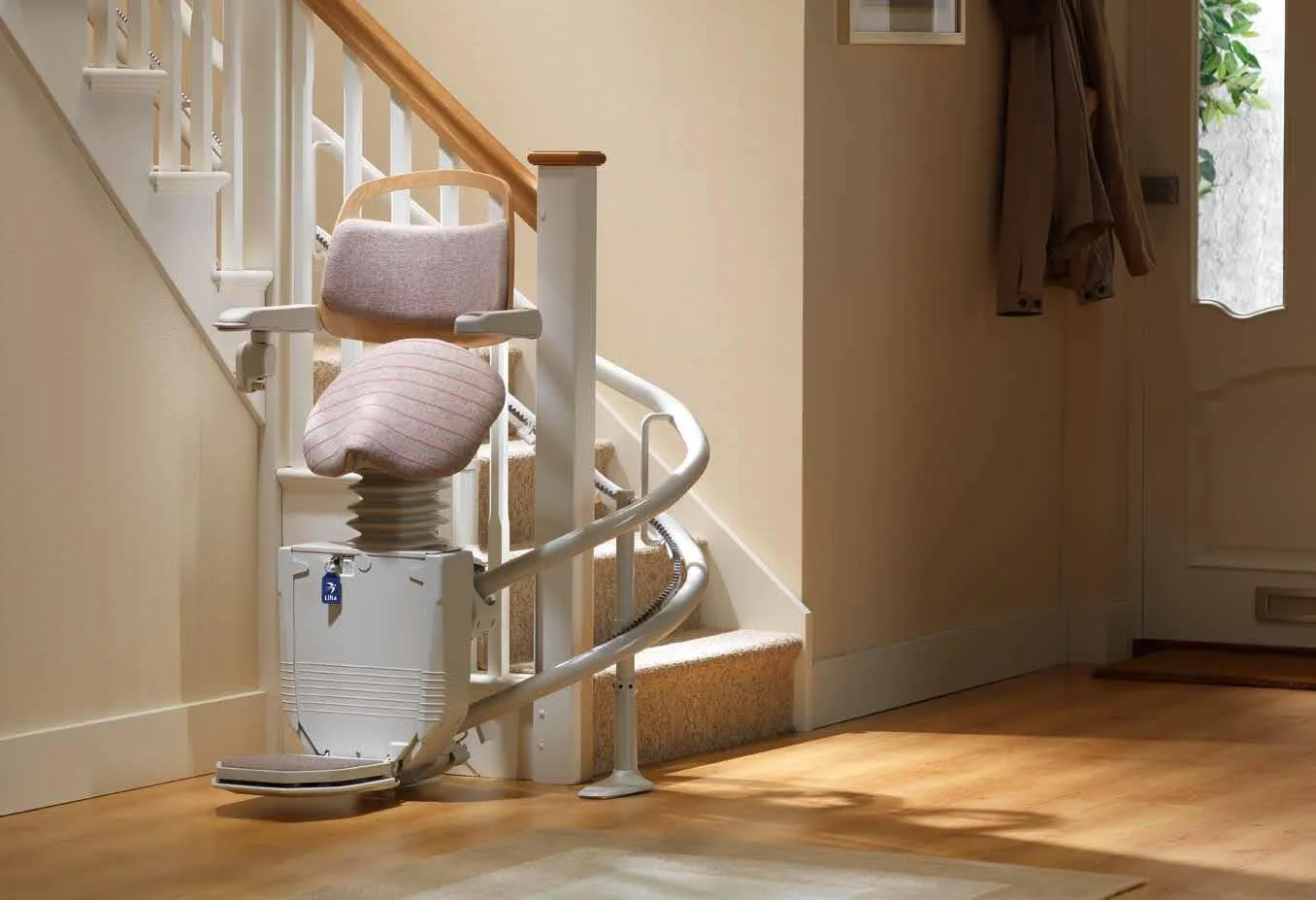
Split-level homes are different. They have several short flights, often with a turn or landing between them, and a curved rail that follows the turns is typically the answer. We measure each run and landing before quoting so the rail fits the actual stairs.
Hillside lots around Ellsworth and the river towns often have steps outside to the door or a deck. An outdoor stair lift built for weather can handle those, and for a wheelchair user a platform lift may make more sense than a seat.
Townhouses usually have a straight interior flight, which suits a standard straight lift. If an association governs the building, check its rules before scheduling an install.
In walk-up apartments the stairs are often shared, so the building owner has to approve anything mounted there. Talk to the landlord first; it saves time for everyone.
The clearest route is the IRIS Waiver, a Wisconsin Medicaid program whose source materials name stair lifts among covered home modifications. Family Care covers home modifications too, though its listed examples do not mention stair lifts. Both start with a functional screen through the ADRC of Pierce County at 412 W. Kinne St. in Ellsworth.
Homeowners with very low incomes can look at USDA Section 504 repair loans and grants, since Pierce County qualifies as rural. Note that the VA HISA grant does not cover stair lifts.
Other statewide options worth asking the ADRC about include the Community Options Program (COP), WisLoan (WisTech Alternative Loan Program) and the WHEDA Home Improvement Loan Program (HILP).
A self-directed Wisconsin Medicaid waiver with no waitlist for people 65+ or 18-64 with a disability who need nursing-facility level of care; its source lists stair lifts as a covered home modification. Income limit is $2,982/month and the asset limit is $2,000 for a single applicant; call (888) 515-4747.
Wisconsin's managed long-term care program covers home modifications such as grab bars, ramps and widened doorways through each member's care plan, but stair lifts are not listed in its examples. Call (800) 362-3002.
The free local starting point in Ellsworth for benefits counseling and the functional screen needed for IRIS and Family Care; it does not fund stair lifts itself. Call (877) 273-0804 or the office line at (715) 273-6780.
Very-low-income rural homeowners can borrow up to $40,000 at 1% over 20 years, and those 62+ who cannot repay a loan may get grants up to $10,000; it funds repairs and accessibility work, though stair lifts are not named. Call (715) 273-5522.
Provides up to $6,800 or $2,000 lifetime for medically needed home changes for disabled veterans, but it does not cover stair lifts; a lift may come through a separate VA prosthetic pathway when medically necessary. Call (800) 827-1000.
Up to $126,526 (FY2026) for veterans with certain severe service-connected disabilities to adapt a permanent home; the source does not itemize stair lifts. Call (800) 827-1000.
Up to $25,350 lifetime (FY2026) for veterans with certain other service-connected disabilities, such as vision or dexterity loss, to adapt a home; stair lifts are not itemized. Call (800) 827-1000.
A low-interest, fixed-rate loan for Wisconsin veterans with at least 10% equity to improve their primary residence; stair lifts are not named specifically. Call (800) 947-8387.
Older adults
412 W. Kinne St., Ellsworth, 54011
Veterans
412 W. Kinne St., Room 30, Ellsworth, 54011
Yes. The IRIS Waiver's source lists stair lifts alongside grab bars, ramps and adaptive lighting as home modification examples. You need to qualify for nursing-facility level of care and meet the income and asset limits.
Contact the ADRC of Pierce County at 412 W. Kinne St. in Ellsworth, (877) 273-0804. It handles the functional screen required for IRIS and Family Care and offers benefits counseling regardless of income.
IRIS and Family Care both accept adults 18-64 with a physical, developmental or intellectual disability who need nursing-facility level of care. USDA Section 504 loans have no age limit, though its grants require age 62+.
Not through the HISA grant, which excludes stair glides. A lift may be furnished through a separate VA prosthetic or rehabilitative pathway when medically necessary, so ask the VA at (800) 827-1000.
Often a curved rail can follow the turns and landings between levels. We measure every run first, since split-level layouts vary a lot from house to house.
Tell us about the stairs in your home and we will explain which lift fits, what it costs and how installation works.
