From Milwaukee and West Allis to Wauwatosa, Cudahy and Whitefish Bay, many older Milwaukee County houses were built in stages. The county has the highest concentration of remaining Polish flats in the United States, and those stacked two-family homes often mean several half-flights of stairs just to get from the door to the kitchen.
This page walks through what the county's homes, lakefront bluffs and snowy winters mean for a stair lift, and which Wisconsin and federal programs may help pay for one. It covers all 19 municipalities, including Oak Creek, Franklin, Greendale, Brown Deer, Hales Corners and River Hills.
A Polish flat started as a modest single-story cottage. Early-1900s immigrant owners later jacked the house up and dug out a basement to create a second rental unit with its own entrance, so the upper unit sits raised and the lower unit sits partly below grade.
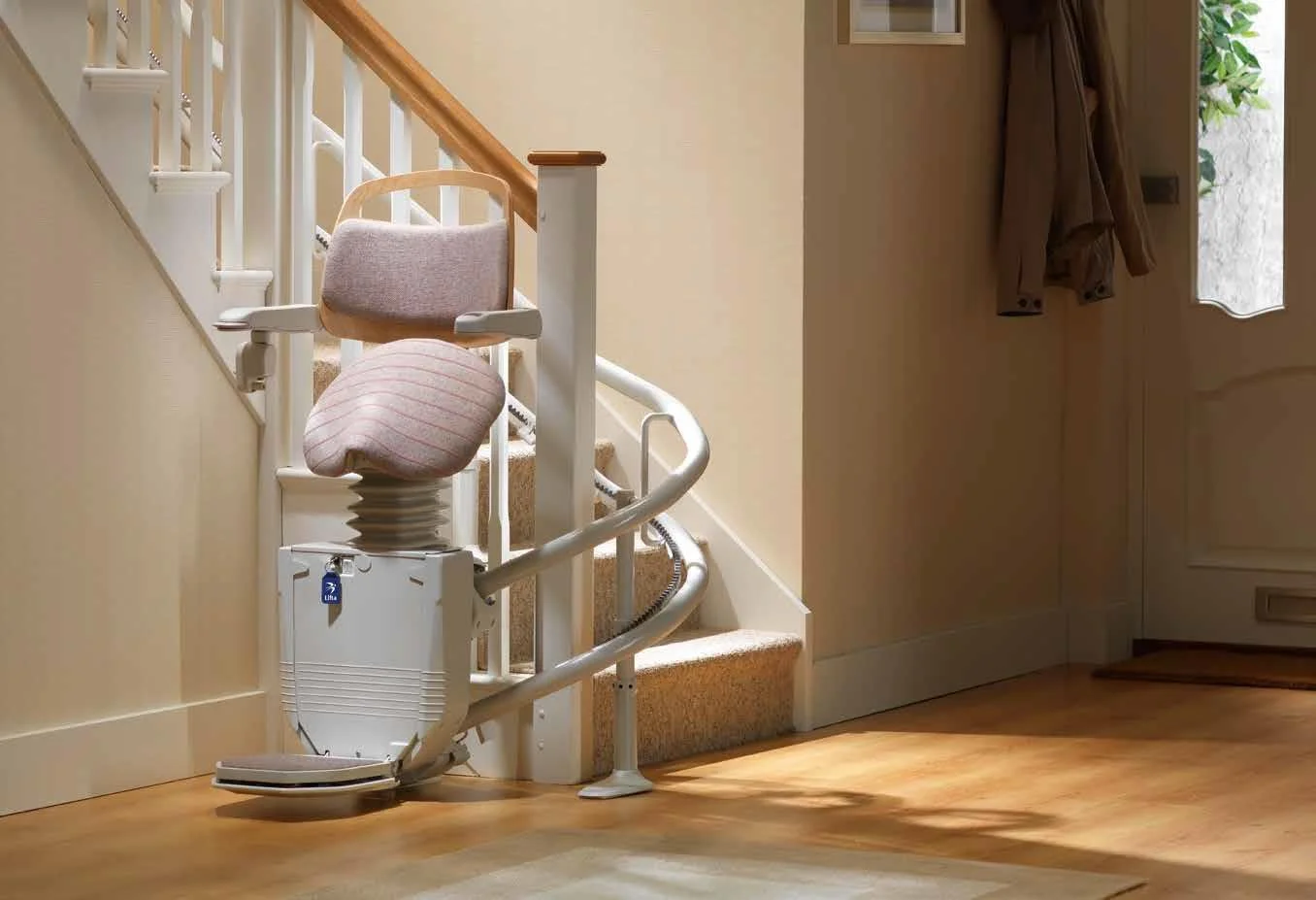
That layout rarely gives you one clean, straight staircase. More often there are short runs with landings or turns, which can call for a curved lift or a separate straight lift on each run. We measure every flight and landing before recommending either approach.
Row houses and townhouses, also common in the county, tend to have a single straight stair between floors. A straight lift is usually the simpler and faster install in those homes.
Milwaukee sits on Lake Michigan where the Milwaukee, Menomonee and Kinnickinnic rivers meet, and steep bluffs rise along the lakefront starting about one mile north of downtown. Homes on sloped lots can have long exterior stairs between the street, the door and the yard.
Winter makes those steps harder. The county averages roughly 48.7 inches of snow a year, and the mean January temperature is near 24°F, so icy steps and walkways add fall risk on top of the stairs inside.
An outdoor-rated stair lift can handle an exterior flight to a raised entrance. Where a wheelchair user needs to get up a short rise, a vertical platform lift may fit better than a seat lift, and we will talk through both options at the visit.
About 49.6% of Milwaukee County households own their home, so roughly half of residents rent. Walk-up apartments and low-rise buildings are part of the local housing mix, and a lift on a shared stairway needs the building owner's approval before anything is installed.
Ownership also matters for funding. The VA housing grants require that the veteran own or plan to own the home, and the WHEDA loan is only for owner-occupied houses. Renters should look first at the Medicaid waiver options below.
About 14.4% of county residents are 65 or older, and many of those households live on fixed or limited incomes. Several programs can help, but they differ on whether a stair lift is named as a covered item.
Wisconsin's IRIS Medicaid waiver is the clearest path: its covered-services list names stair lifts under home modifications. Family Care also covers home modifications such as grab bars, ramps and wider doorways, though its source page does not name stair lifts, so ask your care team directly.
VA housing grants, the WHEDA home improvement loan and IndependenceFirst are other routes, and the state program list also includes the Community Options Program (COP), WisLoan (WisTech Alternative Loan Program) and VA Benefits for Veterans (HISA + Prosthetics). Details for each program are listed below.
The Milwaukee County Dept on Aging is at 1220 W. Vliet St., Suite 302, Milwaukee 53205, phone (414) 289-6874. Residents apply for IRIS and Family Care through the local Aging and Disability Resource Center (ADRC), which handles enrollment and the level-of-care assessment.
Veterans can reach Milwaukee County Veteran Services at 6401 W Greenfield Ave, West Allis 53214, phone (414) 266-1234. Milwaukee-area veterans can also work through the Clement J. Zablocki VA Medical Center for prosthetics and home-adaptation referrals.
A self-directed Medicaid waiver for Wisconsin residents 65 and older, or 18 to 64 with a qualifying disability, who meet Nursing Facility Level of Care and the 2026 limits of $2,982/month income and $2,000 in assets; stair lifts are explicitly listed as a covered home modification paid from the participant's individual budget. Apply through the local ADRC, and call (888) 515-4747 for program information.
A managed long-term-care Medicaid waiver with the same age, level-of-care and financial limits as IRIS; it covers home modifications such as grab bars, wheelchair ramps and widening doorways, but its source page does not mention stair lifts. Call (800) 362-3002.
A managed care organization serving Milwaukee County that runs Family Care, Partnership and PACE, with services authorized by each member's care team; its page does not mention stair lifts or home modifications, so members should confirm with their team. Call (866) 992-6600.
Federal grants for veterans with certain service-connected disabilities who own or plan to own their home, with FY2026 maximums of $126,526 for SAH, $25,350 for SHA, and $50,961 or $9,100 for TRA; the VA page gives ramps and wider doorways as examples and does not mention stair lifts. Call (800) 827-1000.
A general home-improvement loan of $10,000 to $50,000 for owner-occupied Wisconsin homes, with a closing-cost credit up to $500, for borrowers current on their mortgage with a credit score around 620; the source does not mention stair lifts or accessibility work. No public phone number is listed.
A Milwaukee nonprofit at 540 South 1st Street, Milwaukee, WI 53204 that offers home modification options for people with disabilities, mainly as planning and consulting help; stair lifts are not itemized and no funding amount is stated. Call (414) 291-7520.
Older adults
1220 W. Vliet St., Suite 302, Milwaukee, 53205
Veterans
6401 W Greenfield Ave, West Allis, 53214
The IRIS waiver explicitly lists stair lifts as a covered home modification, bought through your individual budget. You must meet Nursing Facility Level of Care and the 2026 limits of $2,982/month income and $2,000 in assets for a single applicant. Family Care covers home modifications too, but its page does not name stair lifts, so ask your care team.
Yes, if they qualify. IRIS and Family Care are open to Wisconsin residents age 18 to 64 who have a physical, developmental or intellectual disability and meet the level-of-care and financial rules. IndependenceFirst also works with people with disabilities in the Milwaukee area.
Usually, yes, but the plan depends on the stairs. Polish flats often have multiple half-flights between the raised upper unit and the below-grade lower unit, so the answer may be a curved lift or a separate straight lift on each run. We measure every flight before recommending one.
The VA's SAH, SHA and TRA page does not mention stair lifts; its examples are ramps and wider doorways. Veterans can call (800) 827-1000, contact Milwaukee County Veteran Services at (414) 266-1234, or ask the Clement J. Zablocki VA Medical Center about prosthetics and home-adaptation referrals.
With roughly 48.7 inches of snow a year and January temperatures near 24°F, exterior steps are a real fall risk here. An outdoor-rated stair lift or a platform lift can replace climbing those steps, and we can look at your entrance during the home visit.
For older adults, start with the Milwaukee County Dept on Aging at (414) 289-6874; IRIS and Family Care enrollment goes through the local ADRC. Veterans can start with Milwaukee County Veteran Services at (414) 266-1234.
Tell us about the stairs in your home and we will explain which lift fits, what it costs and how installation works.
