Lafayette County sits in the Driftless Area of southwestern Wisconsin, where rolling hills and valleys never got flattened by glaciers. From Darlington and Shullsburg to Benton, Gratiot and Blanchardville, homes are often farmhouses and small-town houses set on uneven ground, with steps both inside and out.
That mix shapes which stair lift makes sense. A split-level in Belmont, a multi-story farmhouse outside Argyle and a walk-up apartment in South Wayne each ask for a different setup. Below we cover how local homes affect the choice and which programs may help with the cost.
The county covers 635 square miles of hilly country. Steep grades and long rural driveways are common, and many older farmhouses have more than one floor with steep or narrow staircases.
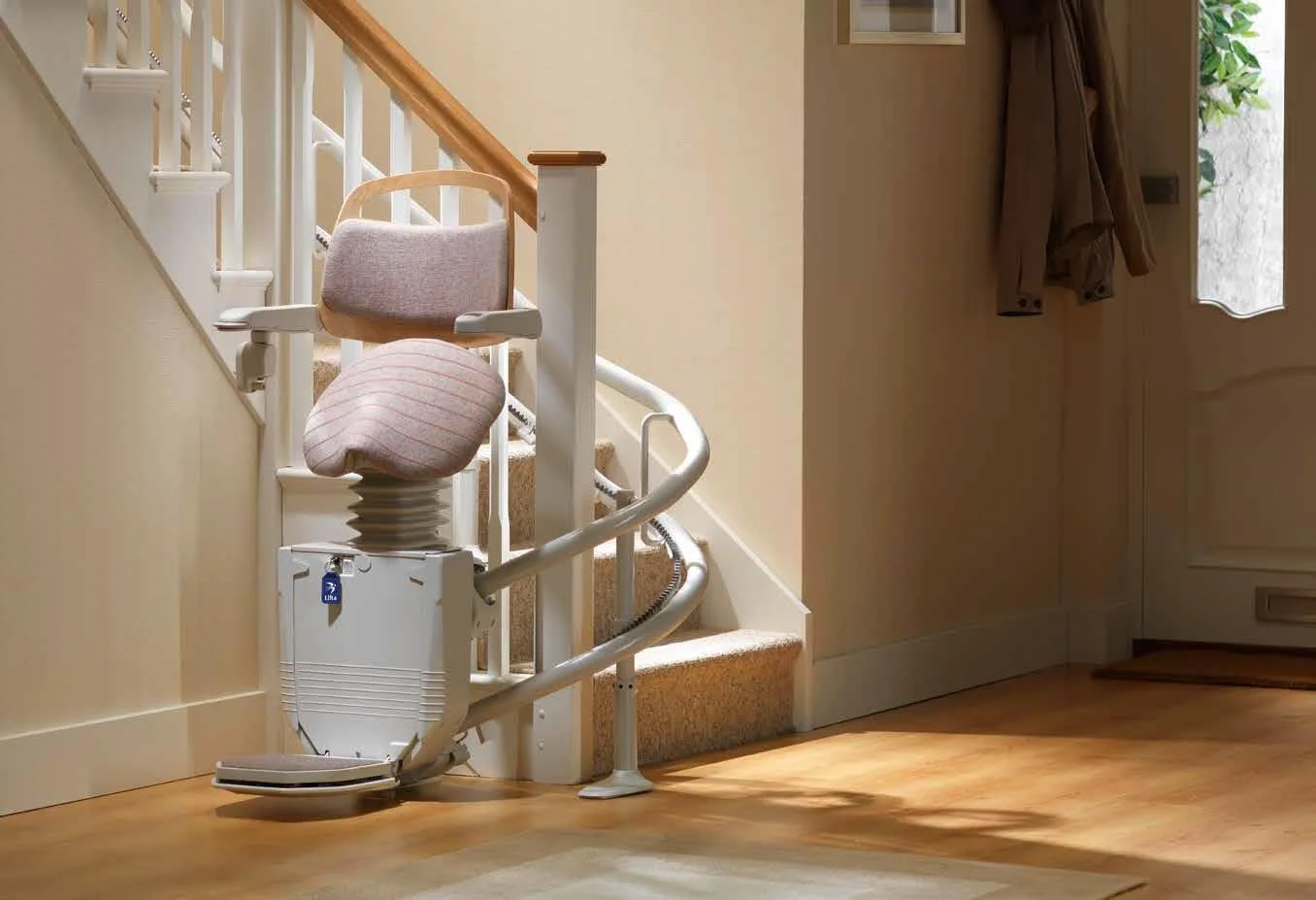
A straight staircase with no landings is the simplest case and usually takes a straight rail. Stairs that turn, have a landing partway up or wind around a corner need a curved rail built to fit that exact staircase.
Ranch-style homes often have just one flight to a basement, which a straight lift handles well. Split-level homes have several short flights, so we look at whether one lift or more than one is needed to reach the rooms you use most.
In walk-up apartments and low-rise buildings, the stairs are usually shared, so the building owner has to approve any installation. Around Darlington's Main Street Historic District, older 19th-century buildings can have unusual stair layouts that we measure carefully before recommending anything.
On a hilly lot, the hardest climb is sometimes the porch or entry steps, not the stairs inside. An outdoor stair lift is built to handle weather and can get someone from the yard to the door.
For a person who uses a wheelchair, a seat lift may not be enough. A platform lift carries the wheelchair itself, and it needs more space, so we check the entry and landing area first.
About 21.2% of residents are 65 or older, and 73.4% own their homes. For many families, that means helping a parent stay in a house they own instead of moving.
If that includes someone in your family, the Lafayette County Veterans Service Office at 627 Washington Street in Darlington, (608) 776-4886, can help sort out which VA benefits apply.
Wisconsin Family Care is the program on this list that names stair lifts as a covered home modification. You start through the ADRC of Southwest Wisconsin at (608) 776-4960, which screens for Family Care and IRIS.
Other programs fund home repairs or accessibility work without naming stair lifts, including USDA rural repair loans and grants, CDBG housing rehab loans and SWCAP home repair loans. Veterans have separate VA options, though the VA HISA grant excludes stair glides. Details for each are listed below.
A free, confidential starting point for older adults and people with disabilities in Lafayette County, and the intake point for Family Care and IRIS. It does not list stair lift funding itself; call (608) 776-4960.
Medicaid managed long-term care for Wisconsin adults 18 and older who pass the Long-Term Care Functional Screen. Home modifications explicitly include stair lifts, funded through your care plan; apply through the ADRC at (608) 776-4960.
A self-directed Medicaid budget that covers environmental accessibility adaptations (home modifications), though stair lifts are not named. Call (888) 515-4747.
Loans up to $40,000 at 1% interest and grants up to $10,000 for very-low-income rural homeowners, with grants limited to those 62 and older; stair lifts are not named, but funds can remove health and safety hazards. Call (715) 345-7600.
Grants for veterans with qualifying service-connected disabilities to modify a home for accessibility, with SAH up to $126,526 and SHA up to $25,350 for FY2026; stair lifts are not specifically listed. Ask the Lafayette County Veterans Service Office at (608) 776-4886.
Up to $6,800 lifetime for service-connected disabilities or $2,000 for non-service-connected, for medically necessary home improvements. It does not cover stair lifts, which the VA excludes as stair glides.
0% interest, deferred-payment loans for owner-occupied homes with income at or below 80% of county median; removal of architectural barriers is eligible, though stair lifts are not named. Call the Housing Help Line at (608) 266-7531.
0% interest, deferred-payment loans for low-income homeowners in Lafayette and four neighboring counties, with an accessibility repair category that does not name stair lifts. Call (608) 943-6909.
A self-directed budget for veterans in VA primary care, including the William S. Middleton Memorial VA in Madison, covering personal care, assistive technology and similar services; home modifications and stair lifts are not listed. Call (608) 243-5670.
Older adults
1 W. Wilson St., Room 450, Madison, 53703
Veterans
627 Washington Street, Darlington, 53530
Wisconsin Family Care lists stair lifts among the home modifications it can fund through a member's care plan. You need to be Medicaid-eligible, 18 or older and pass the Long-Term Care Functional Screen; start with the ADRC at (608) 776-4960.
The HISA grant does not, since it excludes stair glides. SAH and SHA grants fund accessibility changes for qualifying service-connected disabilities but do not name stair lifts, so call the Lafayette County Veterans Service Office at (608) 776-4886 to ask.
The USDA Section 504 program offers grants up to $10,000 to very-low-income homeowners age 62 and older, and Lafayette County is rural and generally eligible. Grants must be repaid if the home sells within 3 years; call (715) 345-7600.
Yes, stairs with a turn or landing usually need a curved rail made to fit that staircase. We measure on site to see what fits.
An outdoor stair lift is designed for exterior steps. If the person uses a wheelchair, a platform lift may be the better fit.
The ADRC of Southwest Wisconsin, Lafayette County Office, is free to use and can walk you through the options. Call (608) 776-4960.
Tell us about the stairs in your home and we will explain which lift fits, what it costs and how installation works.
