La Crosse sits on a narrow strip of flat ground between the Mississippi River and 500-foot bluffs. Out past the city, in Holmen, West Salem, Bangor, Mindoro and the rest of the Driftless Area's coulee country, houses climb ridges and tuck into narrow valleys. That terrain shaped how people built here, and it shapes what kind of stair lift a home needs.
Many homes across the county's 10 towns are split-levels or have walk-out and tuck-under lower levels dug into a hillside. Others are older houses in the flat river-valley core of La Crosse, or homes on French Island and Brice Prairie near the water. This page walks through how those layouts affect a stair lift and which local and state programs can help cover the cost.
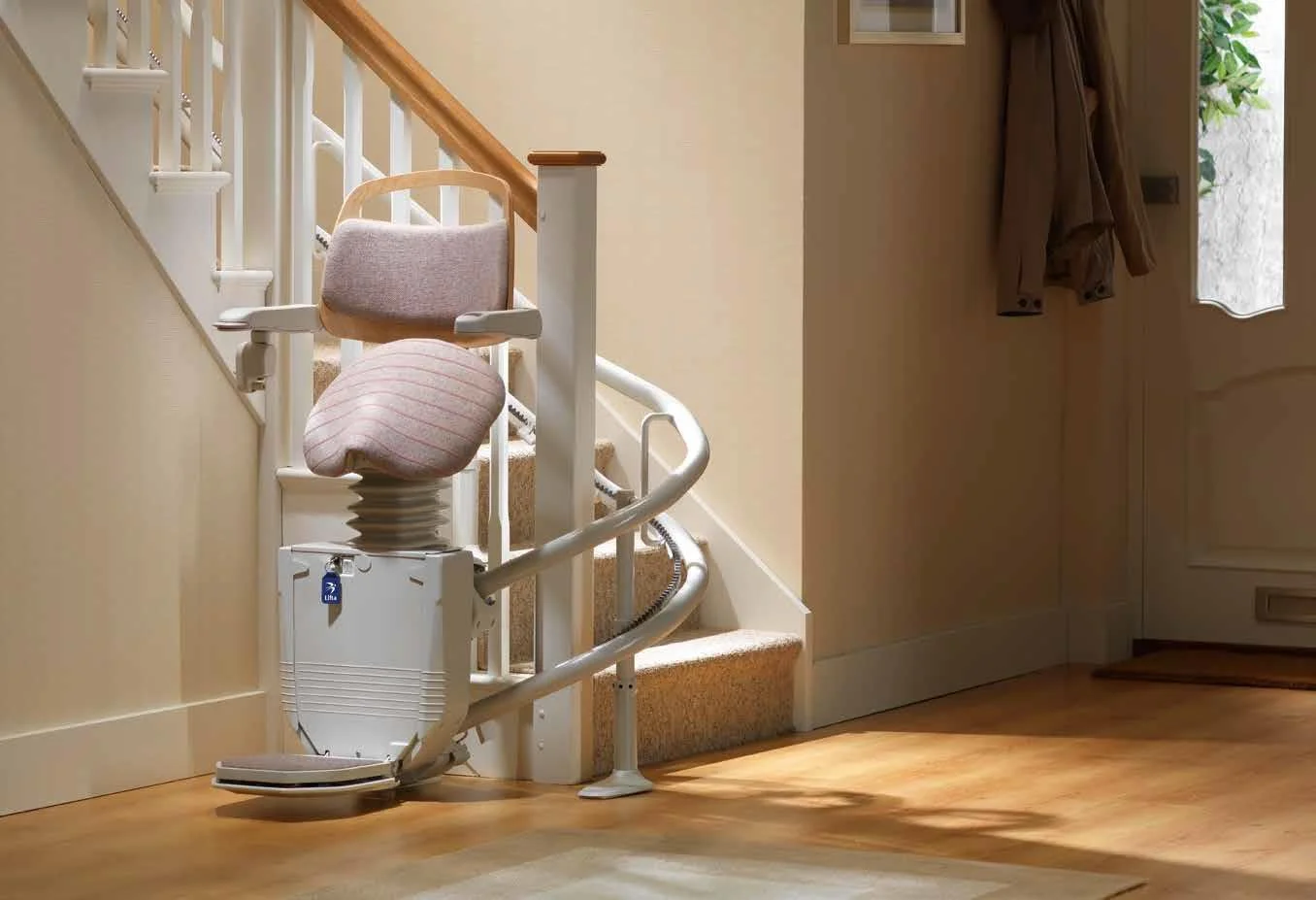
Builders working around the bluffs and coulees often went up instead of out. That means split-levels with several short flights, and hillside homes where the main living area sits above a walk-out or tuck-under lower level. Each flight is a separate question when we measure.
A single straight run, common in older homes in the river-valley core of La Crosse, usually takes a straight stair lift on a standard rail. Stairs that turn at a landing or wrap around a corner need a curved rail built to fit that staircase. In a split-level, the first step is deciding which level the person truly needs to reach every day.
Townhouses, walk-up apartments and low-rise buildings add another wrinkle. Shared stairways usually need the building owner's approval before anything gets bolted to the treads, so that conversation should happen early.
La Crosse County winters are hard on steps. The January average high is 25.9F, the record low is -43F, and the area sees about 43 inches of snow a year. Icy exterior stairs are a real fall hazard for older residents.
Hillside homes often have entry stairs up from the driveway or down to a walk-out door. An outdoor stair lift is built to handle weather on those runs. Where steps are not workable at all, a platform lift is another option, especially for someone using a wheelchair.
For a lot of families, the stair question comes up after a hospital stay or a therapy visit.
That help is usually close by. Gundersen Health System and Mayo Clinic Health System are based locally, so home-health, occupational therapy and medical equipment referrals for stair lifts and home changes are mostly handled in-county. An occupational therapist's notes can also help when you apply to a program.
Two Wisconsin Medicaid long-term care programs can pay for home modifications. Family Care lists stair lifts by name in its home modifications benefit. IRIS lets participants fund home modifications from a self-directed budget. Both go through the ADRC of La Crosse County at (608) 785-5700, 300 4th Street N. in La Crosse.
Local repair programs from the City of La Crosse, Couleecap, Habitat for Humanity and Coulee Region RSVP focus on repairs and safety work. Their published descriptions do not name stair lifts, so ask each one directly. Veterans should know that the VA HISA grant excludes stair glides, though other VA housing grants may still be worth asking about.
Other statewide options to ask the ADRC about include the Community Options Program (COP), WisLoan (WisTech Alternative Loan Program) and the WHEDA Home Improvement Loan Program (HILP). Each program is listed below.
A self-directed Medicaid program for adults 18 and older who meet the Long-Term Care Functional Screen; home modifications are a covered category you can fund from your individual budget, and there is no waitlist. La Crosse County residents enroll through the ADRC, and the IRIS Call Center is (888) 515-4747.
A Medicaid managed long-term care program for frail elders and adults with disabilities, with home modifications as a covered benefit that may include stair lifts, ramps and wheelchair lifts. La Crosse was one of the first five counties to pilot it; call (800) 362-3002 or start with the local ADRC.
Free benefits counseling and long-term care options counseling, and the local entry point for IRIS and Family Care; it does not list its own stair lift grant. Call (608) 785-5700 or visit 300 4th Street N. in La Crosse.
A deferred loan of up to $45,000 at 1% simple interest for income-eligible City of La Crosse homeowners, with no payments until the home is sold or is no longer your main residence; the listed repairs do not mention stair lifts. Call (608) 789-7512.
Funds critical safety and livability repairs for homeowners of at least one year with income at or below 80% of county median income; stair lifts are not named. Call (608) 796-9062.
Offers 0% interest loans for critical repairs under $7,500 and a rural track with a grant of up to $17,300, focused on aging-in-place and accessibility, though stair lifts are not named. The standard track was not taking new applications at last check while the rural track was; call (608) 785-2373.
Volunteers handle small jobs such as grab bars and door hardware for adults 55 and better, people with disabilities and veterans in La Crosse and Monroe counties; stair lifts are not listed. Call (608) 785-0500.
Pays up to $6,800 or $2,000 over a lifetime for medically necessary home changes for veterans, but it specifically excludes stair glides and porch lifts. Call (608) 372-3971.
Grants of up to $126,526 (SAH) or $25,350 (SHA) for veterans with certain severe service-connected disabilities; the VA's examples are ramps and wider doorways, and stair lifts are not mentioned. Call (608) 372-3971.
Loans up to $40,000 at 1% and grants up to $10,000 for homeowners age 62 or older in USDA-eligible rural areas with very low income; grants target health and safety hazards and stair lifts are not named. Call (800) 414-1226.
The VA facilities where La Crosse County veterans get prescriptions and process HISA, SAH, SHA and TRA applications; it is not a grant itself. Call (608) 372-3971.
Older adults
300 4th Street N., La Crosse, 54601
Veterans
300 4th Street North, Health and Human Services - 1st Floor, La Crosse, 54601
It can. Family Care lists stair lifts in its home modifications benefit, and IRIS covers home modifications from a participant's budget. Both require Medicaid and the Long-Term Care Functional Screen, and La Crosse County residents start with the ADRC at (608) 785-5700.
The HISA grant does not; it lists stair glides as excluded. The SAH and SHA grants do not mention stair lifts either way, so ask. Veterans Services at (608) 785-9719 and the Tomah VA at (608) 372-3971 can help.
The City of La Crosse Housing Rehabilitation Loan Program is for City of La Crosse residents only. Homeowners elsewhere in the county can look at Couleecap, the Habitat RePair Program or USDA Section 504 if they live in an eligible rural area.
Outdoor stair lifts are built for exterior stairs, which matters with about 43 inches of snow a year here. For hillside entries where a lift on the steps is not practical, a platform lift is another option to discuss.
The USDA Section 504 grant is only for homeowners age 62 or older. Younger homeowners who qualify can still apply for the repair loan of up to $40,000 at 1%.
Call or visit the ADRC of La Crosse County at (608) 785-5700, 300 4th Street N., La Crosse. Its counselors screen for IRIS and Family Care and can point you to local repair programs.
Tell us about the stairs in your home and we will explain which lift fits, what it costs and how installation works.
