Parkersburg still has houses built when the Ohio and Little Kanawha rivers were the main roads in and out of town. The Tavenner House, a two-story brick Federal-style home built about 1812, is documented as the oldest remaining building in the Parkersburg area. Many of the city's older multi-story homes still have the interior staircases they were built with.
Outside the river bottoms, the land rises into the hills of the Appalachian Plateau around places like Mineralwells, Lubeck, Boaz and Waverly. A home in Vienna or Williamstown can need a very different lift than a farmhouse up a hollow. This page walks through what Wood County homes usually call for and where families can look for help paying.
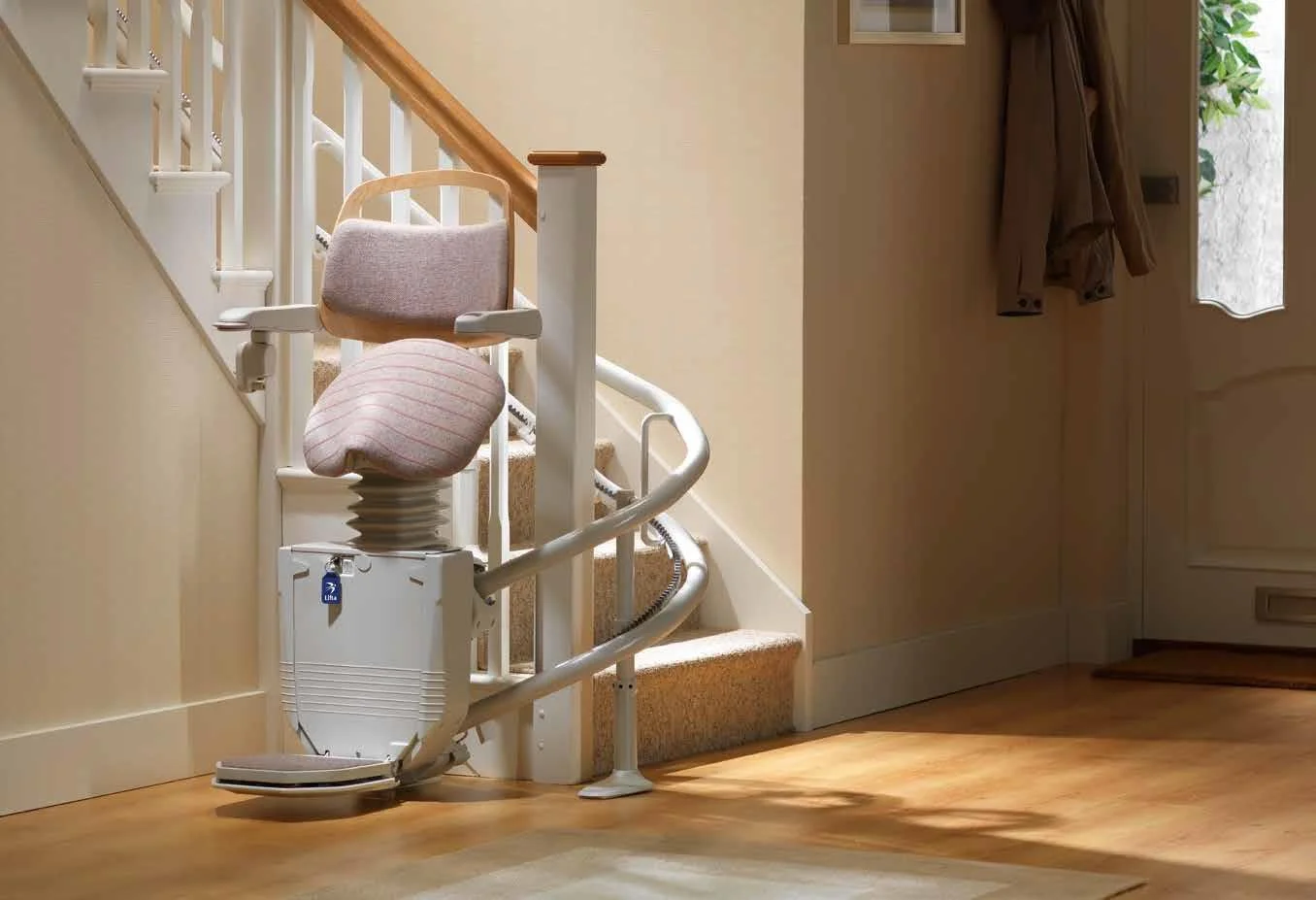
Homes built before the 1940s often have stairs that are narrower or steeper than what newer houses have. Some turn at a landing or wind near the top. Those details decide whether a straight rail works or whether a curved rail has to be built to fit.
A straight lift is usually the simpler job when the staircase runs in one line from bottom to top. When the stairs turn, a curved rail follows the bends. Either way, we measure the stairs themselves before recommending anything, because original staircases rarely match a standard layout.
Wood County housing includes single-family and detached houses, townhouses, walk-up apartments and split-level homes. A split-level often has short runs of stairs between floors, and a lift on the most-used run can make the biggest difference for daily life.
Townhouses tend to have one long straight flight, which often suits a straight rail. In a walk-up apartment, the building owner usually has to approve anything mounted on shared stairs, so that conversation should happen first.
The flatter ground near the rivers in Parkersburg is different from the hilly land farther out in the county. On hillside lots, the hardest stairs are sometimes outside: porch steps, a walk from the driveway, or a set of steps down to a lower entrance.
Outdoor stair lifts are built for weather exposure and can handle those exterior runs. Where a wheelchair needs to go up and down, a platform lift may make more sense than a seat. A site visit is the way to sort out which fits.
About 22.1% of Wood County residents are 65 or older, and 71.6% of households own their homes. For homeowners, a lift can be part of a plan to stay in the house rather than move.
None of the public programs below lists stair lifts by name, and one VA grant specifically excludes them. That does not rule out help, but it means you should ask each office directly and expect paperwork such as a medical assessment or a doctor's prescription.
Good first calls are the ADRC Home Modification and Accessibility Program for people 60 and older, and the Northwestern Area Agency on Aging, which is also where Wood County residents apply for the Aged and Disabled Waiver. Veterans can start with the West Virginia Department of Veterans Assistance Parkersburg Benefits Office at (304) 420-4982, at 1824 Murdoch Avenue, Suite F101, Parkersburg 26101. You can also ask about the West Virginia Technology-Related Assistance Revolving Loan Fund.
A state Medicaid waiver for adults 18 and older who qualify for nursing-facility level of care; its Environmental Accessibility Adaptations cover physical adaptations to the home per the service plan, but stair lifts are not named. Call (866) 767-1575, and note that Wood County residents apply through the Northwestern Area Agency on Aging.
The local intake point for aging services in a 16-county region that includes Wood County, including Aged and Disabled Waiver applications; it is not a cash grant and stair lifts are not listed. Call (304) 242-1800.
Provides nutrition, transportation, in-home care, VA benefits assistance and other services to Wood County seniors; no home modification or stair lift program is listed. Call (304) 485-6748.
A statewide program for residents 60 or older who need home modifications or accessibility devices to stay independent; amounts are set per application and stair lifts are not named. Call (866) 981-2372 for an application.
Pays for permanent, medically necessary home alterations such as ramps and roll-in showers, up to $6,800 or $2,000 lifetime depending on disability status. It does not cover stair lifts; VA lists stair glides as excluded.
Grants for homeowning veterans with qualifying severe service-connected disabilities, up to $126,526 for SAH or $25,350 for SHA in FY2026; stair lifts are not specifically named. Call (800) 827-1000.
Helps people with disabilities coordinate home modifications and durable medical equipment; stair lifts are not listed. Wood County is not named in its service area, so call (304) 525-3324 to confirm before applying.
Older adults
1900 Kanawha Blvd. East, Charleston, 25305
Veterans
1824 Murdoch Avenue, Suite F101, Parkersburg, 26101
Often it can, but older staircases vary in width, steepness and turns. We measure on site to decide between a straight rail and a curved one built for that staircase.
The ADRC Home Modification and Accessibility Program is for people 60 and older, but the Aged and Disabled Waiver starts at age 18 for those who meet its medical and financial rules. Call (866) 767-1575 to ask about the waiver.
No. VA lists stair glides among excluded items for HISA. Veterans can ask about the SAH and SHA grants at (800) 827-1000 or visit the Parkersburg Benefits Office at (304) 420-4982.
Through the Northwestern Area Agency on Aging, run by Belomar Regional Council. Their number is (304) 242-1800.
Yes, outdoor stair lifts are made for exterior steps like porches and walkways. If a wheelchair has to make the trip, a platform lift may be the better choice.
Its listed services are nutrition, transportation, in-home care and VA benefits assistance, with no stair lift program. Staff at (304) 485-6748 can still be a useful contact for other support at home.
Tell us about the stairs in your home and we will explain which lift fits, what it costs and how installation works.
