Wayne County sits in West Virginia's southwestern corner, where the Ohio River meets the Big Sandy River and the county borders both Kentucky and Ohio. From Kenova and Ceredo near the river to Wayne, Lavalette, Prichard and Fort Gay farther along the valleys, a lot of houses here sit on sloped lots or multi-level foundations.
That kind of ground shapes the stairs people climb every day, inside and outside the house. This page walks through how local home styles affect stair lift choices, and which programs a Wayne County family can call about when it comes to paying for one.
The county covers 512 square miles of river-valley-and-hollow terrain, with Twelvepole Creek, Tug Fork, Beech Fork Lake and East Lynn Lake all in the mix. Homes built into hillsides often end up with a basement level, a raised main floor, or a long run of steps from the driveway to the door.
When we look at a house here, we check more than the indoor staircase. Porch and entry steps on a sloped lot can be the harder problem, and an outdoor stair lift built for weather exposure may be the piece that lets someone get in and out of the house at all.
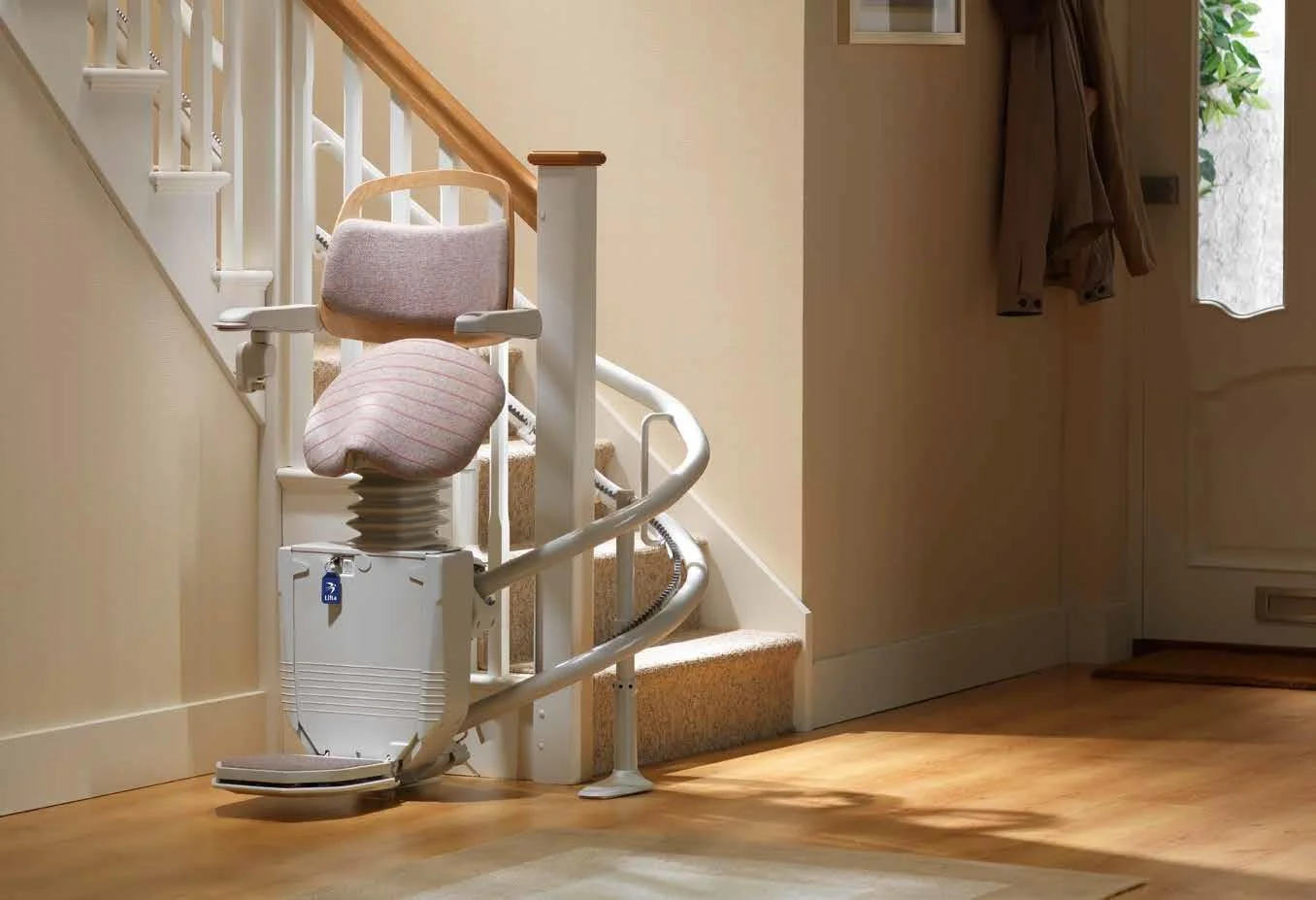
Single-family and detached houses with one straight staircase are the simplest case. A straight stair lift rides a rail mounted to the stair treads, not the wall, and usually goes in without remodeling.
Split-level homes are different. They tend to have several short flights, sometimes with a turn or landing, so one curved rail or more than one straight lift may be needed. Ranch-style homes often have a single basement stair, which is a common spot for a straight lift.
Manufactured homes usually have their steps outside, at the entry. In that case an outdoor lift or a vertical platform lift for a wheelchair user is often the better fit than anything indoors.
In the 2020 census, 13.8% of households had someone 65 or older living alone, which is often the situation where a fall on the stairs goes unnoticed the longest.
The same census counted 75.1% of the county's 18,150 housing units as owner-occupied. Because most older residents own their homes, owner-focused programs like USDA repair grants and VA housing grants are realistic options here, and a rail can be installed without asking a landlord.
No single program here is confirmed to pay for stair lifts by name, so it helps to know how each one is written. The Aged and Disabled Waiver, the Aging Well, Safe at Home Initiative, USDA Section 504 and the VA SAH and SHA grants all fund home adaptations or repairs without listing stair lifts either way. Ask each one directly whether your project qualifies.
One program is a clear no. The VA HISA grant specifically excludes stair glides and porch lifts, though it can still help with other structural changes. For veteran claims help close by, the Huntington Claims Office at 640 4th Avenue, Room 158, Huntington, can be reached at (304) 399-9395.
A good first call for older adults is Metro Area Agency on Aging (Region II) / Superior Senior Care - Wayne County at (304) 824-3448, which can point you toward state aging programs. The West Virginia Technology-Related Assistance Revolving Loan Fund is another statewide resource worth asking about.
A Medicaid waiver for West Virginians 18 and older who meet a nursing-facility level of care; its EAA-Home benefit funds physical adaptations to the home, but stair lifts are not listed either way. Call (304) 558-3317.
Funds home modifications and/or accessibility devices for adults 60 or older who show a need to live more independently; stair lifts are not specifically listed. Call (866) 981-2372.
The local intake point for older Wayne County residents, offering in-home services, meals, transportation and referral to state aging programs; no stair lift benefit is listed. Call (304) 824-3448.
Loans up to $40,000 at 1% over 20 years and grants up to $10,000 for very-low-income homeowners age 62+, for removing health and safety hazards and repairs; stair lifts are not named. Call (304) 284-4868.
Provides up to $6,800 or $2,000 lifetime for medically necessary home alterations for veterans, but it explicitly excludes stair glides, so it does not cover a stair lift. Call (800) 827-1000.
Grants of up to $126,526 (SAH) or $25,350 (SHA) for FY2026 for homeowners with qualifying service-connected disabilities; ramps and doorway widening are given as examples, and stair lifts are not named. Call (800) 827-1000.
Serves people with disabilities in all 55 West Virginia counties, including Wayne, with home modifications such as ramps and grab bars; stair lifts are not mentioned and funding may involve a waiting list. Call (304) 525-3324.
Older adults
1900 Kanawha Blvd. East, Charleston, 25305
Veterans
640 4th Avenue, Room 158, Huntington, 25701
The Aged and Disabled Waiver funds physical adaptations that improve access to and within the home, but its official page does not list stair lifts either way. Call (304) 558-3317 to ask whether your situation qualifies.
No. The VA excludes removable equipment such as stair glides and porch lifts from HISA. The SAH and SHA grants do not name stair lifts either, so ask the VA at (800) 827-1000 about your case.
Yes. The Aging Well, Safe at Home Initiative serves adults 60 and older who need home modifications or accessibility devices, and Metro Area Agency on Aging (Region II) / Superior Senior Care - Wayne County at (304) 824-3448 is the local starting point.
Often, yes. On sloped lots common in the county's hollows and river valleys, an outdoor stair lift or a vertical platform lift at the entry may matter more than an indoor one. We look at both during an assessment.
Not always. Split-level homes usually have short flights, and depending on landings and turns, the answer may be a curved rail or separate straight lifts.
Homeowners age 62 and older with very low income may get a grant of up to $10,000, and loans go up to $40,000 at 1%. The program funds hazard removal and repairs but does not name stair lifts, so call (304) 284-4868 to ask.
Tell us about the stairs in your home and we will explain which lift fits, what it costs and how installation works.
