Roane County covers 484 square miles of hilly Appalachian ground. Most homes sit in and around Spencer, the county seat, and the rest are spread through hollows and hillside communities along narrow valley roads. That layout shapes almost every stair lift job we look at here, from the stairs inside to the steps up from the driveway.
This page walks through how local homes and terrain affect the kind of lift that fits, and which programs may help with the cost. If you are weighing a lift for yourself or a parent, the goal is to give you enough to have a useful first conversation.
The housing here is mostly single-family homes and detached houses, with split-level homes, ranch-style homes and some low-rise buildings mixed in. A plain, straight staircase is the simplest case. A straight stair lift runs on a rail fastened to the treads, not the wall, and usually goes in quickly.
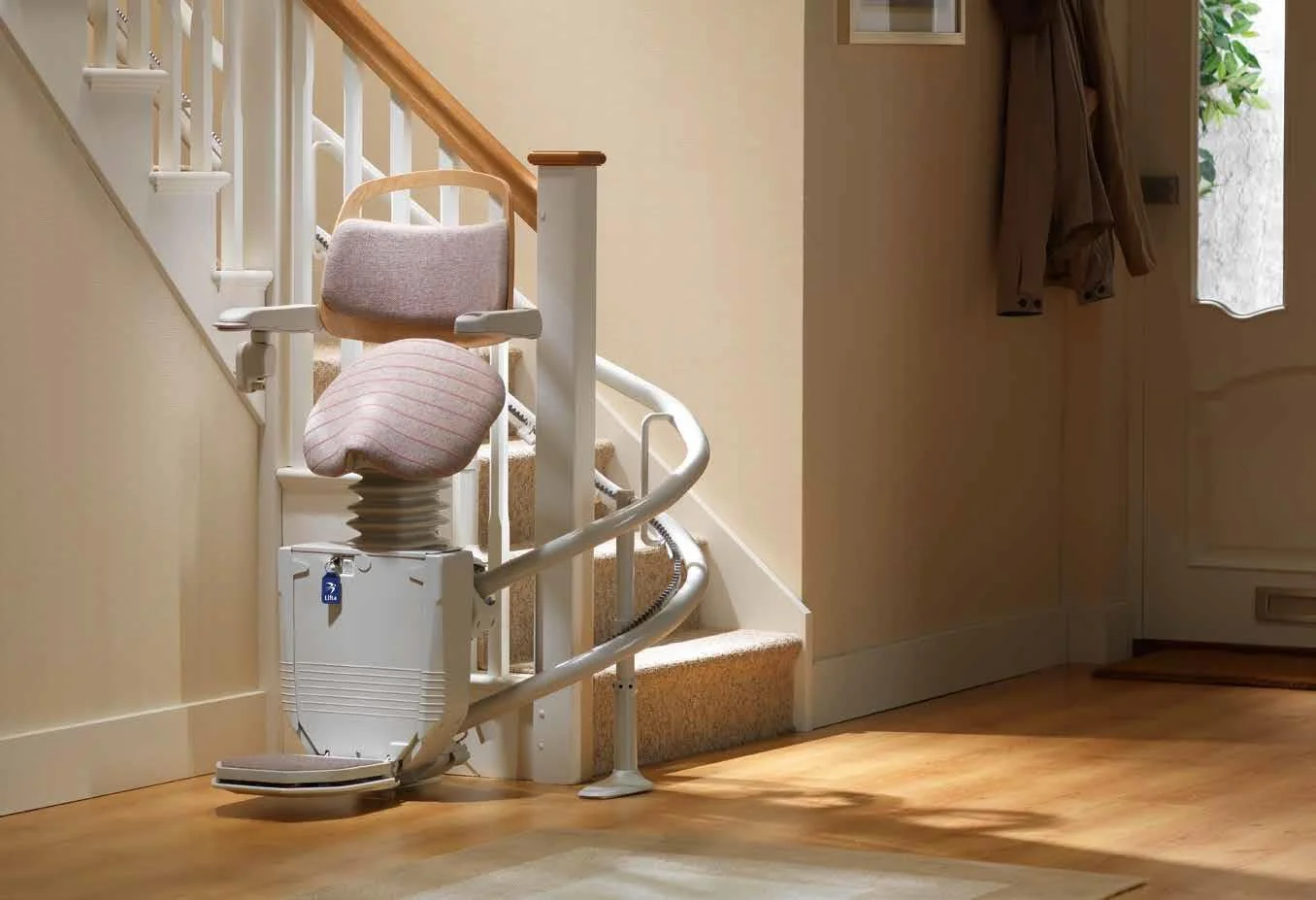
Split-level homes are different. They often have several short flights instead of one long one, so we look at whether one lift can serve the level that matters most or whether a curved rail is needed to follow a turn or landing. Curved lifts are built to the exact shape of the stairs, so they take longer to order and cost more than straight ones.
Ridges and hilltops in the county rise to about 1,000 feet, reaching 1,500 feet in the southeast. With about 29 people per square mile, many residents live outside Spencer on sloped or rural lots. On those properties the hardest climb is often outside, between the car and the front door.
An outdoor stair lift is made to handle weather and can run along exterior steps or a porch stair. Where someone uses a wheelchair, a vertical platform lift may be a better fit than a seat. We also ask about the access road and parking, since narrow valley roads can affect how equipment gets to the house.
At the 2020 census, Roane County had 14,028 residents, 22.6% of them age 65 or older, and a median age of about 46.3. That is older than the national average. Many families here are planning for a parent who wants to stay put.
Money is a real factor. The 2010 figures put median household income at $27,428 and the poverty rate at 27.6%. For many households, paying for a lift out of pocket is hard, which is why it makes sense to check the programs below before deciding.
None of the program sources we reviewed names stair lifts directly, and the VA HISA grant specifically excludes stair glides. Several programs do fund home modifications or accessibility devices in general, so it is worth asking each one whether a lift can be part of your plan.
A good first call is the Roane County Committee on Aging at (304) 927-1997, which serves as the local intake point for referrals to state home-modification programs. The Region III - WVDA Southern AAA in Charleston is at (304) 340-3501. Veterans can reach the Spencer Field Office of the West Virginia Department of Veterans Assistance at 216 Market Street, Suite 301, at (304) 927-0980. The West Virginia Technology-Related Assistance Revolving Loan Fund is another statewide option to ask about.
A Medicaid waiver for West Virginia residents age 18+ who need nursing-facility level of care and meet waiver financial rules; it covers home adaptations (EAA-Home) case by case, but the source does not mention stair lifts. Call (866) 767-1575.
The local senior center at 811 Madison Avenue in Spencer, offering in-home care, transportation and meals, and the intake point for referrals to state home-modification programs; it does not list a stair lift benefit. Call (304) 927-1997.
A state program for people age 60+ who need home modifications or accessibility devices to live more independently; the source does not name stair lifts or state a dollar amount. Call the WV Aging and Disability Resource Center at (866) 981-2372.
A nonprofit program serving Roane County that funds home modifications, wheelchair ramps and assistive devices for people who meet income guidelines, with a waiting list; stair lifts are not named. Call (304) 965-0376.
Loans up to $40,000 at 1% for very low-income rural homeowners, and grants up to $10,000 for homeowners age 62+ who cannot repay a loan; Roane County qualifies as rural, and accessibility improvements are covered, though stair lifts are not named.
A VA grant of up to $6,800 or $2,000 lifetime for medically necessary home changes such as entrance modifications and roll-in showers. It does not cover stair lifts, since stair glides are on its excluded list.
Grants of up to $126,526 (SAH) or $25,350 (SHA) in FY2026 for veterans with certain severe service-connected disabilities to adapt a home; the VA page cites ramps and wider doorways and does not name stair lifts.
Older adults
1900 Kanawha Blvd. East, Charleston, 25305
Veterans
216 Market Street, Suite 301, Spencer, 25276
The Aged and Disabled Waiver covers home adaptations called EAA-Home, approved case by case within your service-plan cost limits. The program page does not name stair lifts, so ask directly at (866) 767-1575.
Yes, the Aging Well, Safe at Home Initiative serves people age 60+ who need home modifications or accessibility devices. Call (866) 981-2372, or start with the Roane County Committee on Aging at (304) 927-1997.
No. HISA lists stair glides among excluded items. A veteran with a qualifying severe service-connected disability can ask about SAH or SHA grants through the Spencer Field Office at (304) 927-0980.
Often, yes. Outdoor stair lifts are built for exterior steps, and a vertical platform lift may suit a wheelchair user. We look at the slope, the steps and the access road during the home visit.
Roane County, including Spencer, qualifies as rural for Section 504 repair loans and grants. You must own and live in the home and meet the very low income limit, and applications are taken year-round while funds last.
Tell us about the stairs in your home and we will explain which lift fits, what it costs and how installation works.
