Ritchie County spreads across 452 square miles of the hilly Allegheny Plateau, with Harrisville as the county seat and Pennsboro and Pullman rounding out its towns. Many of the homes here are older multi-story farmhouses and small-town houses that families have owned for a long time, not new single-story builds.
That mix makes stairs a daily fact of life for a lot of households. If a parent is starting to struggle with the steps to a bedroom, a basement laundry or a front porch, a stair lift can let them keep using the whole house they already own. This page covers which lift types fit local homes and which programs may help pay for one.
According to the 2020 census, 81.0% of occupied housing units in Ritchie County are owner-occupied, and the median age is 48.6 years. People here tend to stay put in homes they have lived in for decades.
That is why most stair lift work in the county is retrofit work. We fit a lift to the staircase that is already there, in a farmhouse outside Pullman or a house near the courthouse in Harrisville, instead of asking a family to move or remodel.
A straight staircase with no turns or landings takes a straight stair lift, which is usually the simplest install. The rail mounts to the stair treads, not the wall, so plaster walls in older farmhouses are not a problem.
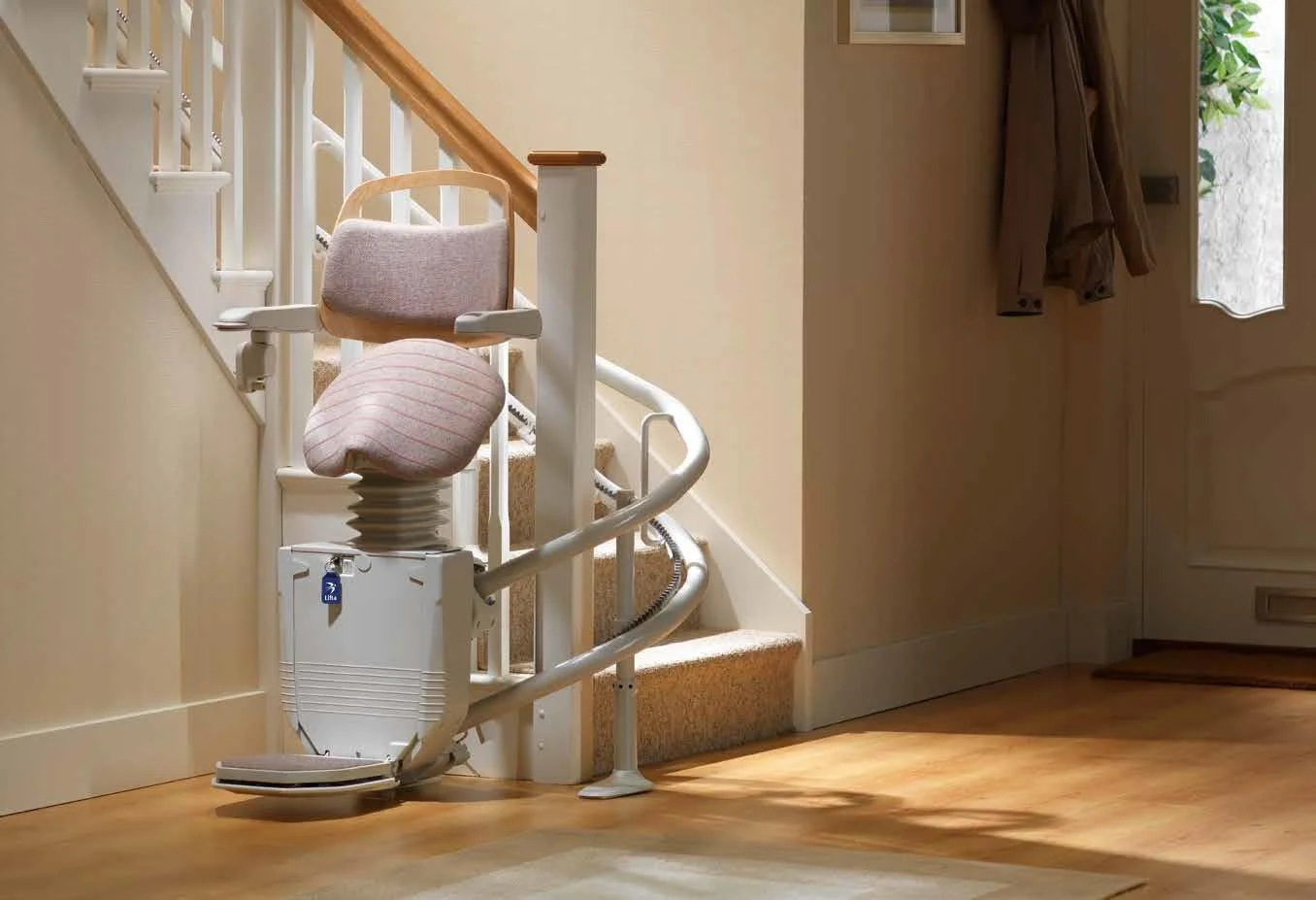
Split-level homes often have two or more short flights with a turn or landing between them. Those may call for a curved lift with a custom rail, or a separate straight lift on each flight. Ranch-style and detached single-story homes often still have stairs down to a basement, which a straight lift usually handles.
If a wheelchair user needs to get up the steps, a seat lift will not do the job, and a platform lift is the better fit. We can measure and talk through that option during a home visit.
The county's hilly terrain means many homes sit on slopes with steep steps up to the porch or down from the driveway. An outdoor stair lift built for weather can cover those exterior steps so getting in and out of the house is safer.
With only 18.7 people per square mile as of the 2020 census, homes are spread out and travel times to contractors and medical services can be long. A lift that works at home every day matters more when help is not close by.
As of the 2020 census, 23.6% of Ritchie County residents were 65 or older, a large and growing share.
The population fell 19.2% between 2010 and 2020, from 10,449 to 8,444 residents. In a smaller county, many older homeowners are living farther from adult children, which is often when a family starts looking at a lift.
Per 2010 census figures, 13.9% of families and 18.9% of the population were below the poverty line, so many households look for outside help with accessibility work. The two programs most likely to help with a stair lift are the West Virginia Medicaid Aged and Disabled Waiver (ADW) and the WV Bureau of Senior Services home modification program, since both cover home modifications.
USDA repair loans and VA housing grants are worth asking about, but their sources do not list stair lifts, and the VA HISA grant excludes stair glides outright. The West Virginia Technology-Related Assistance Revolving Loan Fund is another statewide option to ask about. Each program is summarized below with its phone number where one is published.
A Medicaid waiver for West Virginians age 18 and up who qualify financially and need nursing-facility level of care; its Environmental Accessibility Adaptations category covers home modifications, which includes stair lifts, with no published dollar cap. Apply through the Belomar Regional Council Area Agency on Aging or call (304) 558-3317.
A state program for residents age 60 or older who show a need for home modifications or accessibility devices to keep living at home, and stair lifts fall under that coverage. Funds are based on need; call the WV Aging & Disability Resource Center at (866) 981-2372 for current limits.
Loans up to $40,000 at 1% interest over 20 years, and grants up to $10,000 for homeowners age 62+ who cannot repay a loan, for very-low-income owners in rural areas such as Ritchie County. The source names ramps and walk-in tubs as examples but does not mention stair lifts.
A lifetime grant of up to $6,800 or $2,000, depending on disability status, for medically necessary home changes for veterans enrolled in VA healthcare. It does not cover stair lifts, as stair glides and porch lifts are specifically excluded; call (800) 827-1000 with questions.
Grants of up to $126,526 (SAH) or $25,350 (SHA) for FY2026 for veterans with certain severe service-connected disabilities who own or will own the home. The VA source does not mention stair lifts; call (800) 827-1000 to ask about your case.
Older adults
1900 Kanawha Blvd. East, Charleston, 25305
Veterans
1824 Murdoch Avenue, Suite F101, Parkersburg, 26101
Often, yes. Most of the work in Ritchie County is retrofitting lifts into existing multi-story farmhouses and small-town homes, and the rail attaches to the stair treads. We measure the stairway during a home visit to confirm the fit.
A staircase with a turn or landing usually needs a curved lift with a custom rail, or a straight lift on each flight. The right choice depends on the layout and how the person will use the stairs.
Yes. The WV Bureau of Senior Services Home Modification and Accessibility Program serves people 60 or older who need home modifications or accessibility devices. Call the WV Aging & Disability Resource Center at (866) 981-2372.
The West Virginia Medicaid Aged and Disabled Waiver (ADW) covers Environmental Accessibility Adaptations, which include home modifications like stair lifts, for people who meet its financial and medical requirements. In Ritchie County you apply through the Belomar Regional Council Area Agency on Aging, or you can call (304) 558-3317.
No. HISA specifically excludes stair glides and porch lifts. Veterans can still ask about other benefits through the West Virginia Department of Veterans Assistance Parkersburg Benefits Office at (304) 420-4982.
An outdoor stair lift is designed for exterior steps and weather, which suits the hilly lots common in the county. For a wheelchair user, a platform lift may be the better option.
Tell us about the stairs in your home and we will explain which lift fits, what it costs and how installation works.
