Williamson, Matewan, Delbarton and Gilbert grew up squeezed into the ravines and hollows along the Tug Fork, with houses built wherever a level spot could be found. Many of those older homes sit on raised foundations, with a flight of entrance steps out front and living space spread over more than one level.
That layout works fine until the stairs become the hardest part of the day. This page walks through what Mingo County homes usually need from a stair lift, from Chattaroy and Red Jacket to Gilbert Creek and Justice, and which programs may help cover the cost.
The county's coal-camp towns were tied to the rail yard the Norfolk & Western Railway set up at Williamson in 1890. Homes went up on the narrow bottomland and on the slopes above it, and that bottomland flooded hard, most recently in 1977 and 1984.
Floods led to the R.D. Bailey Lake and Dam in 1980 and to floodwalls protecting Williamson in 1991 and Matewan in 1996. Long before that, though, builders had raised foundations to keep living space above the water. The result is a lot of houses where you climb steps just to reach the front door.
Single-family homes and detached houses with one straight indoor staircase are usually the simplest job. A straight rail mounts to the stair treads, not the wall, and the chair folds up when nobody is using it.
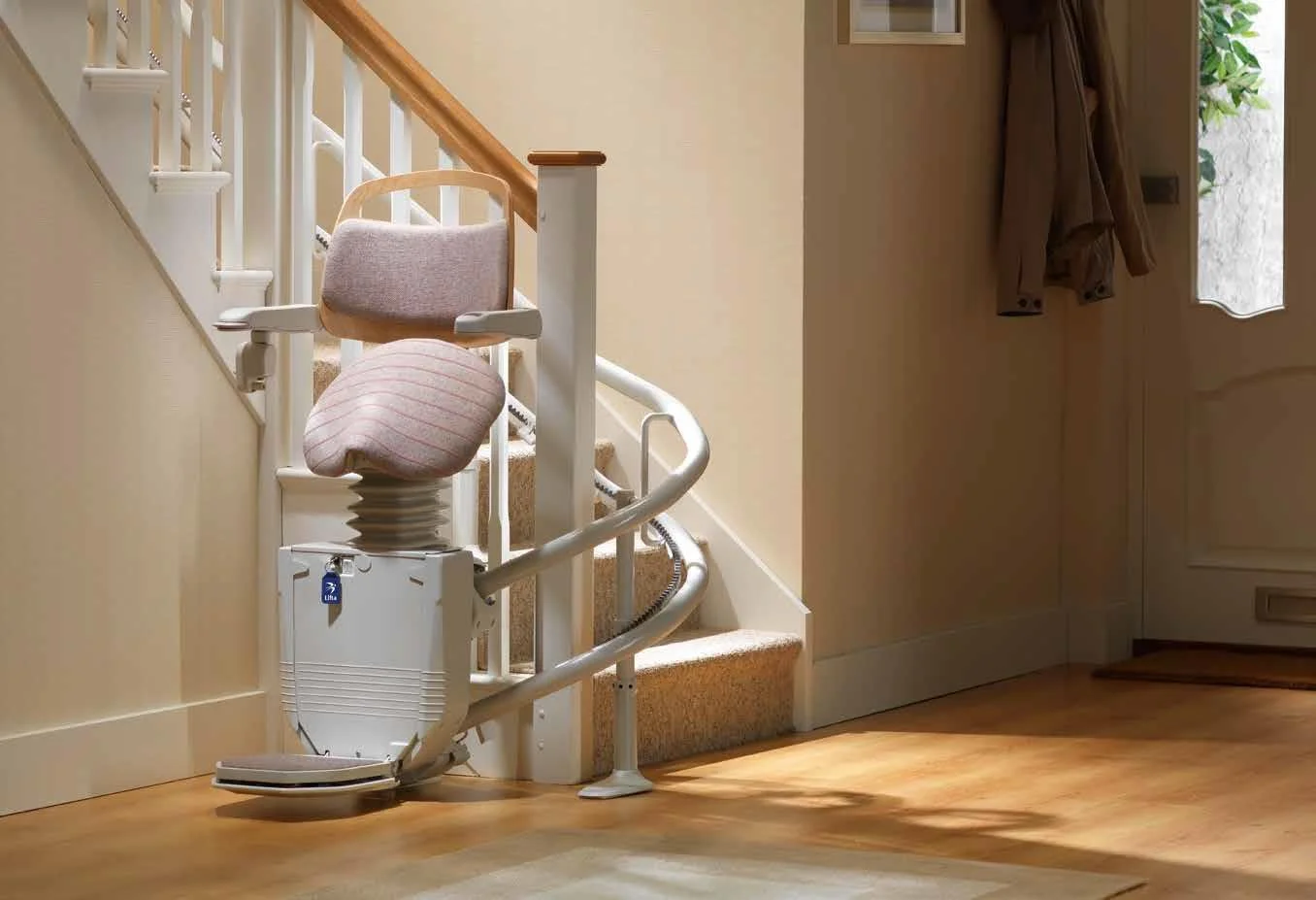
Split-level homes are different. Short runs of steps between levels, or a staircase that turns at a landing, usually call for a curved rail built to the exact shape of the stairs. Sometimes two straight lifts on two separate flights make more sense than one curved one.
Walk-up apartments and low-rise buildings raise another question: who owns the staircase. In a shared hallway, the building owner has to agree before anything is installed, so that conversation comes first.
Mingo County covers about 423.9 square miles of rugged Appalachian terrain, and plenty of homes sit on sloped lots above the road. When the hardest stairs are the exterior entrance steps, an outdoor stair lift built for weather exposure is one option.
Where someone uses a wheelchair, a chair lift will not solve the problem. A vertical platform lift at the porch or entrance can carry the chair itself, and the site, the slope and the height of the foundation all decide whether it fits.
As of the 2020 census, 20.3% of county residents were 65 or older, and the median age was 45.0. Many families here have adult children who moved away and now help a parent plan from a distance.
About 59.7% of residents are homeowners, which matters because most funding programs and most installations assume you own the home.
Household budgets in the county are tight, and few programs hand out money for stair lifts specifically. The ones most likely to help are the West Virginia Aged and Disabled Waiver's home adaptation benefit, the Bureau of Senior Services home modification program for people 60 and older, and the Community Living Services Program through Mountain State Centers for Independent Living.
Some well-known programs do not cover stair lifts. The VA HISA grant explicitly excludes stair glides, and the USDA repair loans and Coalfield weatherization program do not list them. Each program below shows what the source says, along with a phone number to call before you apply.
Statewide, the West Virginia Technology-Related Assistance Revolving Loan Fund is another program name worth asking about when you call the aging office.
A Medicaid waiver benefit that pays for physical adaptations to the home for adults 18 and older who meet Medicaid financial rules and need nursing-facility level of care; home modifications are covered, and a stair lift would go through an EAA-Home prior-authorization request. Call (866) 767-1575.
A statewide grant for people age 60 or older who can show they need home modifications or accessibility devices to live more independently, and the source lists stair lifts as covered. No dollar cap is stated, so call (866) 981-2372 to ask about current limits.
Loans up to $40,000 at 1% fixed interest and grants up to $10,000 for homeowners age 62+ with low income, aimed at repairs like heating, plumbing, roofing and structure; the sources do not mention stair lifts. Call (304) 284-4860.
A VA grant of up to $6,800 or $2,000 lifetime for medically necessary alterations like ramps and roll-in showers, but stair glides and porch lifts are explicitly excluded. Call (800) 827-1000.
Larger VA grants, up to $126,526 for SAH and $25,350 for SHA, for veterans with specific severe service-connected disabilities; the source names ramps and wider doorways but does not mention stair lifts. Call (800) 827-1000.
A state-funded program for people with disabilities who meet income guidelines, with Mingo County in its service area, and it covers home modifications including stair lifts when funding allows. Call (304) 525-3324 and ask for the CLSP Coordinator.
Energy-efficiency and safety repairs for households at or below 200% of federal poverty guidelines, with priority for elderly and disabled clients; stair lifts are not mentioned. Call (800) 234-1706 to ask about referrals to accessibility help.
Older adults
1900 Kanawha Blvd. East, Charleston, 25305
Veterans
120 Nick Savas Drive, Logan, 25601
Yes, possibly. The Aged and Disabled Waiver starts at age 18 for people who meet Medicaid and nursing-facility level of care rules, and the MTSTCIL Community Living Services Program serves people with disabilities who meet income guidelines. The Bureau of Senior Services program is for age 60 and older.
The HISA grant will not; it explicitly excludes stair glides. The SAH and SHA grants do not mention stair lifts either way, so call (800) 827-1000 or the West Virginia Department of Veterans Assistance – Logan Benefits Office at (304) 792-7055 to ask about your situation.
The sources do not list stair lifts among eligible uses, which focus on repairs like heating, plumbing, roofing and structure. Call (304) 284-4860 to ask directly before you count on it.
Often, yes. Outdoor stair lifts are built for exterior steps, and a vertical platform lift is the usual answer when someone needs to stay in a wheelchair. The slope of the lot and the height of the foundation decide which one fits.
The aging office listed for the county is Region III - WVDA Southern AAA at 1900 Kanawha Blvd. East, Charleston, 25305, phone (304) 340-3501. For the home modification grant, the WV Aging & Disability Resource Center line is (866) 981-2372.
It depends on the building owner, since the stairs in a shared hallway usually belong to them. Get their written approval first, then have the staircase measured to see what fits.
Tell us about the stairs in your home and we will explain which lift fits, what it costs and how installation works.
